

WeTest UDT
What is WeTest UDT?
WeTest UDT (Unified Device Toolkit) is a mobile testing platform developed by Tencent WeTest that enables QA teams and developers to execute automated and manual tests on real Android, iOS, car infotainment, and VR devices.
Device Access and Sharing
UDT supports two methods of device access. Teams can connect their own Android or iOS devices to a Windows, Mac, or Linux machine running the UDT Desktop client tool, registering them to the platform for remote use by any colleague regardless of location. This cross-regional sharing model eliminates duplicate hardware purchases across offices. Alternatively, teams can provision devices from WeTest's cloud device farm, hosted in data center environments with 99.9% uptime and professional maintenance.
Remote Debugging
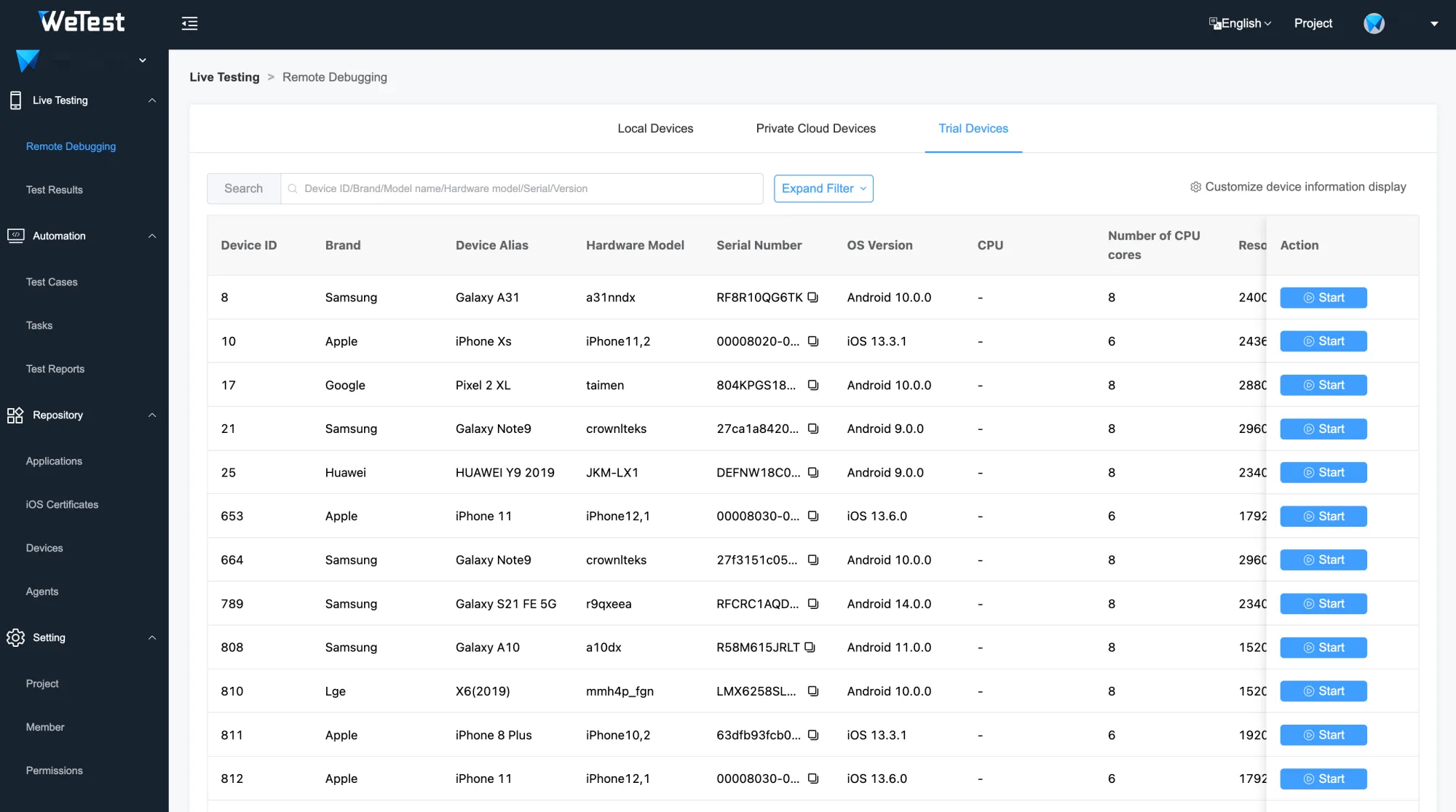
The live testing interface streams device screens via WebRTC at 30-150 ms latency and 30-60 FPS, with frontend CPU usage below 1%. Available debugging tools include application installation and management, filterable real-time device logs, a visual file manager for browsing and transferring files on the device, a web-based command terminal, screenshot capture, and WDB (WeTest Debug Bridge) — a proprietary cross-platform tool for remote ADB and iOS debugging from any operating system, including iOS device debugging without requiring macOS.
Automated Testing
UDT integrates with Appium, Airtest, PyTest, Unittest, and custom frameworks. WeAutomator provides low-code test script recording through OCR, image recognition, and UI control recognition via a VSCode plugin. Test scripts can also be imported from Git repositories or uploaded as zip packages with automatic parsing. Tasks support serial and parallel execution across selected devices, configurable timeout parameters, and scheduled runs through cron expressions or timed triggers. After execution, the platform generates detailed reports broken down by device and test case, including pass/fail results, device activity timelines, screenshots, video recordings, performance metrics (CPU, memory, FPS, network traffic), logs, and downloadable test files.
Device Management
Administrators manage devices through a tag-based configuration system. Tags apply environment settings such as app pre-installation and cleanup exemptions, as well as health checks including network connectivity, disk space, and screenshot verification. iOS certificate and provisioning profile management is built into the platform for app re-signing.
Access Control and Deployment
Projects enforce role-based access control with three permission levels — Administrator, Member, and Guest — with configurable permissions across tasks, devices, tags, applications, and testing operations. Data is fully isolated between projects. UDT is available in three deployment modes: shared cloud (multi-tenant), single-tenant cloud, and on-premises private deployment for organizations with strict data isolation requirements. CI/CD integration supported via Jenkins, GitLab CI, and REST API.
WeTest states they are certified under SOC 2 Type 2, ISO/IEC 27001:2013, ISO 9001:2015, ISO/IEC 20000-1, CMMI Maturity Level 3, and TMMI Maturity Level 3.
Categories & Use Cases
Videos
Screenshots


1 / 3
Screenshot of Remote Debugging
Product Demos
Technical Details
| Deployment Types | On-Premise, SaaS |
|---|---|
| Operating Systems | Windows, Linux, Mac |
| Mobile Application | No |
| Supported Countries | Worldwide |
| Supported Languages | English, Chinese |
FAQs
What is WeTest UDT?
WeTest UDT is a mobile testing platform for executing automated and manual tests on real Android and iOS devices. It supports local device access, cloud device farms, remote debugging, and integrates with Appium, Airtest, and CI/CD pipelines.
What are WeTest UDT's top competitors?
BrowserStack, Sauce Labs, and Kobiton are common alternatives for WeTest UDT.