Adobe Workfront, acquired by Adobe in late 2020, is a web-based project-management tool. It is designed for both IT and marketing teams, but can be implemented for any kind of project. Workfront offers all the features standard to project management platforms, as well as resource allocation, automation, and agile workflow.
N/A
StoriesOnBoard
Score1.1 out of 10
N/A
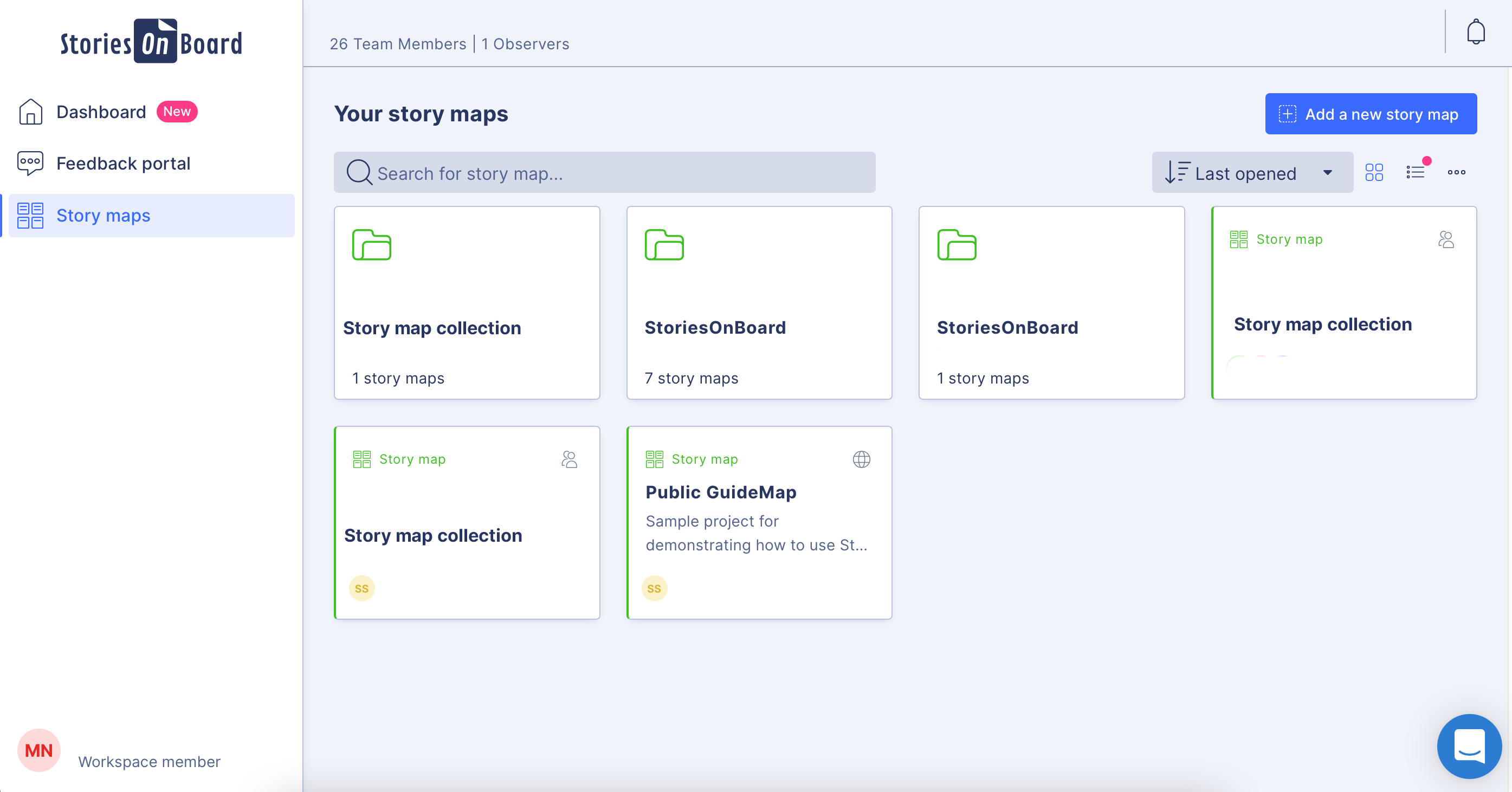
StoriesOnBoard is a holistic product management tool powered by user feedback. Through collecting user and customer feedback into a single repository and sorting it based on custom rules and collaborating with stakeholders to form actionable feature ideas from them, users can make sure their ideas will be driven by real user needs. Ideas can be validated on a public roadmap and then placed on a user story map to plan releases. StoriesOnBoard supports the product management…
Since I work remotely from my laptop, when I am finished with work, I enter my hours and submit my time at the end of the week. It's quick, it's easy, and it helps me keep a record of how many hours of vacation and sick time I have used. But when I am on the go, it is a hassle to record my time on my phone because of the lack of responsive design.
A de minimis incentive was given to thank the reviewer for their time. The incentive was not used to bias or drive a particular response, nor was the incentive contingent on a positive endorsement. More Info
As mentioned earlier, we also use StoriesOnBoard to create other processes (customer and employee journey). We use the swim lanes to differentiate between measures, tools and processes and working with them is very easy and understandable for this purpose.
Less easy is the use of context, i.e. when one part of a story map depends on another story map. This cannot be avoided (at least for us) to avoid creating redundancy (and the risk of creating different stages). At appropriate places, we refer to the other map in the title.
A de minimis incentive was given to thank the reviewer for their time. The incentive was not used to bias or drive a particular response, nor was the incentive contingent on a positive endorsement. More Info
A de minimis incentive was given to thank the reviewer for their time. The incentive was not used to bias or drive a particular response, nor was the incentive contingent on a positive endorsement. More Info
Workfront is sometimes a bit clunky to use, but overall it works well for our teams when it comes to project management and collaboration across multiple, involved teams. It also has flexibility that allows us to adapt it to diverse use cases, some of which aren't necessarily always the first things that one would think of using workfront for.
A de minimis incentive was given to thank the reviewer for their time. The incentive was not used to bias or drive a particular response, nor was the incentive contingent on a positive endorsement. TR verified that a representative sample of customers was invited. More Info
Workfront is overly complex, but it is functional as a tool to keep track of projects. It is a shame that sometimes it takes a lot of clicks to find anything. Workfront is slowly modernizing its interface but at the same time, hides certain information away thus making the experience feels worse.
A de minimis incentive was given to thank the reviewer for their time. The incentive was not used to bias or drive a particular response, nor was the incentive contingent on a positive endorsement. More Info
StoriesOnBoard works really well; all features are well thought through. It could look a bit fresher, although the new updated dashboard is already much better than it was.
I have found that Adobe Workfront is a reliable resource, because in the post 6 years of using it, rarely has it been unavailable to our team. I think I could count on one hand the number of times the site has been down over my time using it with my team.
A de minimis incentive was given to thank the reviewer for their time. The incentive was not used to bias or drive a particular response, nor was the incentive contingent on a positive endorsement. More Info
I think overall, Adobe Workfront performs well. There have been some times when it doesn't load or run as quickly as our team would like. This is frustrating when it is such a crucial tool that our team utilizes on a daily basis. It can show our workflow when it lags.
A de minimis incentive was given to thank the reviewer for their time. The incentive was not used to bias or drive a particular response, nor was the incentive contingent on a positive endorsement. More Info
I know that this particular company has it's own Adobe Workfront employee that builds out things they need from the software, and meets with them regularly to troubleshoot. I'm not part of this process, but it's refreshing to see Adobe provide this level of customer service to people, and they're expedient.
A de minimis incentive was given to thank the reviewer for their time. The incentive was not used to bias or drive a particular response, nor was the incentive contingent on a positive endorsement. More Info
The training is very easy to use and you can simply choose the topics included in the course(s) that are most important to your training needs. After each training course, you are tested on what you have learned. If you need a refresher course, they provide Course Catalogs as well as instructor-led courses & workshops.
Most people learn as you go, a lot of this stuff requires trial and error throughout so my suggestion is to provide as much information in the upfront and keep it as simple as possible. You can add other tools and features as you go but everyone should have the basics down so no bad habits can start to develop. Be persistent with everyone, and don't be afraid to correct and talk through steps again so everyone is on the same page
A de minimis incentive was given to thank the reviewer for their time. The incentive was not used to bias or drive a particular response, nor was the incentive contingent on a positive endorsement. More Info
Much increased functionality and templating aspects. While I liked JIRA's setup, the Workfront is so much more flexible. The moving away from Jira i was able to show the possibilities of what a full pm software could accommodate and how it all connected in. Also, the pluses of connectivity with the Adobe suite for our creative teams were excellent. From providing updates within other programs, it allowed a much more fluid working process and instant communication.
A de minimis incentive was given to thank the reviewer for their time. The incentive was not used to bias or drive a particular response, nor was the incentive contingent on a positive endorsement. More Info
The only other competitor we looked at was cardboardit.com. Both had solid functionality, but StoriesOnBoard was more user-friendly and quick to learn and use in our opinion.
As I stated earlier, I didn't have to pay for Workfront myself- I'm a user under a large organization. I know it's not cheap to implement, I don't know how the price scales for a small-business, but I do like the product enough that I'm going to look into it in the future for my own company.
A de minimis incentive was given to thank the reviewer for their time. The incentive was not used to bias or drive a particular response, nor was the incentive contingent on a positive endorsement. More Info
Our organization has thousands of users that use Workfront and it seems to hold up very well. I have not encountered any issues using it and I think it makes it very easy for multiple people to be involved in a project and keep things organized and clear for everyone involved.
A de minimis incentive was given to thank the reviewer for their time. The incentive was not used to bias or drive a particular response, nor was the incentive contingent on a positive endorsement. More Info
Increased efficiency in threaded updates to Outlook emails - no time wasted looking for things in email vs Workfront - they automatically are in both places.
Time tracking allows us to average out how much time tasks & deliverable types take, allowing better long-term forecasting.
Planning has given us a system of record for campaigns, allowing us to easily find historic plans and/or view calendar views of upcoming ones.
A de minimis incentive was given to thank the reviewer for their time. The incentive was not used to bias or drive a particular response, nor was the incentive contingent on a positive endorsement. More Info
StoriesOnBoard (and story mapping in general) creates a low-cost visual method of aligning on high-level business and technical requirements early in a project and provides an ongoing reference as the project progresses. Having this alignment is critical for the later stages of the project.