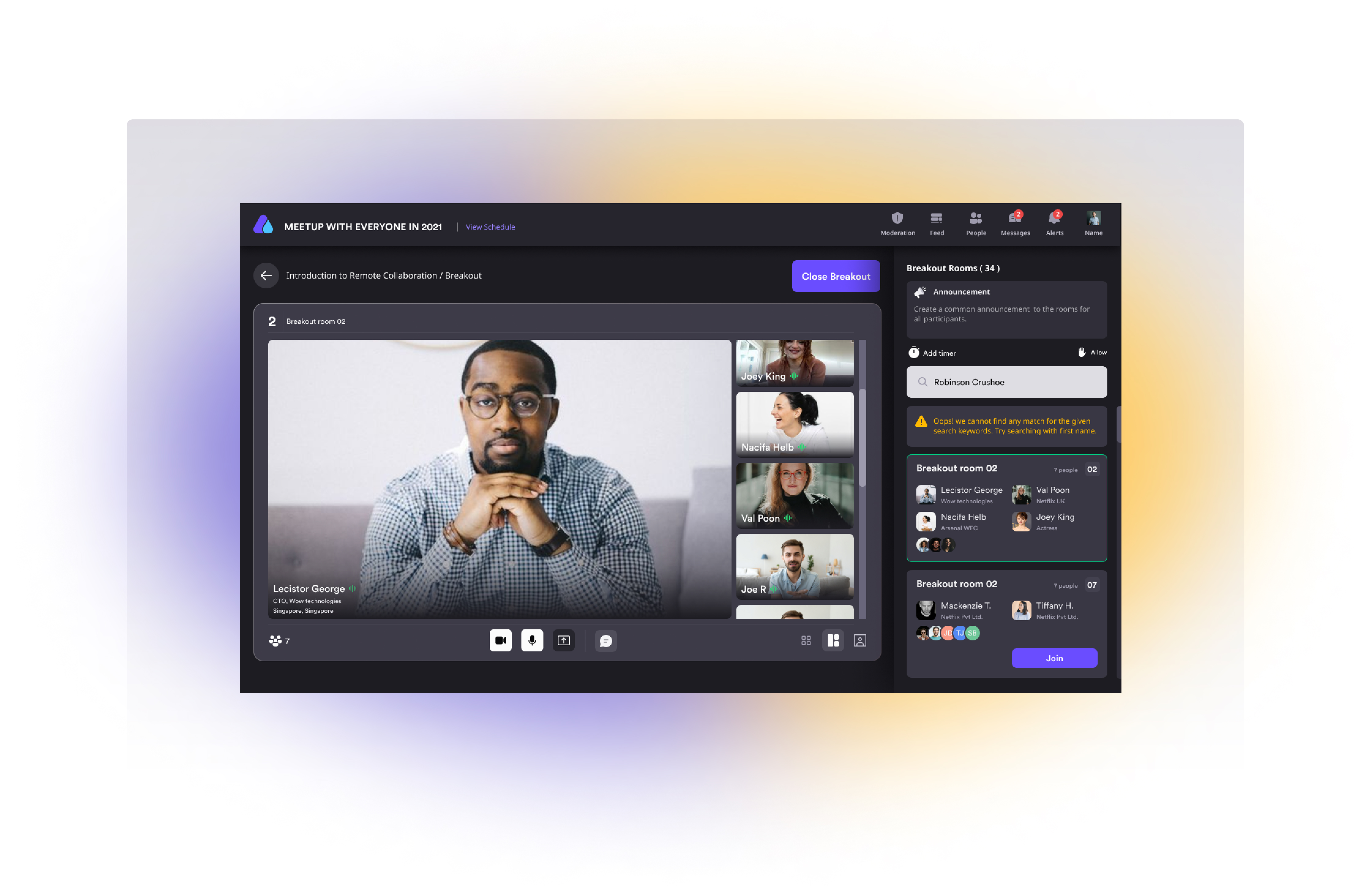
Airmeet, from the company of the same name, is an all-in-one platform for community managers to host interactive virtual events, conferences & workshops aimed at providing a real networking experience. Airmeet has a free plan to support relatively small scale workshops and seminars, and a paid plan available at $99 per month aimed at supporting large scale multi stage, and parallel session conferences with dedicated sponsorship opportunities & booths.
$0
per year Per Attendee
Brightcove
Score 8.3 out of 10
N/A
Brightcove Video is a video hosting and publishing solution. The company also provides a cloud media processing product called Zencoder.
N/A
Pricing
Airmeet
Brightcove
Editions & Modules
Free
$0
One Time Event - Airmeet Professional
$5,000
one-time fee 300 attendees
Starter
$6000/year
per year
Professional
$18000/year
per year
Enterprise
Custom Quote
per year
No answers on this topic
Offerings
Pricing Offerings
Airmeet
Brightcove
Free Trial
Yes
Yes
Free/Freemium Version
Yes
No
Premium Consulting/Integration Services
No
Yes
Entry-level Setup Fee
Optional
No setup fee
Additional Details
—
—
More Pricing Information
Community Pulse
Airmeet
Brightcove
Features
Airmeet
Brightcove
Virtual Event
Comparison of Virtual Event features of Product A and Product B
We never could really find a scenario where Airmeet really excelled over other major conferencing and webinar platforms. Especially post-COVID. It seemed overly complicated to set up an event and their support was somewhat difficult to deal with. The major platforms, conversely, made many improvements at a fraction marketed at a fraction of the cost. So most of Airmeet is really gimmicky from my experience. The students found it somewhat cumbersome.
It works very nicely for our company site because it can easily and seamlessly embed into the site and email HTML pages. It also has picture in picture, sharing, closed captioning (CC) as basic functions. It will also show the time of the video. Because these are short-term-use videos or might get updated frequently and also are just targeting a specific audience, being able to hide or not able to show the number of views or date published (unlike YouTube) actually helps us.
Ability to easily output a JSON response for requested video data. This makes it easy to work with Brightcove as partner.
The read APIs are very flexible and can the output can be easily customized using cgi args. This provides great customization of the output and sorting and filtering mechanisms to find the videos you're looking for.
The ability to add captions to videos is good, especially with the regulations requiring video captioning. DFXP support works great as long as the player is given the exact XML format it is looking for.
The code for customizing the video player can be made easier, I think it still uses BEML code.
Easily accessible ready made code will help users like me to implement a cool looking player.
I would love to implement Brightcove video cloud on most of the projects that I work on and I see we could use it in so many different ways but pricing is not easily available on the website.
Again if I could work with someone to price for small, medium and large businesses that would be great.
It took quite some time to upload and organize our video library. The amount of time it would require to relocate all this information outweighs any negative aspect I personally have with the experience. They have been pretty good to work with and from speaking with my Brightcove rep, I know some of the issues I have listed are currently being addressed and tested for future releases.
We are notified often of downtime, and I have not heard from a support rep for over a year. It really makes it hard to learn what new things are coming out and how we can take our video to the next level when there is no contact from the team on a regular cadence.
Marketing department favors it because EVERYONE uses YouTube. Overall, YouTube offers decent features and functionality. But Brightcove offers the ability to brand and style players, and control what our users see (and so much more) and YouTube does not. For instance, on YouTube, users are presented with other videos (which could contain competitor videos).