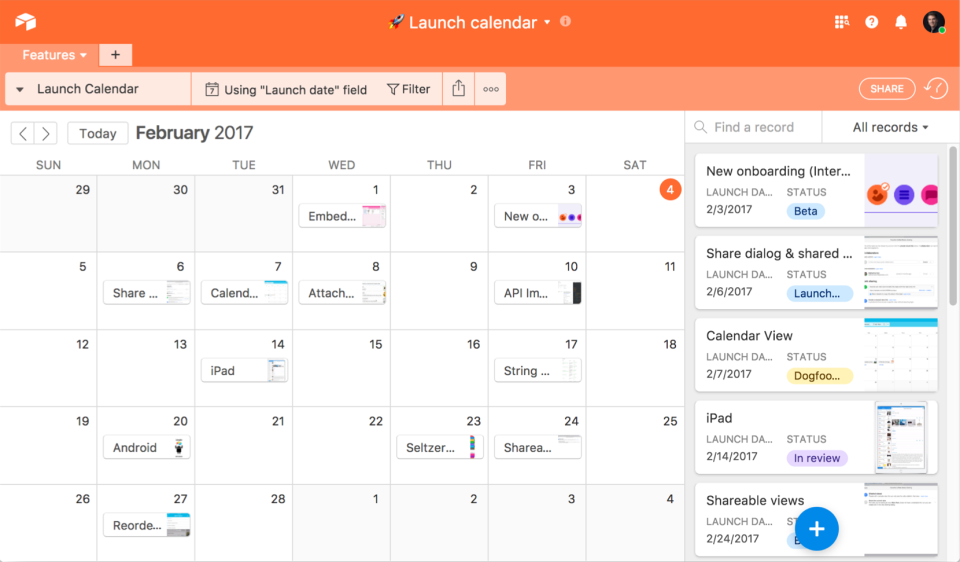
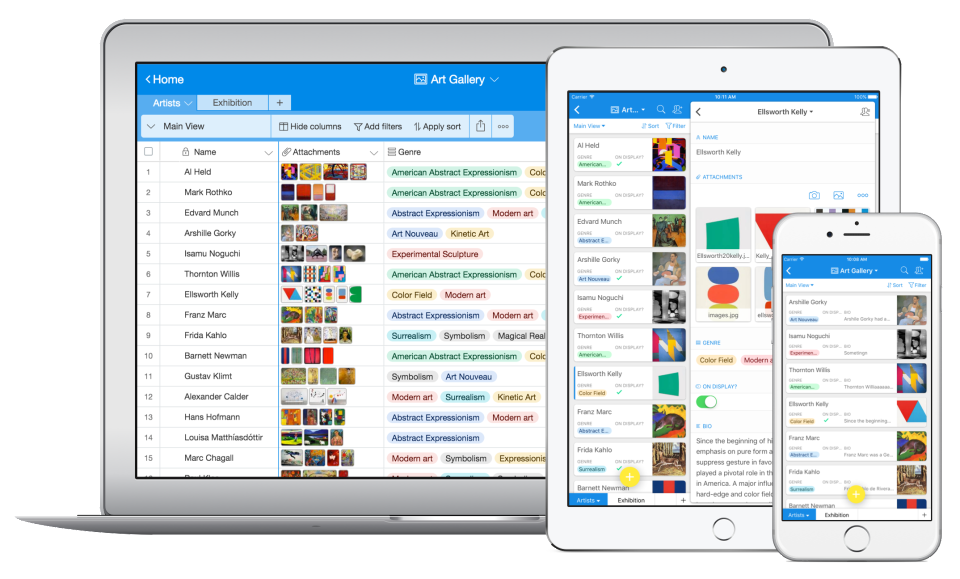
Airtable is a project management and collaboration platform designed to enable content pipelines, product management, events planning, user research, and more. It combines spreadsheet,database, calendar, and kanban functionality within one platform.
$24
per month per seat
LibreOffice
Score 8.8 out of 10
N/A
LibreOffice is a free and open-source Office Suite from The Document Foundation, presented as the successor to OpenOffice.org. The suite includes Writer (word processing), Calc (spreadsheets), Impress (presentations), Draw (vector graphics and flowcharts), Base (databases), and Math (formula editing).
$0
free and open source under the Mozilla Public License v2.0
Pricing
Airtable
LibreOffice
Editions & Modules
Team
$24
per month per user
Business
$54
per month per user
Enterprise
Custom Pricing
No answers on this topic
Offerings
Pricing Offerings
Airtable
LibreOffice
Free Trial
Yes
No
Free/Freemium Version
Yes
Yes
Premium Consulting/Integration Services
No
No
Entry-level Setup Fee
No setup fee
No setup fee
Additional Details
—
—
More Pricing Information
Community Pulse
Airtable
LibreOffice
Features
Airtable
LibreOffice
Project Management
Comparison of Project Management features of Product A and Product B
Airtable is an ideal platform for small and growing businesses to keep track of just about EVERYTHING they need to keep things running smoothly. It's a great way to keep tasks organized, and keep everyone on the same page with progress on all things. Our company finds the kanban particularly useful, as products go through a lifecycle from ideation to retirement, it's good to keep a database of what is in production, what's working, and what we've tried before. I can see the platform being challenging with much larger businesses, but for the small to medium businesses I've used the platform with, it is ideal.
If you're working with numbers, LibreOffice doesn't get in your way and try to make changes as it sees fit, forcing you to repeatedly go back and undo processes you didn't want, didn't ask for, and that have no place in the document you are trying to produce. All I want to do is assemble the data, process it for the task at hand, and then print it for distribution. LibreOffice allows me to do that.
Airtable has capabilities commonly found in spreadsheet applications, but also has some of the features found in databases.
The ability to filter fields. I set up a filter on the status field, so when a project is marked, complete, on hold, or canceled, that record is hidden from my current projects table view. If it is marked complete, the record is moved to the completed projects table view. In this way I can easily access a record of past projects
Being able to duplicate tables and create alternate views
Collapse and expand records. When I collapse the rows, I can easily scan current projects, next steps, project status, and due dates. When I expand the row, or field, I can see more detailed information about that field or record very easily. I can also expand or open the entire record. This is is helpful, when I am entering a lot of information to multiple fields in that record.
We will 10/10 renew the use of Airtable because it has brought great value to our team. Not only is Airtable affordable, but it's also user-friendly and helps our team be efficient. We no longer need to rely on Excel spreadsheets being passed from person to person via email. Furthermore, we aren't dealing with corrupt Excel spreadsheets and the need to salvage data when a file is accidentally altered.
We use it consistently and have a lot of documents in the OpenDocument format so it will be necessary to use LibreOffice or a compatible product such as Openoffice in the future to be able to open these files. Because the license fee for Libreoffice is zero it is not very costly to keep using it - the costs are mostly for keeping it installed on the office PCs and regularly updated, and solving employee issues with the user support.
IMO the usability of this product is its greatest asset. The UI is clean and the menus are intuitive to the point where I'd feel confident having a non-spreadsheety colleague take on building an Airtable for the first time with next to no training. I can't say that about every table-like software product that I've used such as Notion.
For all of the reasons in the foregoing evaluation. Its menus are clean, intuitive and straightforward. Any function I need to use can be accessed via keystrokes, without having to stop, move my hand to the mouse, deal with it, and then get back to the keyboard to proceed. It helps me keep my mind on my work and not worry about dealing with the mouse all the time.
I have rarely experience downtime, compared to other tools, and given how much time we spend on the tool. Even if there were to be, their updates on it are very timely, and our support team are able to provide any questions regarding
Libreoffice is a desktop app not requiring any server part so it is always available when the PC is working normally. Installing it on another machine if one PC fails is very quick and easy. This is a non-issue.
I never had any issues with load time, even with the integrations that we use today (google sheets) However, I'm curious if adding additional layers of integrations would slow down performance. We do carry quite a bit of data in Airtable, but, again, no impact on overall performance
For big/imported tables or text documents with images loaded from the internet it is sometimes getting very slow, RAM and CPU intensive, and sometimes even hangs due to some memory leaks or other bugs. This is a long-term problem and is still not resolved perfectly.
Airtable has great support. They have a variety of support features to answer any questions. They have great self teaching instructions for templates and product tours. They also have support for teams and project management. They also have a fantastic customer help line. They are able and willing to answer customer questions and never have customers waiting long
Support is not officially offered. However, you can find answers to any usage questions or trouble-shooting online easily, typically starting with a Google search. (I believe that all forums / tips for OpenOffice apply equally to LibreOffice, and vice versa.) While Microsoft Office, for example, officially includes support, I find that typically you end up going to a Google search in any case. So, this is not really a downside. However, in all these cases, you end up doing a lot of figuring things out for yourself.
Recorded trainings were provided by the Airtable team. Great as an evergreen resources to new team members and for anyone that wants to refresh their Airtable knowledge
Training all users was an important part of the implementation, which did take considerable time and effort. At first glance without training, the content calendar can be overwhelming because of the amount of data. The features within Airtable seem to be endless but our team was able to identify the most important to be successful.
Generally easy to perform, issues are how to ensure regular automatic updates on Mac OS X. Fortunatly we have only a few machines with OS X run by management and we can do these updates manually occasionally. Windows updates are quite easy with the support of third party software such as Ninite or Chocolatey, and Linux updates are super-easy thanks to the package manager (apt-get).
Airtable was a really good fit for this specific use case as it provided a huge number of collaboration features in an intuitive and pleasant-to-use interface. The free tier worked initially with our work, and the upgrade pathway was fair and made sense for us.
If you are looking for a well-rounded, GNU-licensed product that will encompass word processing, spreadsheets, presentations, and database then LibreOffice is probably all you need.
For online collaboration, links with cloud storage, and more robust support, Microsoft Office 365 and Google Docs are probably what you or your organization needs.
LibreOffice is at its best for regular document creation and spreadsheet management. It is more cumbersome when it comes to fonts but also when it comes to linkages with cloud-based services. It is there, but you need some more computer knowledge to make it work.
There are other free alternatives, most notably Apache Open Office, which is also a very good alternative if you do not like LibreOffice.
Having said that, I honestly think off-line computers or laptops used off-site can certainly benefit from having LibreOffice installed.
There are TONS of opportunity to scale, but I think it's a matter if you have the time and resources to do so because the initial setup can be fairly time consuming and prioritized dedication
With more users using it in the company there are more cases when a simultaneous editing of the same document is needed and this feature is lacking in Libreoffice even though the files concerned are shared and synced by some solution (we use ownCloud). Google Docs or MS Office365 via Sharepoint/Onedrive offer a better function for this.
Through this platform, I always have the idea bout which of my team member is working on which particular part of the project, I can easily track their progress, and also I can easily correct them where it is required by adding sticky notes, by sending the attachments and URLs.
I am able to quickly create and edit word processing documents and spreadsheets which are for all intents and purposes equivalent to documents I could create and edit in other tools such as Microsoft Office and Google Docs/Sheets.
Lack of an online portal for sharing documents necessitates the use of Google Sheets for automation/integration. Ideal would be an all-in-one solution.
Having open-source software that provides common functionality eliminates the need for expensive licenses.
Lack of dedicated support is negligible. Most issues can be resolved using online search.