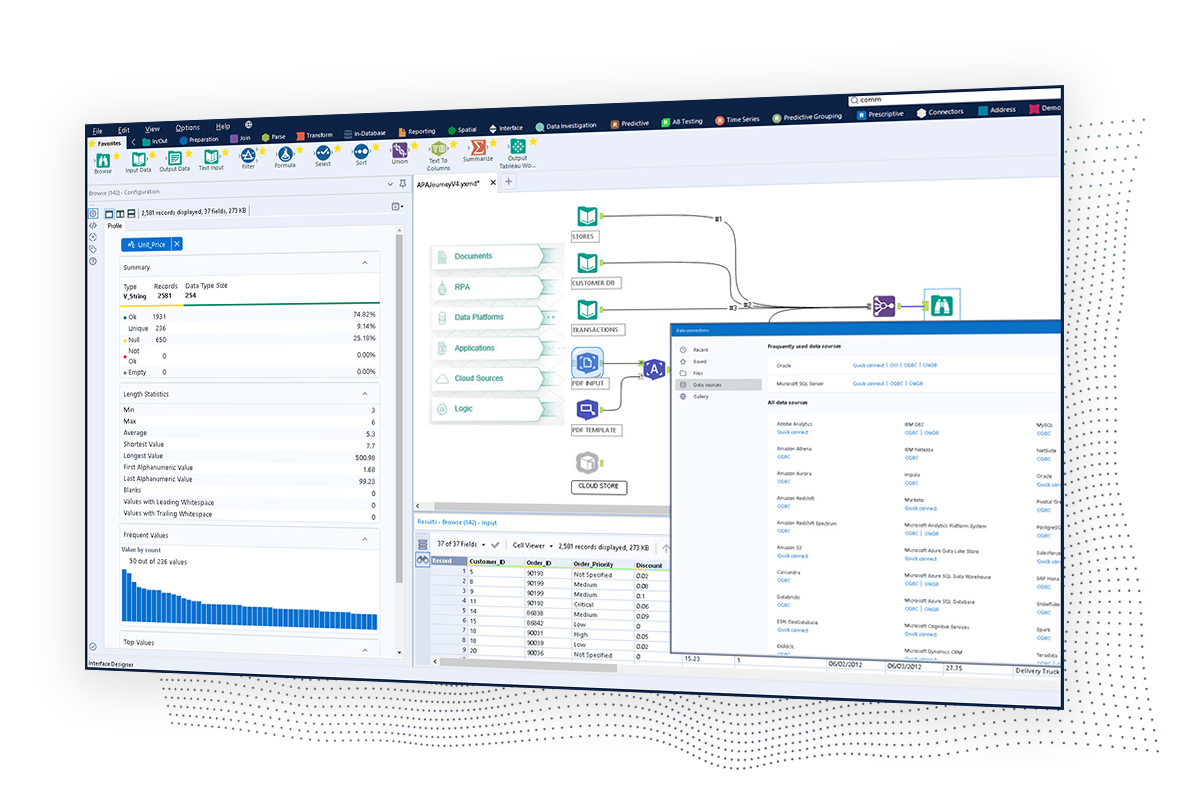
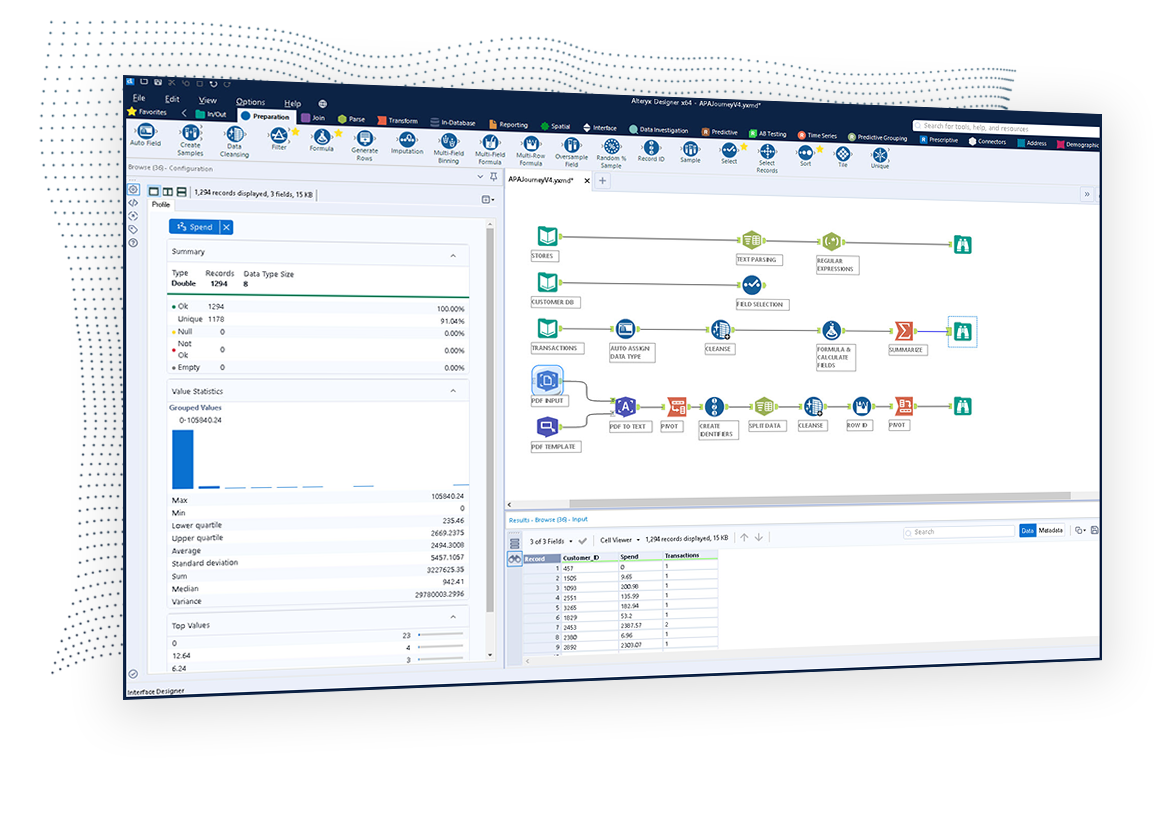
The Alteryx AI Platform gives organization automated data preparation, AI-powered analytics, and machine learning with embedded governance and security. Its self-service functionality, with self-service data prep, machine learning, and AI-generated insights, gives enterprise teams with a simplified user experience allowing everyone to create analytic solutions that improve productivity, efficiency, and the bottom line. Alteryx Designer can be used to automate every analytics step…
$14,850
per year 3 users (minimum), cloud edition
AWS Glue
Score 8.6 out of 10
N/A
AWS Glue is a managed extract, transform, and load (ETL) service designed to make it easy for customers to prepare and load data for analytics. With it, users can create and run an ETL job in the AWS Management Console. Users point AWS Glue to data stored on AWS, and AWS Glue discovers data and stores the associated metadata (e.g. table definition and schema) in the AWS Glue Data Catalog. Once cataloged, data is immediately searchable, queryable, and available for ETL.
$0.44
billed per second, 1 minute minimum
Azure Data Factory
Score 8.2 out of 10
N/A
Microsoft's Azure Data Factory is a service built for all data integration needs and skill levels. It is designed to allow the user to easily construct ETL and ELT processes code-free within the intuitive visual environment, or write one's own code. Visually integrate data sources using more than 80 natively built and maintenance-free connectors at no added cost. Focus on data—the serverless integration service does the rest.
N/A
Pricing
Alteryx Platform
AWS Glue
Azure Data Factory
Editions & Modules
Designer Desktop
starting at $5,195
per year per user
Designer Cloud Professional Edition
Starting at $4,950
per year per user (minimum of 3 users)
per DPU-Hour
$0.44
billed per second, 1 minute minimum
No answers on this topic
Offerings
Pricing Offerings
Alteryx Platform
AWS Glue
Azure Data Factory
Free Trial
Yes
No
No
Free/Freemium Version
No
No
No
Premium Consulting/Integration Services
Yes
No
No
Entry-level Setup Fee
No setup fee
No setup fee
No setup fee
Additional Details
—
—
—
More Pricing Information
Community Pulse
Alteryx Platform
AWS Glue
Azure Data Factory
Considered Multiple Products
Alteryx Platform
Verified User
Executive
Chose Alteryx Platform
Alteryx stacks up against its competitors in the marketplace because from day one its goal was to simplify and democratize data processes. Its visual nature and transparent tool set, combined with its highly addictive joy to use make it stand out from the crowd.
AWS Glue
Verified User
Director
Chose AWS Glue
The cataloging of data objects is the best in the case of AWS Glue. We use AWS Glue in all of our data pipelines to sync external and internal data sources and to automatically produce SQL-based ETL based on AWS Glue catalog objects. Integration with Amazon products is the …
We are already in AWS services, so AWS glue is the first choice for us. But for the comparison of ETL job making and process time, it's way faster for other services.
Azure Data Factory fits well into our overall systems architecture where we already utilize largely Azure services and also Microsoft based products in the on-premises environment. I think cost structure is also very competitive with Azure Data Factory. Most services provide a …
Azure Data Factory helps us automate to schedule jobs as per customer demands to make ETL triggers when the need arises. Anyone can define the workflow with the Azure Data Factory UI designer tool and easily test the systems. It helped us automate the same workflow with …
I would 100% recommend Alteryx to a friend, for me its friendly interface is the best, it has all the tools I need without the headache that programming is. It can be used for simple or complex analysis, so honestly, I don’t see a scenario where it wouldn’t suit. I’ve used Alteryx to make simple things I could do in Excel, for example, but it was less complex and faster to do in Alteryx, so why not? Its a very versatile tool.
One of AWS Glue's most notable features that aid in the creation and transformation of data is its data catalog. Support, scheduling, and the automation of the data schema recognition make it superior to its competitors aside from that. It also integrates perfectly with other AWS tools. The main restriction may be integrated with systems outside of the AWS environment. It functions flawlessly with the current AWS services but not with other goods. Another potential restriction that comes to mind is that glue operates on a spark, which means the engineer needs to be conversant in the language.
Best scenario is for ETL process. The flexibility and connectivity is outstanding. For our environment, SAP data connectivity with Azure Data Factory offers very limited features compared to SAP Data Sphere. Due to the limited modelling capacity of the tool, we use Databricks for data modelling and cleaning. Usage of multiple tools could have been avoided if adf has modelling capabilities.
Pulling data from multiple disparate data sources.
Allows users to see the data at every step of the workflow to be able to cleanse, analyze, and optimize the data.
Provides an analytics platform that is easy for users of all levels to thrive in whether they are just starting out in their analytics journey or they have a master's degree in Data Science.
It is extremely fast, easy, and self-intuitive. Though it is a suite of services, it requires pretty less time to get control over it.
As it is a managed service, one need not take care of a lot of underlying details. The identification of data schema, code generation, customization, and orchestration of the different job components allows the developers to focus on the core business problem without worrying about infrastructure issues.
It is a pay-as-you-go service. So, there is no need to provide any capacity in advance. So, it makes scheduling much easier.
Steeper Learning Curve: Alteryx can have a steep learning curve for users who are new to the platform or have limited experience with data analytics. Enhancements to the user interface and user onboarding resources could help make the learning process more intuitive and accessible to a wider range of users.
Enhanced Data Visualization Capabilities: Alteryx offers basic data visualization capabilities, but there is room for improvement in terms of advanced visualizations and interactive dashboarding features. Adding more sophisticated chart types, interactive widgets, and customization options would enhance the data visualization capabilities within the platform.
Improved Error Handling and Debugging: Alteryx provides error handling mechanisms, but enhancing the error reporting and debugging capabilities would be beneficial. Improved error messages, better visibility into data flow, and debugging tools could help users troubleshoot and resolve issues more efficiently.
Granularity of Errors: Sometimes, Azure Data Factory provides error messages that are too generic or vague for us, making it challenging to pinpoint the exact cause of a pipeline failure. Enhanced error messages with more actionable details would greatly assist us as users in debugging their pipelines.
Pipeline Design UI: In my experience, the visual interface for designing pipelines, especially when dealing with complex workflows or numerous activities, can become cluttered. I think a more intuitive and scalable design interface would improve usability. In my opinion, features like zoom, better alignment tools, or grouping capabilities could make managing intricate designs more manageable.
Native Support: While Azure Data Factory does support incremental data loads, in my experience, the setup can be somewhat manual and complex. I think native and more straightforward support for Change Data Capture, especially from popular databases, would simplify the process of capturing and processing only the changed data, making regular data updates more efficient
We've developed a working partnership with Alteryx. As an enablement suite, we're continuing to innovate and deliver great products with use of Alteryx in our solutions. Alteryx use expands to our global product development teams and is in use in multiple parts of our organization. Alteryx also delivers Experian demographic content to other clients in their product offering. We're highly likely to renew, but that decision is way above my pay grade.
I've found that while some things might take a little longer to create, the flexibility of Alteryx allows you to perform any function needed. I haven't found a use that was not available in Alteryx yet. APIs and XMLs can be created to perform certain functions. In addition, CMD line commands can be sent using Alteryx to perform certain functions as well.
While easy to set up and manage monitoring for large datasets, its complexity can be a barrier for new users. Integration with AWS Ecosystem, Managed Monitoring, Dashboards and monitoring tools for AWS Glue are generally easy to set up and maintain, Automated Data Pipelines. Automates data pipeline creation, making it efficient for certain data integration
So far product has performed as expected. We were noticing some performance issues, but they were largely Synapse related. This has led to a shift from Synapse to Databricks. Overall this has delayed our analytic platform. Once databricks becomes fully operational, Azure Data Factory will be critical to our environment and future success.
I use many programs and compared to others, Alteryx virtually never goes down, freezes up or gives an application error. Over a 4 year time period that I have used this program, any of these may have happened 3 times. It is an incredibly stable program that I feel completely confident in.
I already gave the example of journal entries created in less than a second. What else can I tell you about.... I can tell you those 2 journal entries have historically had to be split into separate accounting systems so the outputs had to be very different (D365 vs Intacct) such that they are exactly ready for uploading. I can tell you I used to have some tire and battery queries hitting a line item detail table and they took hours to run UNTIL I asked IT for a view in SQL and now they're ready in about 5 minutes total. I guess I'd say if anything does take a long time - do some research with others and figure out what would speed them up
Stellar, bar-none. Some of the best support folks of any vendor. The Alteryx Community is the most responsive and supportive. On the rare occasion of a release issue or bug, we've been able to get quick help to solve the core problem. Alteryx does not play the blame game. They genuinely help the users solve their issues or respond to questions
Amazon responds in good time once the ticket has been generated but needs to generate tickets frequent because very few sample codes are available, and it's not cover all the scenarios.
We have not had need to engage with Microsoft much on Azure Data Factory, but they have been responsive and helpful when needed. This being said, we have not had a major emergency or outage requiring their intervention. The score of seven is a representation that they have done well for now, but have not proved out their support for a significant issue
1st level of trainings which I've attended in Paris was easy and I was already knowing %90, that learning could have been an e-learning instead of in-person
Very good, detailed online trainings which you can take at your own pace, and strong certifications exists, certifications are extremely detailed and hard...
There is really not much to it (the installation, that is). Once you get it installed, along with any of the add-ons (demographics, R, etc.), you are up and running almost immediately. There is really no additional setup. You can immediately begin blending data, running demographics, performing spatial queries, running predictive analysis, etc. And for many of these functions, the learning curve is quite easy.
Alteryx is MUCH more user friendly. both provide the ability to code within them, but Alteryx has much nicer interface. The formula tools have a more simple language that is easier to learn than formulae in SSIS. Alteryx is easy to read with multi colored tools identifying what each one does. It also allows for macros. You can build your own tool to process records of data or batch records together.
AWS Glue is a fully managed ETL service that automates many ETL tasks, making it easier to set AWS Glue simplifies ETL through a visual interface and automated code generation.
Azure Data Factory helps us automate to schedule jobs as per customer demands to make ETL triggers when the need arises. Anyone can define the workflow with the Azure Data Factory UI designer tool and easily test the systems. It helped us automate the same workflow with programming languages like Python or automation tools like ansible. Numerous options for connectivity be it a database or storage account helps us move data transfer to the cloud or on-premise systems.
Individual analysts can quickly generate results using their own copy of Alteryx Designer. But using the Server and developing macros for more complex needs can be time consuming.
Error handling - allows controls to be built into workflows easily and allows them to be isolated and spat into control reports that can be easily reviewed and audited, thanks to the ability to create multiple outputs in one go.
Time-saving - saved huge amounts of time, especially when moving Excel processes into Alteryx.
Product development - allowed my firm to create products that we have been able to market and sell to clients.
We are using GLUE for our ETL purpose. it’s ease with other our AWS services makes our ROI, 100% ROI.
One missing piece was compatibility with other data source for which we found a work around and made our data source as S3 only, so our dependencies on other data source is also reducing