Overview
ProductRatingMost Used ByProduct SummaryStarting Price
CouchDB
Score 6.0 out of 10
N/A
Apache CouchDB is an HTTP + JSON document database with Map Reduce views and bi-directional replication. The Couch Replication Protocol is implemented in a variety of projects and products that span computing environments from globally distributed server-clusters, over mobile phones to web browsers.N/A
MariaDB Platform
Score 9.5 out of 10
N/A
MariaDB is an open-source relational database made by the original developers of MySQL, supported by the MariaDB Foundation and a community of developers. The community states recent additional capabilities as including clustering with Galera Cluster 4, compatibility with Oracle Database, and Temporal Data Tables, allowing one to query the data as it stood at any point in the past.N/A
MongoDB
Score 8.9 out of 10
N/A
MongoDB is an open source document-oriented database system. It is part of the NoSQL family of database systems. Instead of storing data in tables as is done in a "classical" relational database, MongoDB stores structured data as JSON-like documents with dynamic schemas (MongoDB calls the format BSON), making the integration of data in certain types of applications easier and faster.
$0.10
million reads
Pricing
Apache CouchDBMariaDB PlatformMongoDB
Editions & Modules
No answers on this topic
Shared
$0
per month
Serverless
$0.10million reads
million reads
Dedicated
$57
per month
Offerings
Pricing Offerings
CouchDBMariaDB PlatformMongoDB
Free Trial
NoYesYes
Free/Freemium Version
NoYesYes
Premium Consulting/Integration Services
NoYesNo
Entry-level Setup FeeNo setup feeOptionalNo setup fee
Additional DetailsFully managed, global cloud database on AWS, Azure, and GCP
More Pricing Information
Community Pulse
Apache CouchDBMariaDB PlatformMongoDB
Considered Multiple Products
CouchDB
Chose Apache CouchDB
I have briefly used MongoDB in other products, and it proved that it had better integration capabilities with Ruby on Rails and node.js software platforms, more than CouchDB. But I never had the chance to actually replace CouchDB with MongoDB in the current product to see what …
Chose Apache CouchDB
We looked at MongoDB and Firebase. MongoDB gives us the best working db engine with a very intuitive design. However, it does not work as well offline. Firebase was extremely hard to create searching and indexing. Using a third-party to search didn't work for us or at least it …
Chose Apache CouchDB
MongoDB and CouchDB are both document stores, but their concurrency models and ability to scale are very different. MongoDB cannot replicate / shard over unreliable links and network partitions have been the cause of data loss in the past. MongoDB has an easier query language …
Chose Apache CouchDB
Compared to MongoDB, CouchDB's Map-Reduce paradigm poses a steeper learning curve for SQL users. However, CouchDB's master-master replication is an advantage of implementing a load-balanced solution.
Even though, currently, CouchDB has strong community support, as an open …
Chose Apache CouchDB
It has been 5+ years since we chose CouchDB. We looked an MongoDB, Cassandra, and probably some others. At the end of the day, the performance, power potential, and simplicity of CouchDB made it a simple choice for our needs. No one should use just because we did. As I said …
Chose Apache CouchDB
It stacks up well against Mongo DB. Mongo DB definitely has more marketing and developer and customer mindshare because it is so widely known.
MariaDB Platform
Chose MariaDB Platform
Thanks to MySQL compatibility, everything you've learned while using it can be utilized when using MariaDB. Therefore it's a better choice than MongoDB and MSSQL if you're looking to switch away from MySQL. MariaDB is also a very mature and stable product, unlike MongoDB that …
Chose MariaDB Platform
MariaDB is perhaps the best open source database server available, combining a wide range of supported platforms, MySQL compatibility, a low footprint, and reasonably high performance. If you have cost constraints, or limited server resources, I recommend MariaDB, particularly …
Chose MariaDB Platform
MariaDB gives a low-cost option for DB engines like Oracle with plenty of features and flexibility while having better ease of use than PostgreSQL.
Chose MariaDB Platform
MariaDB stacks up the the competition just fine. Due to is ture open source nature we do not have to worry about licencing and spending money on nothing. Moreover, MariaDB does everything that we need to get done. We can run data that is a million rows or many smaller projects …
Chose MariaDB Platform
MariaDB provided the best fit for our business in upgrading legacy systems which were originally designed to use MySQL as a backend. By using MariaDB, no changes to the overall systems needed to be altered, reducing the time needed to upgrade everything. Other solutions …
MongoDB
Chose MongoDB
MongoDB is the most reliable and fastest for storing document-based data. It has a place among the most popular DB's these days.
Chose MongoDB
MongoDB is probably the most famous NoSQL database of the moment. it has become one of the most promising startups. Some companies that currently use MongoDB are Foursquare or eBay. This type of database is designed to perform queries and aggregations on large amounts of data. …
Chose MongoDB
MongoDB is the most complete database of NoSQL type. In my opinion, it has all the tools for a good development of a database. I have not had problems when using the application.
Chose MongoDB
I only briefly looked at CouchDB after I already began using MongoDB. Naturally, I have used many relational SQL databases.

Since MongoDB did everything I needed, I saw no need to look around for alternatives.
Chose MongoDB
MongoDB was the most full-featured NoSQL database we evaluated - that offered atomic transactions at a document level, built-in HA & DR, open source, robust queries, and enterprise level support.

Other platforms had specific parts of what we were looking for - MongoDB had it all.
Chose MongoDB
MySQL is a great for querying related data, but it's unable to store structured data and has a fixed schema. Also SQL can be non-intuitive. DynamoDB, CouchDB and Redis all make querying the data quite difficult and lack important features. The problem CouchDB tries to solve is …
Chose MongoDB
MongoDB provides better performance on a big database. If you prefer to define indexes rather than a map/reduce function, MongoDB is good for you. It's quick to start it up and very easy to learn, basically no entry barrier. MongoDB's community is very welcoming.
Chose MongoDB
Cassandra, CouchDB were master less technology platforms. MongoDB single master per shard is well suited for many business models
Features
Apache CouchDBMariaDB PlatformMongoDB
NoSQL Databases
Comparison of NoSQL Databases features of Product A and Product B
Apache CouchDB
7.9
2 Ratings
12% below category average
MariaDB Platform
-
Ratings
MongoDB
10.0
39 Ratings
12% above category average
Performance8.02 Ratings00 Ratings10.039 Ratings
Availability8.52 Ratings00 Ratings10.039 Ratings
Concurrency8.52 Ratings00 Ratings10.039 Ratings
Security6.02 Ratings00 Ratings10.039 Ratings
Scalability8.02 Ratings00 Ratings10.039 Ratings
Data model flexibility7.02 Ratings00 Ratings10.039 Ratings
Deployment model flexibility9.02 Ratings00 Ratings10.038 Ratings
Best Alternatives
Apache CouchDBMariaDB PlatformMongoDB
Small Businesses
IBM Cloudant
IBM Cloudant
Score 7.4 out of 10
InfluxDB
InfluxDB
Score 8.8 out of 10
IBM Cloudant
IBM Cloudant
Score 7.4 out of 10
Medium-sized Companies
IBM Cloudant
IBM Cloudant
Score 7.4 out of 10
SQLite
SQLite
Score 8.0 out of 10
IBM Cloudant
IBM Cloudant
Score 7.4 out of 10
Enterprises
IBM Cloudant
IBM Cloudant
Score 7.4 out of 10
SQLite
SQLite
Score 8.0 out of 10
IBM Cloudant
IBM Cloudant
Score 7.4 out of 10
All AlternativesView all alternativesView all alternativesView all alternatives
User Ratings
Apache CouchDBMariaDB PlatformMongoDB
Likelihood to Recommend
9.0
(10 ratings)
10.0
(30 ratings)
10.0
(79 ratings)
Likelihood to Renew
9.0
(9 ratings)
-
(0 ratings)
10.0
(67 ratings)
Usability
8.0
(1 ratings)
10.0
(4 ratings)
10.0
(15 ratings)
Availability
-
(0 ratings)
-
(0 ratings)
9.0
(1 ratings)
Support Rating
-
(0 ratings)
8.7
(16 ratings)
9.6
(13 ratings)
Implementation Rating
9.0
(1 ratings)
-
(0 ratings)
8.4
(2 ratings)
User Testimonials
Apache CouchDBMariaDB PlatformMongoDB
Likelihood to Recommend
Apache
Great for REST API development, if you want a small, fast server that will send and receive JSON structures, CouchDB is hard to beat. Not great for enterprise-level relational database querying (no kidding). While by definition, document-oriented databases are not relational, porting or migrating from relational, and using CouchDB as a backend is probably not a wise move as it's reliable, but It may not always be highly available.
Read full review
MariaDB
  • Applications where the users need [to] execute many short queries.
  • With new storage engines such as Aria, which allows to replace MyISAM with some improvements, and XtraDB, which evolves InnoDB.
  • To fuse the legacy features with the features available in NoSQL databases.
  • Connection management, which allows multiplying the number of concurrent accesses.
  • New clustering engines, such as Galera, which allow interesting possibilities for Cloud adoption.
Read full review
MongoDB
If asked by a colleague I would highly recommend MongoDB. MongoDB provides incredible flexibility and is quick and easy to set up. It also provides extensive documentation which is very useful for someone new to the tool. Though I've used it for years and still referenced the docs often. From my experience and the use cases I've worked on, I'd suggest using it anywhere that needs a fast, efficient storage space for non-relational data. If a relational database is needed then another tool would be more apt.
Read full review
Pros
Apache
  • It can replicate and sync with web browsers via PouchDB. This lets you keep a synced copy of your database on the client-side, which offers much faster data access than continuous HTTP requests would allow, and enables offline usage.
  • Simple Map/Reduce support. The M/R system lets you process terabytes of documents in parallel, save the results, and only need to reprocess documents that have changed on subsequent updates. While not as powerful as Hadoop, it is an easy to use query system that's hard to screw up.
  • Sharding and Clustering support. As of CouchDB 2.0, it supports clustering and sharding of documents between instances without needing a load balancer to determine where requests should go.
  • Master to Master replication lets you clone, continuously backup, and listen for changes through the replication protocol, even over unreliable WAN links.
Read full review
MariaDB
  • Simpler learning curve. MariaDB is a cleaner, simpler system that is (IMO) easier to learn and easier to manage effectively than many other database systems.
  • Lower hardware requirements. After migrating to MariaDB from another database software system, we find that our hardware needs have substantially decreased.
  • MariaDB support is very responsive. It's like they actually care. On the few occasions we've run into technical issues, support has always come through with what we needed. Once it was showing me a relatively new feature the server supported that I wasn't aware of, that, once I was able to properly make use of it helped me resolve a serious production performance issue.
  • Architectural flexibility. As an example, the ready availability of synchronous (Galera) versus asynchronous replication schemes without being locked into one of the other by enormous technical complexity or punitive licensing, allows the customer to find what really works best for their needs.
Read full review
MongoDB
  • Being a JSON language optimizes the response time of a query, you can directly build a query logic from the same service
  • You can install a local, database-based environment rather than the non-relational real-time bases such a firebase does not allow, the local environment is paramount since you can work without relying on the internet.
  • Forming collections in Mango is relatively simple, you do not need to know of query to work with it, since it has a simple graphic environment that allows you to manage databases for those who are not experts in console management.
Read full review
Cons
Apache
  • NoSQL DB can become a challenge for seasoned RDBMS users.
  • The map-reduce paradigm can be very demanding for first-time users.
  • JSON format documents with Key-Value pairs are somewhat verbose and consume more storage.
Read full review
MariaDB
  • Driver Support - Some third party applications use database drivers that cause unexplained slowness with MariaDB. This can be worked around by using the MySQL drivers, but it's not clear what causes the problem in the first place.
  • Support - While online communities are helpful in diagnosing problems, there isn't as much professional documentation/support available for MariaDB as some of the other major database options.
  • Data Visualization - It would be helpful if there were more built in options for analyzing statistics and generating reports.
Read full review
MongoDB
  • An aggregate pipeline can be a bit overwhelming as a newcomer.
  • There's still no real concept of joins with references/foreign keys, although the aggregate framework has a feature that is close.
  • Database management/dev ops can still be time-consuming if rolling your own deployments. (Thankfully there are plenty of providers like Compose or even MongoDB's own Atlas that helps take care of the nitty-gritty.
Read full review
Likelihood to Renew
Apache
Because our current solution S3 is working great and CouchDB was a nightmare. The worst is that at first, it seemed fine until we filled it with tons of data and then started to create views and actually delete.
Read full review
MariaDB
No answers on this topic
MongoDB
I am looking forward to increasing our SaaS subscriptions such that I get to experience global replica sets, working in reads from secondaries, and what not. Can't wait to be able to exploit some of the power that the "Big Boys" use MongoDB for.
Read full review
Usability
Apache
Couchdb is very simple to use and the features are also reduced but well implemented. In order to use it the way its designed, the ui is adequate and easy. Of course, there are some other task that can't be performed through the admin ui but the minimalistic design allows you to use external libraries to develop custom scripts
Read full review
MariaDB
MariaDB is very usable and stable to be used in production settings as an alternative to MySQL. The shortcomings of SQL are present but well understood in the community, and if the decision were to be made again, I would choose MariaDB over MySQL on future projects.
Read full review
MongoDB
NoSQL database systems such as MongoDB lack graphical interfaces by default and therefore to improve usability it is necessary to install third-party applications to see more visually the schemas and stored documents. In addition, these tools also allow us to visualize the commands to be executed for each operation.
Read full review
Support Rating
Apache
No answers on this topic
MariaDB
We have launched several inquiries to MariaDB support and they have always responded very quickly and have not been tutoring for the duration of the incident/problem.
Likewise, they want to hold constant meetings with the client to get their opinion as well as how they can help.
I see a very human support and concerned about the customer.
Read full review
MongoDB
Finding support from local companies can be difficult. There were times when the local company could not find a solution and we reached a solution by getting support globally. If a good local company is found, it will overcome all your problems with its global support.
Read full review
Implementation Rating
Apache
it support is minimal also hw requirements. Also for development, we can have databases replicated everywhere and the replication is automagical. once you set up the security and the rules for replication, you are ready to go. The absence of a model let you build your app the way you want it
Read full review
MariaDB
No answers on this topic
MongoDB
While the setup and configuration of MongoDB is pretty straight forward, having a vendor that performs automatic backups and scales the cluster automatically is very convenient. If you do not have a system administrator or DBA familiar with MongoDB on hand, it's a very good idea to use a 3rd party vendor that specializes in MongoDB hosting. The value is very well worth it over hosting it yourself since the cost is often reasonable among providers.
Read full review
Alternatives Considered
Apache
It has been 5+ years since we chose CouchDB. We looked an MongoDB, Cassandra, and probably some others. At the end of the day, the performance, power potential, and simplicity of CouchDB made it a simple choice for our needs. No one should use just because we did. As I said early, make sure you understand your problems, and find the right solution. Some random reading that might be useful: http://www.julianbrowne.com/article/viewer/brewers-cap-theorem https://www.couchbase.com/nosql-resources/why-nosql\ https://www.infoq.com/articles/cap-twelve-years-later-how-the-rules-have-changed
Read full review
MariaDB
MariaDB stacks up the the competition just fine. Due to is ture open source nature we do not have to worry about licencing and spending money on nothing. Moreover, MariaDB does everything that we need to get done. We can run data that is a million rows or many smaller projects on the same environment with little overhead. One of the best features that MariaDB has is the ability of backup or dump data to standard text sql statements. That was one of the reasons why we choose MariaDb because it makes backups or transferring data a snap
Read full review
MongoDB
We have [measured] the speed in reading/write operations in high load and finally select the winner = MongoDBWe have [not] too much data but in case there will be 10 [times] more we need Cassandra. Cassandra's storage engine provides constant-time writes no matter how big your data set grows. For analytics, MongoDB provides a custom map/reduce implementation; Cassandra provides native Hadoop support.
Read full review
Return on Investment
Apache
  • It has saved us hours and hours of coding.
  • It is has taught us a new way to look at things.
  • It has taught us patience as the first few weeks with CouchDB were not pleasant. It was not easy to pick up like MongoDB.
Read full review
MariaDB
  • Low CAPEX if you have a team that use open source software day by day
  • Medium OPEX if you have a team that use open source software day by day
  • Perfect to use in academic ambient to support researchers and students
Read full review
MongoDB
  • Open Source w/ reasonable support costs have a direct, positive impact on the ROI (we moved away from large, monolithic, locked in licensing models)
  • You do have to balance the necessary level of HA & DR with the number of servers required to scale up and scale out. Servers cost money - so DR & HR doesn't come for free (even though it's built into the architecture of MongoDB
Read full review
ScreenShots

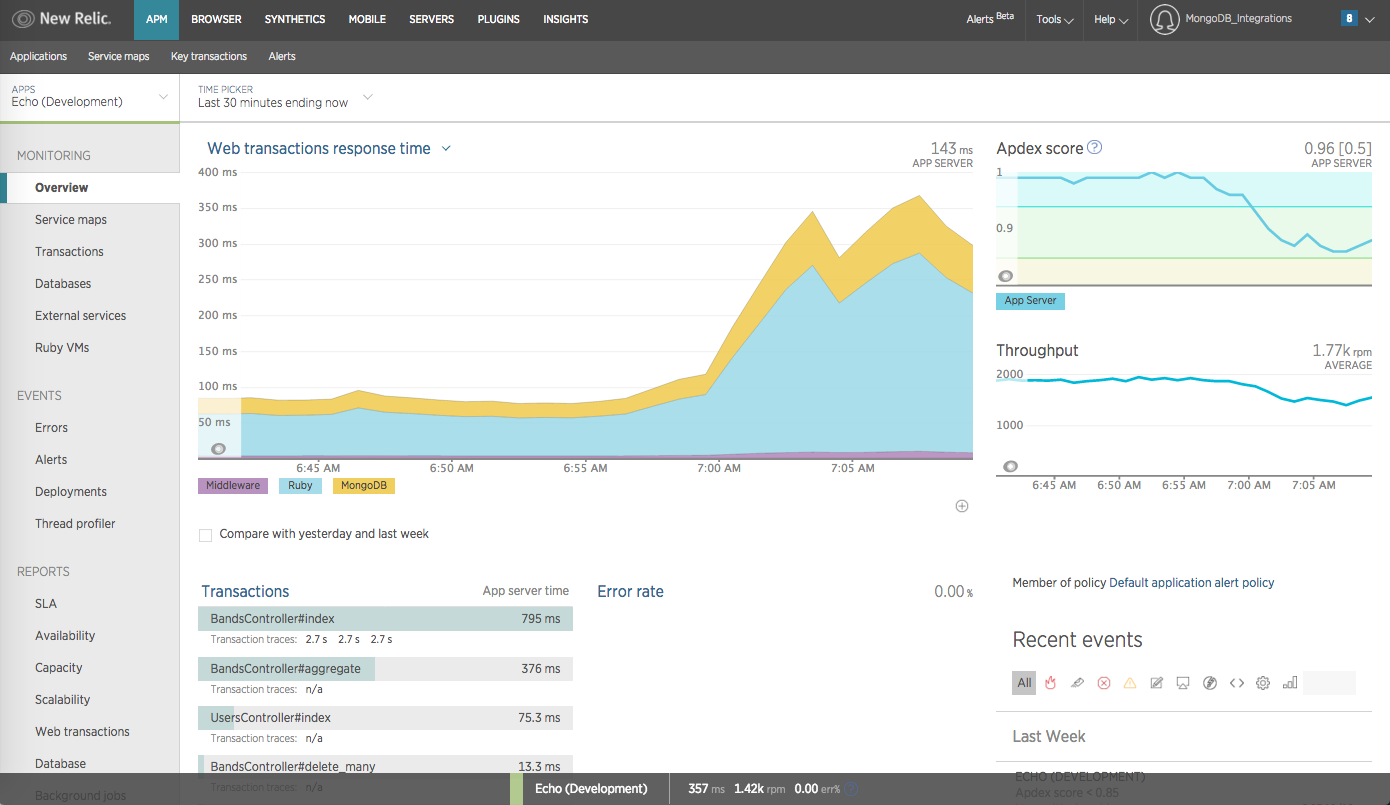
MongoDB Screenshots

Screenshot of Screenshot of Screenshot of Screenshot of Screenshot of Screenshot of