Overview
ProductRatingMost Used ByProduct SummaryStarting Price
Apache HTTP Server
Score 9.1 out of 10
N/A
Apache Web Server (Apache HTTP Server) is an open source HTTP web server for modern operating systems including UNIX and Windows.N/A
Apache Tomcat
Score 8.0 out of 10
N/A
Tomcat is an open-source web server supported by Apache.N/A
NGINX
Score 9.1 out of 10
Mid-Size Companies (51-1,000 employees)
NGINX, a business unit of F5 Networks, powers over 65% of the world's busiest websites and web applications. NGINX started out as an open source web server and reverse proxy, built to be faster and more efficient than Apache. Over the years, NGINX has built a suite of infrastructure software products o tackle some of the biggest challenges in managing high-transaction applications. NGINX offers a suite of products to form the core of what organizations need to create…N/A
Pricing
Apache HTTP ServerApache TomcatNGINX
Editions & Modules
No answers on this topic
Offerings
Pricing Offerings
Apache HTTP ServerApache TomcatNGINX
Free Trial
NoNoYes
Free/Freemium Version
NoNoYes
Premium Consulting/Integration Services
NoNoYes
Entry-level Setup FeeNo setup feeNo setup feeOptional
Additional Details
More Pricing Information
Community Pulse
Apache HTTP ServerApache TomcatNGINX
Considered Multiple Products
Apache HTTP Server
Chose Apache HTTP Server
Both Nginx and Apache are trying to accomplish the same thing, with the exception that Nginx is a much faster product. It allows for multi-threading which spreads out the traffic around the server. Apache is typically enabled by default and due to the high volume of websites …
Chose Apache HTTP Server
Apache is often used in conjunction with Nginx, with Nginx in front of Apache to serve static assets like CSS and JS. Both are easy to configure. IIS is pretty cumbersome and is not as flexible as Apache.
Chose Apache HTTP Server
We chose Apache because it handles dynamic content better than Nginx and it's very well supported. Nginx does handle high traffic sites better, but most of our sites do not get thousands of visitors or more a day as we are a small company serving niche markets. It is notable …
Chose Apache HTTP Server
Against Nginx: Mainly- it's been in the field the longest. There's not really a reason to move to Nginx on it's own. Apache has a mountain of documentation and how-tos that extend from the Foundation itself, to Individual Developers, spanning over 20 years, and most of it …
Chose Apache HTTP Server
To be quite honest I often select Apache because it is the world's most commonly used web server and I have been using it for more than 20 years across many organizations. I have never been burned using Apache. Apache rises above IIS in functionality, configurability, and the …
Chose Apache HTTP Server
Apache lacks the scalability and feature set of NGINX but our team was not only far more experienced with Apache HTTP Server but was relying on tools and frameworks that required Apache HTTP Server. We've recently considered moving to NGINX but the workload to migrate and train …
Chose Apache HTTP Server
Apache is more simple, also it tends to be more stable and it is less complicated to use, comparing with other complex solutions that are difficult to troubleshot.
So wherever possible I select Apache HTTP Server for own/enterprise use also advise consumers to select the Apache …
Chose Apache HTTP Server
The comparison with other products from IBM or Oracle is difficult. These are mostly software that has to be paid for. The only fair comparison at eye level is probably the NGINX web server: It is also free and offers even higher performance. In the meantime, there is also a …
Chose Apache HTTP Server
I have loved Apache and the brief experience I had with IIS wasn't as good. Nginx I have heard good things and though we use it heavily for our servers now without problems, I haven't configured it myself.
Chose Apache HTTP Server
Apache HTTP Server has more stability and features than the other products. It is also more secure. Apache HTTP Server has a more developer base so it is easier to find resources on it.
Chose Apache HTTP Server
By having a similar purpose, which is to publish and manage access to services, sites, and/or web systems, I have had to implement them to analyze their qualities and virtues, but stability, the power of implementation of different solutions and to be able to expand through own …
Chose Apache HTTP Server
Apache Web Server is the oldest among all of these above-mentioned web server solutions provide a wider range of tools and support available which is of great help when creating a web app because less investment of time and money is what contributes to the success of a project …
Chose Apache HTTP Server
I've used Microsoft's IIS and IBM's HTTP server. The major and a clear advantage of Apache web server over these products is that it’s free and has no licensing issues. Being in the industry for quite sometime (oldest web server) a lot of products and customizations have been …
Apache Tomcat
Chose Apache Tomcat
Apache Tomcat is very smooth tool compared to other applications. Since there are very less feature it's very smooth. NGINX server doesn't need Apache Tomcat we can directly deploy so it faster comparatively. In my working time I have never come across the UI of NGINX. Apache …
Chose Apache Tomcat
Apache Tomcat is lightweight but performs well, even when running multiple applications. Its performance and security features are the reasons for choosing Apache Tomcat among its competitors. Also, there is a huge community support than other products.
Chose Apache Tomcat
Apache Tomcat is a much wider open standard than Microsoft IIS. It also seems to use fewer resources and is simpler to maintain. Troubleshooting when an issue arises is difficult. We had trouble managing the Tail logs when something strange happened. Logging is very complex and …
Chose Apache Tomcat
It's clear that JBoss is a full JEE stack implementation while Tomcat isn't, but if you don't need the whole JEE stack there are many lightweight alternatives that implement the required feature with Tomcat.
NGINX
Chose NGINX
Nginx's cache mechanism is better than Apache and HAProxy. Also Nginx is very light weight and works for multiple sites with much less work. i.e. As front end proxy server configuration is very easy as compared to other applications. Apache sometimes crashes and is not able to …
Chose NGINX
MS IIS and Apache HTTP Server both provide many similar services. However the configuration simplicity, and performance characteristics helped us choose NGINX above the other 2 products.
Chose NGINX
The support and ability to provide near zero downtime for changes is a winner. The lightweight engine also helps reduce cost.
Chose NGINX
How does it compare? We use Apache ATP server and we also use Tom Cat also owned by Apache, but both Apache, ATP, and MKA. They are relatively older than GX and so they're one problem for Apache and MKA they need more power, more memory, and more space.
Chose NGINX
NGINX have higher market share which obviously show to us it is the preferred choice of most of the customers. Both of platform competes in the Web and Application server areas, but due the security features of NGINX be more flexible this in my opinion makes more sense.
Chose NGINX
It is like comparing a formula 1 car against a regular street car in terms of performance or installation simplicity
Chose NGINX
Apache is a market leader but NGINX is new and has new features. Lightweight and can handle static requests. We use EC2 and I believe NGINX is more suited when it comes to scalability.
Chose NGINX
NGINX is faster and easier to configure. It has better reverse proxy features which is much easy to configure.
Chose NGINX
Nnginx is more light-weight than many other web servers, has a very expressive configuration language, easier to configure than tools like IIS and Apache, easy to install certificates for SSL, much easier to model complex routing scenarios than IIS, easier to configure than …
Chose NGINX
I have found that [NGINX] seems to perform better throughout the years with less issues although I've used Apache more. I would definitely recommend [NGINX] for any high volume site and I've seen this to usually be the case from most provided web hosts who will pick [NGINX] …
Chose NGINX
Nginx is much more lightweight than apache HTTP.
Chose NGINX
NGINX Stacks up at the top for me because it's fast, reliable, and secure and apache is also usable but not so good in comparison to NGINX and since I and my organization have switched to NGINX I also don't want to look back at apache as NGINX works the best for our use case …
Chose NGINX
NGINX's footprint is much smaller than Apache, and it's great for serving up static content. The URL rewriting was not as familiar as Apache, but just as powerful once configured correctly. As a load balancer, it's much more affordable than Citrix ADC. We used the load …
Chose NGINX
Compared to Apache, NGINX is much lighter on resource consumption, and also far faster as a server, serving static content over twice as fast in most benchmark tests. NGINX doesn't offer as much potential configuration and customization as Apache, however, so if these advanced …
Chose NGINX
Nginx is way easier to configure and runs better than Microsoft’s offering, in my opinion, and I’ll take it over Apache for its simplicity.
Chose NGINX
Other Web servers are either not performant enough or locked to a platform. The main competitor in my opinion is the Apache Web Server, that can be extended in functionality through a diverse set of modules to perform almost any task related to a network server. But at scale, I …
Chose NGINX
I selected Nginx because it is easy to learn, use, and maintain. I almost never have to troubleshoot it ever since I deploy it. It just meets my need for a personal learning experience. It works well with PHP and MySQL on Linux. That is why I chose it at first.
Chose NGINX
We were happy to drop Apache to serve our applications.
Chose NGINX
Microsoft IIS server is not open source and it comes with its own overhead in terms of cost which is not the case with Nginx as we do not need to purchase a handful of other products in order to get an HTTP server up and running. If I compare it to Apache Server, it …
Chose NGINX
Nginx works on basic operating system principles and what I like the most about it is that even after being feature-rich and easily customizable it uses minimum resources.
Chose NGINX
Apache has the advantage of being very widely supported and well-known, which makes integration with various tools and software simple, whereas Nginx often requires manual configuration to achieve the same thing. However, the ease of use, configurability, and relatively small …
Features
Apache HTTP ServerApache TomcatNGINX
Application Servers
Comparison of Application Servers features of Product A and Product B
Apache HTTP Server
-
Ratings
Apache Tomcat
9.2
24 Ratings
14% above category average
NGINX
8.7
32 Ratings
9% above category average
IDE support00 Ratings10.022 Ratings7.617 Ratings
Security management00 Ratings9.024 Ratings8.627 Ratings
Administration and management00 Ratings8.224 Ratings8.827 Ratings
Application server performance00 Ratings8.124 Ratings9.327 Ratings
Installation00 Ratings10.024 Ratings8.929 Ratings
Open-source standards compliance00 Ratings10.024 Ratings9.025 Ratings
Best Alternatives
Apache HTTP ServerApache TomcatNGINX
Small Businesses
NGINX
NGINX
Score 9.1 out of 10
NGINX
NGINX
Score 9.1 out of 10
Apache HTTP Server
Apache HTTP Server
Score 9.1 out of 10
Medium-sized Companies
NGINX
NGINX
Score 9.1 out of 10
NGINX
NGINX
Score 9.1 out of 10
Apache Tomcat
Apache Tomcat
Score 8.0 out of 10
Enterprises
NGINX
NGINX
Score 9.1 out of 10
NGINX
NGINX
Score 9.1 out of 10
Apache Tomcat
Apache Tomcat
Score 8.0 out of 10
All AlternativesView all alternativesView all alternativesView all alternatives
User Ratings
Apache HTTP ServerApache TomcatNGINX
Likelihood to Recommend
8.0
(20 ratings)
9.0
(24 ratings)
8.9
(50 ratings)
Likelihood to Renew
-
(0 ratings)
10.0
(1 ratings)
9.1
(1 ratings)
Usability
-
(0 ratings)
8.0
(3 ratings)
8.3
(3 ratings)
Availability
-
(0 ratings)
6.0
(1 ratings)
-
(0 ratings)
Performance
-
(0 ratings)
9.0
(2 ratings)
-
(0 ratings)
Support Rating
9.3
(2 ratings)
9.1
(3 ratings)
8.1
(4 ratings)
Configurability
-
(0 ratings)
8.0
(1 ratings)
-
(0 ratings)
Ease of integration
-
(0 ratings)
9.0
(1 ratings)
-
(0 ratings)
Product Scalability
-
(0 ratings)
9.0
(1 ratings)
-
(0 ratings)
User Testimonials
Apache HTTP ServerApache TomcatNGINX
Likelihood to Recommend
Apache
As I mentioned earlier, the Apache HTTP Server has a small disadvantage compared to the competition (NGINX) in terms of performance. If you run websites that really have a lot of visitors, NGINX might be the better alternative.
On the other hand, the Apache HTTP Server is open source and free. Further functionalities can be activated via modules. The documentation is really excellent.
Read full review
Apache
Excellent value for companies wishing to host Java applications in the cloud. Utilizing hosting tools such as load balancers and network and application firewalls, Tomcat can be part of a powerful system to host web applications to thousands of users. There has been consistency in the development and support of Tomcat since its initial release in the late '90s and the best commonalities have been carried forward. If you host Java web applications, Tomcat is as good as any for an application server.
Read full review
F5
Nginx is well-suited for any web server scenarios, such as web applications, backend or reverse proxy for both application and HTTP requests, and distribution. It is less appropriate for Windows-based applications that run directly on a Windows Server host. In any case, it is very easy to manage, through separate conf files for each application or site you want to host with it.
Read full review
Pros
Apache
  • Street Cred: Apache Web Server is the Founder for all of Apache Foundation's other projects. Without the Web Server, Apache Foundation would look very different. That being said, they have done a good job of maintaining the code base, and keeping a lot of what makes Apache so special
  • Stability: Apache is rock-solid. While no software is perfect, Apache can parse your web sources quickly and cleanly.
  • Flexibility: Need to startup your own Webpage? Done. Wordpress? Yup. REST Endpoint? Check. Honeypot? Absolutely.
Read full review
Apache
  • Fast to start up, which is useful when we need to just check that our changes are working correctly.
  • Free, which allows us to not be involved with the finance/legal team about using it.
  • Bundled with Spring Boot, which makes it even more convenient for our testing.
Read full review
F5
  • Very low memory usage. Can handle many more connections than alternatives (like Apache HTTPD) due to low overhead. (event-based architecture).
  • Great at serving static content.
  • Scales very well. Easy to host multiple Nginx servers to promote high availability.
  • Open-Source (no cost)!
Read full review
Cons
Apache
  • The default configurations which comes with Apache server needs to get optimized for performance and security with every new installation as these defaults are not recommended to push on the production environment directly.
  • Security options and advanced configurations are not easy to set up and require an additional level of expertise.
  • Admin frontend GUI could be improved to a great extent to match with other enterprise tools available to serve similar requirements.
Read full review
Apache
  • Using tomcat manager to troubleshoot is not very informative. Error messages are vague, you have to dig into log files for more information about the problems.
  • Is great for simple web applications, but may not work for heavy development which may require a full J2EE stack, might like JBoss better.
  • Security in tomcat is not straightforward, as I discovered that you have to understand how to set up realms in tomcat in order to hash passwords, which I was not overly familiar with, which is a big deal when setting up users in the tomcat-users.xml file.
Read full review
F5
  • Customer support can be strangely condescending, perhaps it's a language issue?
  • I find it a little weird how the release versions used for Nginx+ aren't the same as for open source version. It can be very confusing to determine the cross-compatibility of modules, etc., because of this.
  • It seems like some (most?) modules on their own site are ancient and no longer supported, so their documentation in this area needs work.
  • It's difficult to navigate between nginx.com commercial site and customer support. They need to be integrated together.
  • I'd love to see more work done on nginx+ monitoring without requiring logging every request. I understand that many statistics can only be derived from logs, but plenty should work without that. Logging is not an option in many environments.
Read full review
Likelihood to Renew
Apache
No answers on this topic
Apache
We have a huge knowledge of the product within our company and we're satisfied with the performance.
Read full review
F5
Great value for the product
Read full review
Usability
Apache
No answers on this topic
Apache
Tomcat has a very rich API set which allows us to implement our automation script to trigger the deployment, configure, stop and start Tomcat from the command line. In our projects, we embedded Tomcat in our Eclipse in all of the developer's machines so they could quickly verify their code with little effort, Azure Webapp has strong support for Tomcat so we could move our application to Azure cloud very easy. One drawback is Tomcat UI quite poorly features but we almost do not use it.
Read full review
F5
This tool is really easy to use and configure. Consumes very less system resources. It is highly modular and configurable. You can easily use it with other tools like certbot for SSLs. You can configure basic security with configuration and headers
Read full review
Reliability and Availability
Apache
No answers on this topic
Apache
Tomcat doesn't have a built-in watchdog that ensures restart upon failure, so you have to provide it externally. A very good solution is java service wrapper. The community edition is able to restart Tomcat upon out of memories exceptions.
Read full review
F5
No answers on this topic
Performance
Apache
No answers on this topic
Apache
Tomcat support to customize memory used and allow us to define the Connection pool and thread pool to increase system performance and availability, Tomcat server itself consume very little memory and almost no footprint. We use Tomcat in our production environment which has up to thousands of concurrent users and it is stable and provides a quick response.
Read full review
F5
No answers on this topic
Support Rating
Apache
I give this rating because there is so much Apache documentation and information on the web that you can literally do anything. This has to do with the fact that there is a huge Open Source community that is beyond mature and perhaps one of the most helpful to be found. The only thing that should hold anyone back from anything is that they can not read. RTFM, my friend. And I must say that the manual is excellent.
Read full review
Apache
Well, in actuality, I have never needed support for Apache Tomcat since it is configured and ready-to-go with no configuration needed on my end.
Read full review
F5
Community support is great, and they've also had a presence at conferences. Overall, there is no shortage of documentation and community support. We're currently using it to serve up some WordPress sites, and configuring NGINX for this purpose is well documented.
Read full review
Alternatives Considered
Apache
I has a lot more features, except that IIS is more integrated in a Windows environment. But now with .net core also possible from Apache it would work anywhere really. Only in a full Windows environment where full integration is needed I would chose to go for IIS. Otherwise Apache it is.
Read full review
Apache
Eclipse Jetty is the best alternative for Apache Tomcat because which is also an open-source and lightweight servlet container like Tomcat. A major advantage of this over Tomcat is that Jetty server can easily be embedded with the source code of web applications. Since it requires less memory to operate, you may realize that it is very efficient.
Read full review
F5
I have found that [NGINX] seems to perform better throughout the years with less issues although I've used Apache more. I would definitely recommend [NGINX] for any high volume site and I've seen this to usually be the case from most provided web hosts who will pick [NGINX] over alternatives
Read full review
Scalability
Apache
No answers on this topic
Apache
It's very easy to add instances to an existing deployment and, using apache with mod proxy balancer, to scale up the serving farm
Read full review
F5
No answers on this topic
Return on Investment
Apache
  • Works as intended, so it's less to worry about.
  • Works great on elastic environments (like EC2).
  • As an Open Source project, you can get support for almost any problem you can have.
  • Configuration files, while powerful, can be tricky to dominate for some.
Read full review
Apache
  • Tomcat is cheap and very quick to deploy, so it has benefited much when situation needs applications to be deployed quickly without wasting time on licensing and installations.
  • Plenty of documentation available so no vendor training is required. Support contract is not needed as well.
Read full review
F5
  • By using Nginx, we can host multiple web services on a single server, keeping our infrastructure costs lower.
  • Nginx maintains our HTTPS connections, allowing us to keep our promise to our customers that their data is safe in transit.
  • Due to Nginx's extremely low failure rate, our web addresses always return something meaningful, even when individual services go down. In sense, this means we are "always online" and allows us to maintain brand and support our customers even in the face of catastrophe.
Read full review
ScreenShots

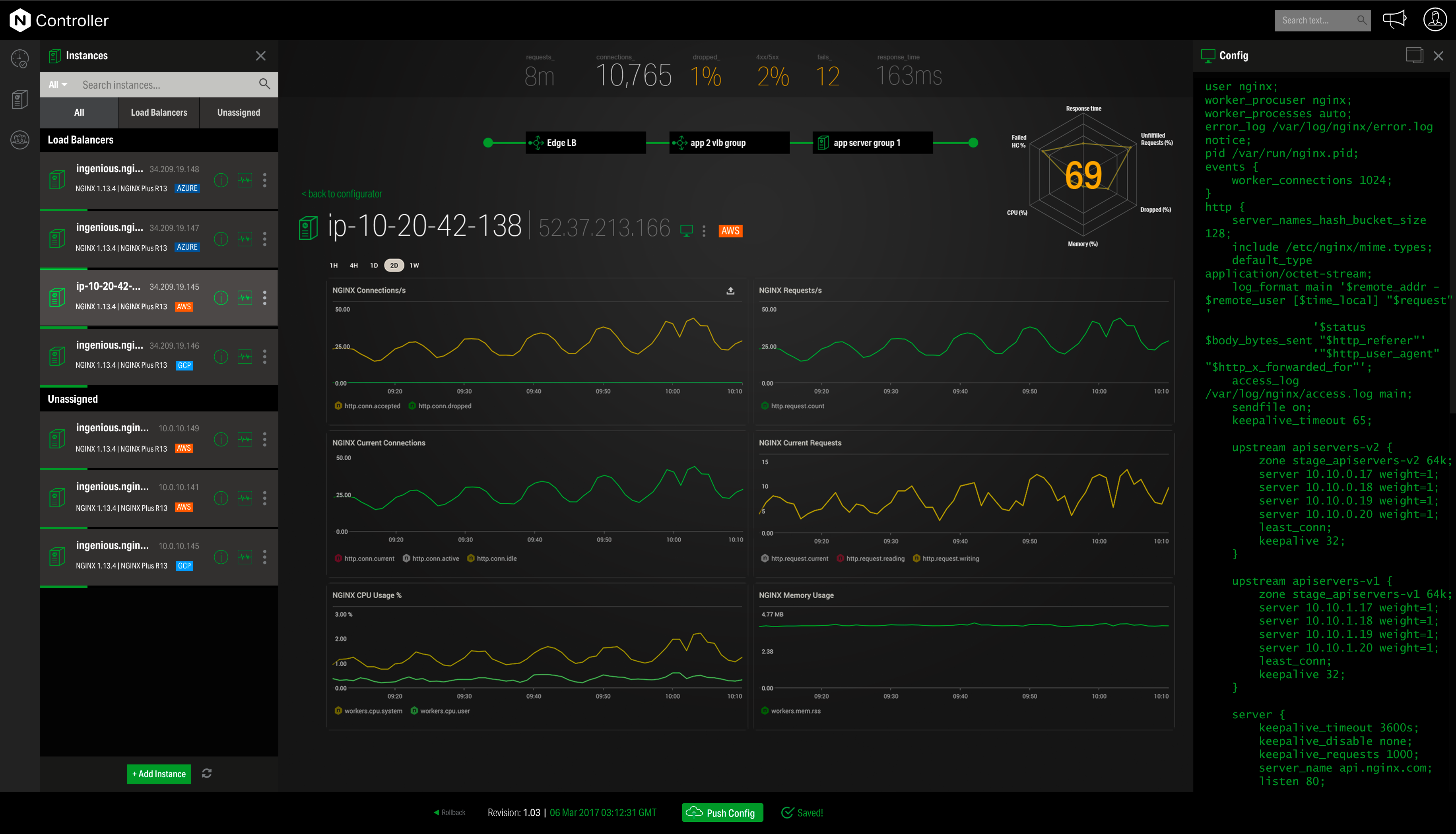
NGINX Screenshots

Screenshot of Overview of the NGINX Application PlatformScreenshot of NGINX Controller - MonitoringScreenshot of NGINX Controller - Configuration