AppFog was a cloud-agnostic application and infrastructure management platform used to manage workloads across on-premises and third-party cloud environments. It has been discontinued.
$0
HPE Zerto Software
Score 8.9 out of 10
Enterprise companies (1,001+ employees)
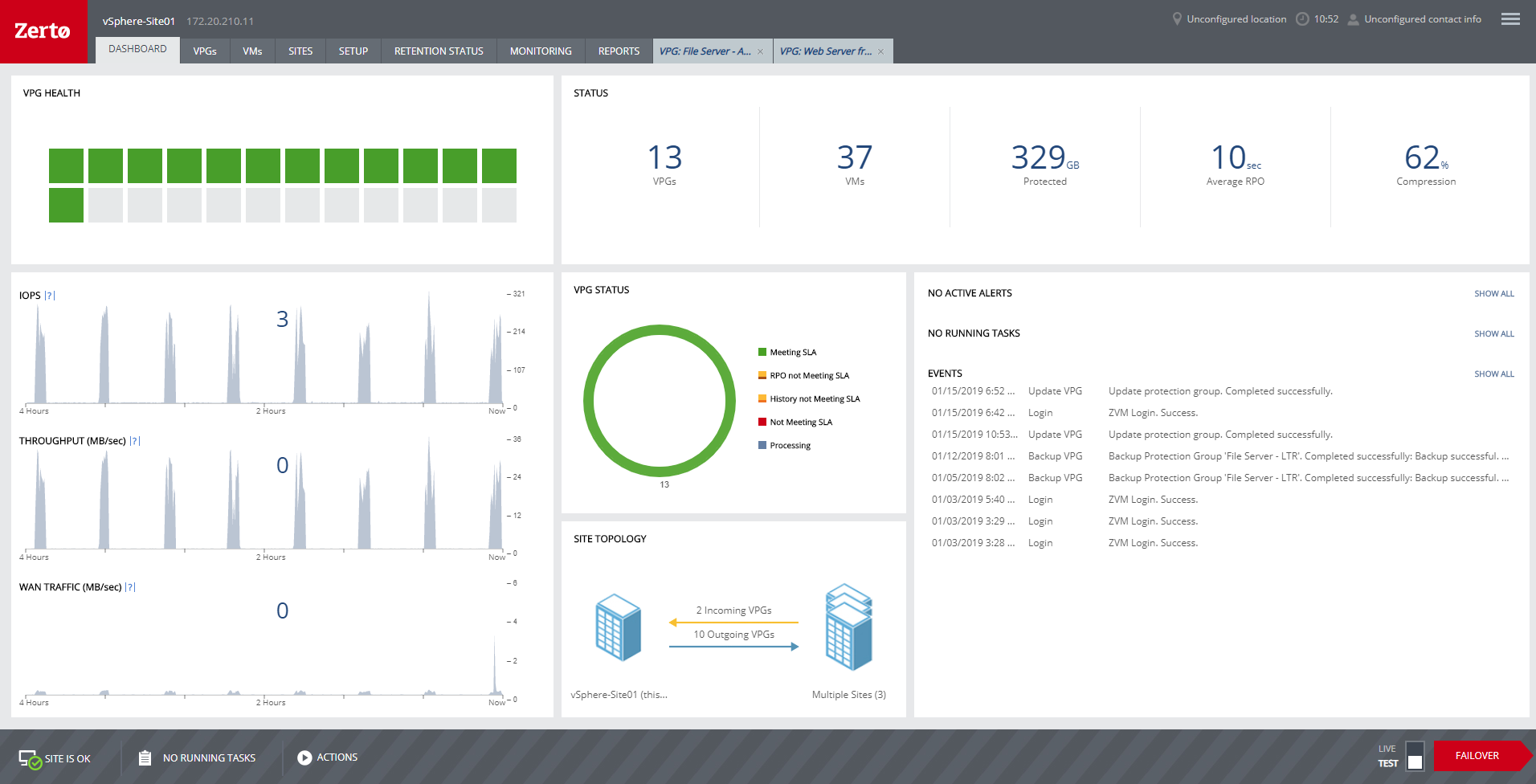
HPE Zerto Software aims to enable customers to run an always-on business by simplifying the protection, recovery, and mobility of on-premises and cloud applications.
N/A
Pricing
AppFog (discontinued)
HPE Zerto Software
Editions & Modules
No answers on this topic
No answers on this topic
Offerings
Pricing Offerings
AppFog (discontinued)
HPE Zerto Software
Free Trial
No
Yes
Free/Freemium Version
Yes
No
Premium Consulting/Integration Services
No
No
Entry-level Setup Fee
No setup fee
Optional
Additional Details
—
—
More Pricing Information
Community Pulse
AppFog (discontinued)
HPE Zerto Software
Features
AppFog (discontinued)
HPE Zerto Software
Platform-as-a-Service
Comparison of Platform-as-a-Service features of Product A and Product B
AppFog (discontinued)
6.5
2 Ratings
18% below category average
HPE Zerto Software
-
Ratings
Ease of building user interfaces
7.01 Ratings
00 Ratings
Scalability
5.32 Ratings
00 Ratings
Platform management overhead
6.02 Ratings
00 Ratings
Workflow engine capability
6.01 Ratings
00 Ratings
Platform access control
6.01 Ratings
00 Ratings
Services-enabled integration
6.62 Ratings
00 Ratings
Development environment creation
7.42 Ratings
00 Ratings
Development environment replication
8.42 Ratings
00 Ratings
Issue monitoring and notification
6.01 Ratings
00 Ratings
Issue recovery
6.42 Ratings
00 Ratings
Upgrades and platform fixes
7.02 Ratings
00 Ratings
Data Center Backup
Comparison of Data Center Backup features of Product A and Product B
AppFog (discontinued)
-
Ratings
HPE Zerto Software
8.3
3 Ratings
3% above category average
Universal recovery
00 Ratings
8.52 Ratings
Instant recovery
00 Ratings
8.33 Ratings
Recovery verification
00 Ratings
9.33 Ratings
Business application protection
00 Ratings
8.73 Ratings
Multiple backup destinations
00 Ratings
8.52 Ratings
Incremental backup identification
00 Ratings
8.02 Ratings
Backup to the cloud
00 Ratings
7.43 Ratings
Deduplication and file compression
00 Ratings
7.73 Ratings
Snapshots
00 Ratings
8.02 Ratings
Flexible deployment
00 Ratings
8.73 Ratings
Management dashboard
00 Ratings
9.13 Ratings
Platform support
00 Ratings
7.03 Ratings
Retention options
00 Ratings
9.03 Ratings
Encryption
00 Ratings
8.02 Ratings
Enterprise Backup
Comparison of Enterprise Backup features of Product A and Product B
AppFog (discontinued)
-
Ratings
HPE Zerto Software
8.3
2 Ratings
2% below category average
Continuous data protection
00 Ratings
9.52 Ratings
Replication
00 Ratings
8.52 Ratings
Operational reporting and analytics
00 Ratings
7.52 Ratings
Malware protection
00 Ratings
7.01 Ratings
Multi-location capabilities
00 Ratings
9.52 Ratings
Ransomware Recovery
00 Ratings
8.02 Ratings
Disaster Recovery
Comparison of Disaster Recovery features of Product A and Product B
It was very good to use in small scale projects. Considering the high end projects with many instances and multi-platform architectures, it is better to test before the application is deployed. I think few of the questions can be general - who are the system users and what size is the application focussing on? How much resources are required? Will the application require any additional services?
Zerto is well suited for disaster recovery and virtual machine replication between multiple data centers. DR testing for audit or regulations is much easier with Zerto, great reporting, dashboard etc. It is not well suited for physical server replication for disaster recovery or as a primary backup solution.
Anyone with a large disk (VMDK) knows the issues of VMware snapshots. Most backup software is a "point in time backup" that uses snapshots. While the backup can be run multiple times per day the stress of the snapshot on the host and storage is eliminated by the continuous protection of Zerto log replication.
A client had a the disks on a VM go missing for some reason. We had them "flip the switch" for a real fail over and press the fail over button. The VM on our DR site started to come alive as the VM at the customer site was brought down. When the DR VM was fully up, automatic reverse replication started. The DR machine was available in a few minutes (to take into account different host hardware) for access. One the vm at both sites were in sync, we had the customer again repeat the fail over process and the DR site VM was turned off and the Production site VM was brought back on line. This was a 200 GB VM and the whole process was finished in about 3 hours.
Zerto also allows for "Test" fail overs that can be configured on many different functions, such as host, datastore, network and IP usage. Configuring the IPs is crucial to avoid inadvertent site cross contamination of the same VM.
Zerto can also retrieve files from any VM disk on the DR site without starting a VM. Very handy for retrieving files or directories.
Since Zerto is running continuous log replication, changes on the production VM are nearly instantaneously copied to the DR site. As with any data process, having sufficient bandwidth for "churn" peaks minimizes the delay in updating the DR site.
We really like the easy setup of this replication solution, as well as the ease of management. Not to mention, our internal IT Economist determined that the Zerto solution would provide the best ROI out of the competing solutions we analyzed. So far, his calculations have been spot on, and we have saved substantially
Zerto is very easy to implement and support. Uses are broad, only issues are once something doesn't sync it is difficult to get assistance until your reach tier 2 or tier 3 support. Basic file and folder recovery is great. Live and test fail overs are also easy to implement without issue.
Overall support is very good. We sometimes get pushback when asking Level 1 support to escalate to Level 2. This causes undue frustrations when you need a more knowledgeable support person to get involved. We've had to escalate to account reps a few times for this scenario. Zerto is very responsive and normally handles our requests very quickly.
Primarily because it used to have a good free tier earlier, which it does not anymore. It's simple, and things are available to use. Compared to it's competitors, it does has less features, but that kind of acts in its favor. That adds to the simplicity, and ease of use for a new user.
We started out using Backup Exec which was in service until we virtualized our environment where it didn't perform as well at the time. Then we switched to Veeam which worked well, but then as we started needing to do migrations and off-site DR, we found ourselves relying on Zerto more often.
For my organization, the pricing model was an upfront investment for the Zerto licenses. My organization prefers to pay upfront and not deal with month-to-month or year-to-year pricing models that most companies are moving to. But for some, the investment may be more than they can afford, and would prefer the year-to-year pricing model.
I mean, it was 6 years ago, but we were up and going with all applications synchronizing in short order. The longest tasks was getting the 30 TB of application data synchronized between the datacenters.
Zerto is like having the best possible insurance ... it just works, and often provides the backups taken overnight that are key in recovering data/work between overnight backups.
Zerto easily enabled the move of primary datacenters by allowing easy failover to a secondary site, and failback to the primary site.