Appian is a low-code development and business process management platform. It features drag-and-drop design for app building, automated work processes, unified data management, and cloud-based deployment.
$0
IDERA SQL Diagnostic Manager
Score 8.2 out of 10
N/A
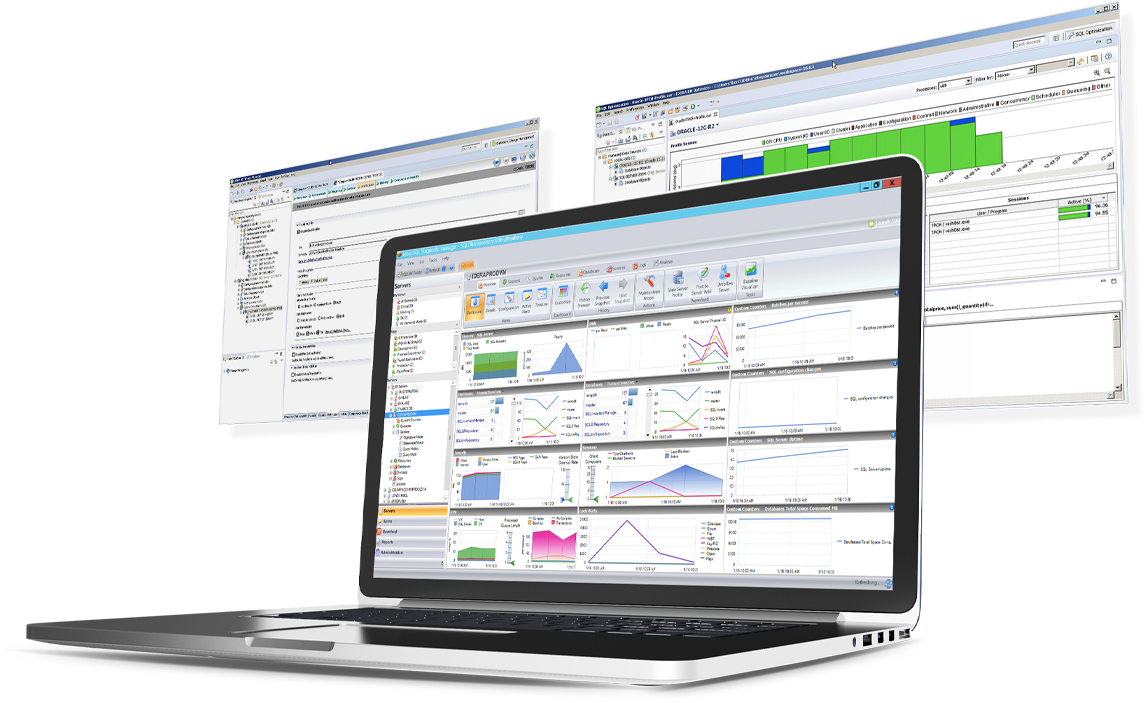
SQL Diagnostic Manager for Microsoft SQL Server helps database administrators to find and fix Microsoft SQL Server performance problems in physical, virtual, and cloud environments. Unlike its competition, it provides effective scalability, advanced SQL query analysis and optimization, prescriptive analysis with corrective SQL scripts, powerful automated alert responses, broad PowerShell integration, complete customization, and extensive support for current and legacy Microsoft SQL Server and…
$1,996
per instance with first year maintenance included
Pricing
Appian
IDERA SQL Diagnostic Manager
Editions & Modules
Appian Community Edition
$0
Application - Input-Only
$2
per month per user
Application - Infrequent
$9
per month per user
Application - Standard
$75
per month per user
Platform
Custom Quote Priced per user with unlimited apps.
minimum 100 users, no maximum
Unlimited
Custom Quote Priced per development with unlimited apps.
unlimited
Platform
Custom Quote Priced per user with unlimited apps.
Minimum 100, no maximum
Unlimited
Custom Quote Priced per development with unlimited apps.
Unlimited
Standard via eCommerce
1,996.00
per instance with first year maintenance included
Offerings
Pricing Offerings
Appian
IDERA SQL Diagnostic Manager
Free Trial
Yes
Yes
Free/Freemium Version
Yes
No
Premium Consulting/Integration Services
Yes
No
Entry-level Setup Fee
No setup fee
No setup fee
Additional Details
—
—
More Pricing Information
Community Pulse
Appian
IDERA SQL Diagnostic Manager
Features
Appian
IDERA SQL Diagnostic Manager
Low-Code Development
Comparison of Low-Code Development features of Product A and Product B
Appian
9.1
75 Ratings
8% above category average
IDERA SQL Diagnostic Manager
-
Ratings
Visual Modeling
8.873 Ratings
00 Ratings
Drag-and-drop Interfaces
8.972 Ratings
00 Ratings
Platform Security
9.271 Ratings
00 Ratings
Platform User Management
8.872 Ratings
00 Ratings
Reusability
9.575 Ratings
00 Ratings
Platform Scalability
9.573 Ratings
00 Ratings
SQL Performance Monitoring
Comparison of SQL Performance Monitoring features of Product A and Product B
Appian works great for automating manual processes and integrating multiple systems through its toolset. It gives great flexibility for establishing rules for approvals, routings, escalations, and the like. Because of the low code toolset, it's very easy to deploy and make changes as needed as processes evolve and as the organization learns to utilize the system better. Minimal maintenance is required to support the applications build on the platform. Some of the automated testing integration with tools like Jenkins is limited so that may be an issue for some.
SQL Server [Business Intelligence] Manager is useful for tracking performance across SSIS, SSRS and SSA and have the data represented in dashboards. It helps improve performance and helps end users. However, several features are redundant for smaller organization that can use the tools that comes with existing Microsoft products. These features also takes time to learn and use.
Allows at a glance workflow documentation which assists in the need we have for information readiation.
Drag and drop interface for workflow development greatly speeds our apps time to market.
Using the advanced features of Appian, we are able to create working sites in a fraction of the time it would take to do so using "traditional" development.
SQLdm does a good job of providing information at a high level, but also allows me to drill down to specific queries and events if needed. I don't always need to sift through tons of details to get the information I need. It also gives a very wide range of information from SQL specific metrics, to OS metrics, to VM metrics, all the way up to host server metrics.
I like how the alert and notification system can be customized. For example, if you know a certain server regularly has long-running queries, you can adjust the alert to not fire unless a query has been running for 30 minutes while the rest of the servers fire after 30 seconds. That is very helpful in not being bombarded at dinner with alerts from a server similar to, "I've been at 90% cpu for 26 milliseconds!!!!!!!...and now it's back down to 30%" Good information to know, but not something you need to literally lose sleep over.
I like how you can configure different servers to be monitored differently. For example, you can have a group of servers called DEVELOPMENT that you can turn on heavier monitoring on so you can test how changes in applications might affect the SQL environment, but in the PRODUCTION group, you may only want to enable the heavier analysis and logging when performance issues are actively being reported.
Search issues when type ahead and database search are used in the same field.
Buttons implementation where user is require[d] to click on the button description - if clicks on the button outside that text - button will not work.
Problems with using certain off-the-shelf performance tools like WebLoad or Neoload. That is because of different dynamic variables being used internally in Appian - which these tools are unable to correlate. We are still investigating using other tools like Jmeter to overcome dynamic correlation problem for performance testing.
Windows client has some issues. When you have small time intervals for your data collection, it can cause the client to become unresponsive and require you to restart it.
It takes more time to get the web client running than it does to get the windows client running.
The visualizations have been the same for the last eight years--could use a little bit of a refresh.
We recently renewed our license with Appian. We are convinced that its flexibility, relative ease of use, the support they provide, there mobile advancements and their general willingness and desire to see us succeed all contributed to our reason to renew our agreement with Appian
Appian is a low code environment, because of this, a very good visual interface is required. Appian is providing a feature-rich dashboard [that] we can use for building the dashboards and other interfaces. Appian also provides patches and releases to enhance these features. A developer can start off development just by going through a basic course from the Appian learning community.
Appian is one of the leading low code business automation platforms that support RPA, decision rules, case management, workflow automation, and machine learning all in a single bundle. But it is also harder to implement and replace the traditional business process.
As analyst I participated in a developer boot camp. At times it was hard to keep up but most of the time it made sense. Trainer took the time to explain and slowed pace down to answer questions etc.
Appian has enormously transformed and keeps on updating the product every quarter to meet the latest needs of the world with new innovations & technologies being integrated within the platform. What gives more pleasure than a product that keeps on continuous[ly] improv[ing]?
IDERA SQL Diagnostic Manager for SQL, Redgate SQL, and MonitorLogicMonitor are similar products to each other. We decided on IDERA SQL Diagnostic Manager for SQL because our experience with locating heavy queries has been very good and it provides real-time monitoring of all servers and databases. It also allows you to have a large volume of historical data which allows you to analyze trends in the databases.
I believe it has negatively impacted our release dates. There may have been a misunderstanding as to the learning curve, even though it is "low code."
The look and feel of the applications created using Appian have uniformity and it's easier to have "reuse" between applications.
There is less developer control when it comes to features. I think this mainly has to do with the amount of plugins available. I would think there should be many more available plugins. But again, our use case is probably different than most others.