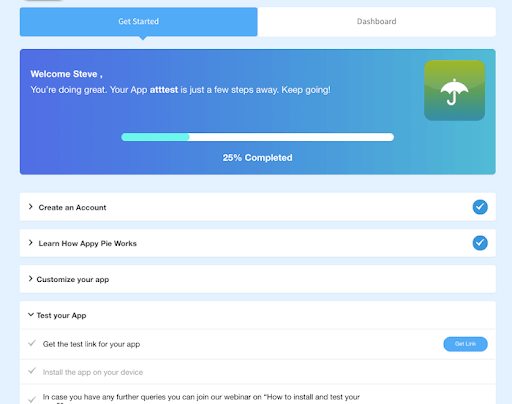
Appy Pie is a diversified no-code development platform. It offers app and web development, helpdesk support, chatbot building, design features, and integration that are helpful when starting, running, or growing a business.
$16
per app/per month
CircleCI
Score 9.5 out of 10
N/A
CircleCI is a software delivery engine from the company of the same name in San Francisco, that helps teams ship software faster, offering their platform for Continuous Integration and Continuous Delivery (CI/CD). Ultimately, the solution helps to map every source of change for software teams, so they can accelerate innovation and growth.
$0
for up to 6,000 build minutes and up to 5 active users per month
Pricing
Appy Pie
CircleCI
Editions & Modules
Basic
$16
per app/per month
Gold
$36
per app/per month
Platinum
$60
per app/per month
Server
Contact Sales
Performance
starting at $15
per month
Scale
starting at $2000
per month
Offerings
Pricing Offerings
Appy Pie
CircleCI
Free Trial
Yes
No
Free/Freemium Version
No
Yes
Premium Consulting/Integration Services
Yes
No
Entry-level Setup Fee
No setup fee
No setup fee
Additional Details
—
—
More Pricing Information
Community Pulse
Appy Pie
CircleCI
Features
Appy Pie
CircleCI
Low-Code Development
Comparison of Low-Code Development features of Product A and Product B
Based on my personal experience, this application is well-suited for noncoders who are busy setting up their businesses and since coders are expensive for the company in the initial days as in for startups, this application goes hand in hand and is quick and robust along with its amazing features like drag and drop and just the cloud storage facility.
Based on our experience, CircleCI is well-suited for automating mobile app release cycles. For example, to release an iOS app, you would need to build, sign, and upload it to TestFlight, which requires a dedicated Mac in the office. But with CircleCI, you can have macOS executors, so you don't have to manage a physical build machine. Another benefit is that CircleCI's certified AWS Orbs abstract away complex authentication and deployment logic, allowing us to build, push, and deploy Docker containers to Amazon ECS with minimal configuration and high reliability. CircleCI is less suited for smaller projects where the development and deployment are not that extensive, for example, a static site. Once you have built a static site, you probably won't make any further changes, so there's no point in paying for it.
Automated builds! This is really why you get CircleCI, to automate the build process. This makes building your application far more reliable and repeatable. It can also run tests and verify your application is working as expected.
Simple. Unlike Jenkins, Teamcity, or other platforms, CircleCI doesn't need a lot of setup. It's completely hosted, so there's no infrastructure to set up. The config file does take a bit to understand, but if you follow their example and start with something small and add to it, you can get it up and going quicker than it first looks.
Scales easily. Again, since it's all cloud-based, you don't have to manage or scale infrastructure. Simply subscribe to the number of containers you want, and scaling up just means buying more containers.
The application requires to be run on fast processing computers/laptops
This is a good application that isn't much known among non-coders, it needs to be marketed so that boosts this app developer to add more advanced features
Like I said in previous questions, the no-code application has basic and easy features that are literally a no-brainer and even a person with zero knowledge of coding can do wonders with this as his/her tool. Apart from that, the application is cost-effective while time and money are two key things to be taken care of as a startup owner, this app came hand in hand with me
The reliability & speed, it just works. The ability to spin up macOS runners and Docker containers on demand without managing hardware is a huge win. The Orbs system makes integrating with AWS and Slack incredibly easy, saving us weeks of custom scripting and providing real-time updates in our Slack channel. This makes it easy for us to track and ensures that everyone involved knows the status. Of course, it has drawbacks related to configuration complexity and, in some cases, cost transparency, but overall, it is an industry-standard, robust tool that solves our core infrastructure problems well.
It's pretty snappy, even with using workflows with multiple steps and different docker images. I've seen builds take a long time if it's really involved, but from what I can tell, it's still at least on par if not faster than other build tools.
I have been using this for some time now and the website of the no-code application is all self-explanatory that is the reason I never have reached to the support team anytime, but before using this application I have gone through the reviews and read the positive response and I believe it has still gotten stronger since then.
Unless you have a reasonably large account, you're going to be mainly stuck reading their documentation. Which has improved somewhat over the years but is still extremely limited compared to a platform like Digital Ocean who invested in the documentation and a community to ensure it's kept up to date. If you can't find your answer there, you can be stuck.
Webflow has quite a lot of complexity in comparison to the no-code app which instead is user-friendly. There are more issues with application getting hung in between working but that isn't a bigger problem in the no-code app. Apart from that, the no-code app has blocks that can be used to edit/add/delete which are literally a no-brainer.
Jenkins is usually self-hosted, Travis CI's infrastructure is largely unreliable (lots of tests time out for no discernable reason), and Semaphore encourages you to configure your CI/CD from a web UI. We like CircleCI because its hosted, our tests run largely as expected on their infrastructure, and we can configure it from a config file that we track in GitHub.
We pay over $5K/ month and we have high expectations for service. Sometimes I feel that we don't get the value, but only sometimes.
We have had to build our own application to keep state and broker releases and deployments. We call our app deployer. I feel that CircleCI could do more to understand our needs and possibly build additional features that would enable us to invest less in build and deployment infrastructure and justify paying more for Circle.