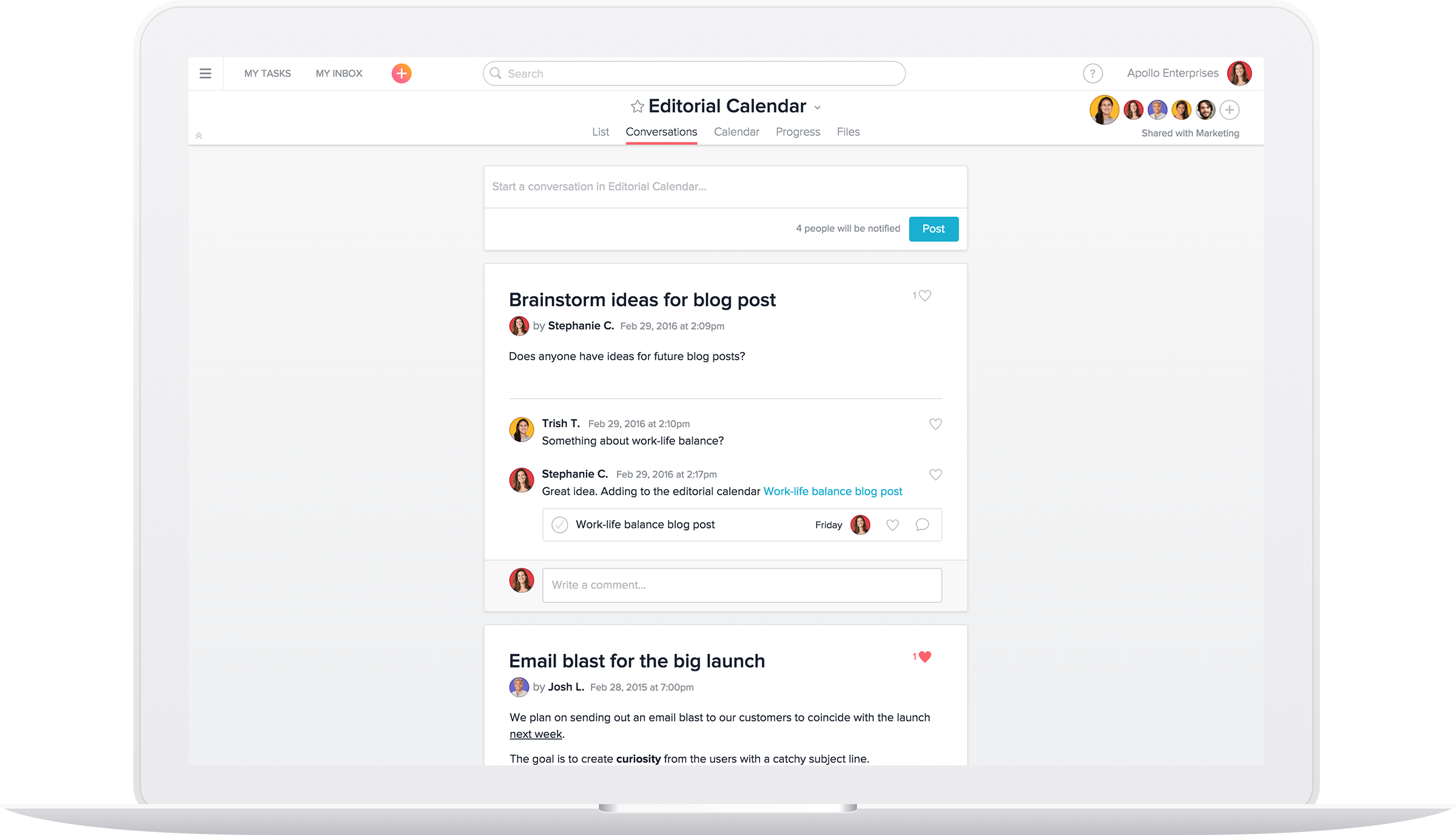
Asana is a web and mobile project management app. With tasks, projects, conversations, and dashboards, Asana lets an entire team know who's doing what by when, enabling workload balancing. Users can also add integrations for GANTT charts, time tracking and more.
$13.49
per month per user
Google App Maker (discontinued)
Score 7.3 out of 10
N/A
Google AppMaker was a low-code development environment. App Maker is included with G Suite Business and Enterprise editions, as well as with G Suite for Education. It was discontinued in early 2021.
N/A
Pricing
Asana
Google App Maker (discontinued)
Editions & Modules
Starter
$13.49
per month per user
Advanced
$30.49
per month per user
Enterprise
Contact Sales
Personal
Free
No answers on this topic
Offerings
Pricing Offerings
Asana
Google App Maker (discontinued)
Free Trial
Yes
No
Free/Freemium Version
Yes
No
Premium Consulting/Integration Services
Yes
No
Entry-level Setup Fee
Optional
No setup fee
Additional Details
A discount is offered for annual billing.
—
More Pricing Information
Community Pulse
Asana
Google App Maker (discontinued)
Features
Asana
Google App Maker (discontinued)
Project Management
Comparison of Project Management features of Product A and Product B
Asana
8.3
179 Ratings
7% above category average
Google App Maker (discontinued)
-
Ratings
Task Management
9.2179 Ratings
00 Ratings
Resource Management
8.0152 Ratings
00 Ratings
Gantt Charts
9.061 Ratings
00 Ratings
Scheduling
8.4162 Ratings
00 Ratings
Workflow Automation
9.0132 Ratings
00 Ratings
Team Collaboration
9.4178 Ratings
00 Ratings
Support for Agile Methodology
8.57 Ratings
00 Ratings
Support for Waterfall Methodology
8.57 Ratings
00 Ratings
Document Management
8.2150 Ratings
00 Ratings
Email integration
8.2142 Ratings
00 Ratings
Mobile Access
8.7149 Ratings
00 Ratings
Timesheet Tracking
6.16 Ratings
00 Ratings
Change request and Case Management
8.44 Ratings
00 Ratings
Budget and Expense Management
7.077 Ratings
00 Ratings
Professional Services Automation
Comparison of Professional Services Automation features of Product A and Product B
Asana
6.5
48 Ratings
17% below category average
Google App Maker (discontinued)
-
Ratings
Project & financial reporting
5.51 Ratings
00 Ratings
Integration with accounting software
7.647 Ratings
00 Ratings
Low-Code Development
Comparison of Low-Code Development features of Product A and Product B
The usability of Asana is broad since it's available in a variety of platforms that are widely used nowadays. I think that it would be great for people who are constantly on the move and switching devices, since it has allowed me to work from my phone, too. I also think that Asana has proven itself to handle a large quantity of work
App Maker is exceptionally strong when you need things to just get done, but your internal development team has a full queue. Or maybe you don't even have an internal development team! If you need a check-in system, an applicant tracking system, an office cleaning checklist with notifications and reports, etc. you can use App Maker to throw something together and make sure your team can use it. You can also collaborate on it, so teams can make this part of their process improvement goals.
Through it, we were able to communicate and cooperate with the rest of the team to complete the work in the required manner and at the appropriate time.
Minimal coding experience required. Javascript is a must-have, but the documentation is excellent, and once you're past the learning curve, it's great!
Great WYSIWYG editor. It's easy to see the layout and still have deep control over what you're putting together.
Excellent integrations with G Suite. There are methods built-in that allow you to easily authenticate and work with the G Suite APIs.
Definitely not for beginners. App Maker certainly isn't usable by "everybody," but it's excellent for those who are willing to learn and get their hands dirty!
Experienced developers will have issues. The target user is someone who doesn't want to (or know how to) use something like App Engine or Kubernetes. People with more experience will certainly see limitations and find it difficult to use to the fullest extent.
Data sources can be iffy to manage. It used to be that App Maker would use a sheet or "Drive table" as a data source, but it now requires a GCP data source like CloudSQL.
It is very user-friendly. Takes a new employee an hour to start figuring out how the system works. That's an important factor. You don't want to encounter the issue where employees need a week to understand how the system works. For example, JIRA, I tried using it for a week and I still don't understand the complicated layout. Asana has a simple interface. Once you see it, you get it type of program.
I haven't had to use their support so I can't rate it. The fact that I haven't needed them reflects the ease of use of the product. I would recommend that any new users schedule a complete demo of the product to ensure that they are using it to it's fullest (there's a lot of useful features).
App Maker is a very "do it yourself" platform. There is a huge amount of documentation and plenty of examples to begin learning, plus a vast community support through StackOverflow that can assist anywhere that you're stuck, but the great thing is that it's all up to you. If there are specific features that don't work, Google is always there to help troubleshoot.
Asana is a top-tier project management software that helps us organize and track projects from start to finish. It allows us to apply tasks/to-dos to multiple projects without duplication, divide complex projects into smaller tasks, and track project progress. It also helps us organize work on Kanban boards or linear lists. It stands out from the crowd in a big way compared to the competition.
App Maker is really kind of new in its own space. We haven't seen the level of functionality, nor the deep integrations, with anything else. It can replace a lot of products, and we've seen it in place in many applications across our organization, so it's been able to reduce our spend on products that offer specific functionality and still need to be customized.
We have seen a reduction in time spent on manual processes by being able to automate functions in Google Sheets, take input with special functionality, and have App Maker do the work for us.
We have seen the internal development queue decrease, which allows us to focus on larger projects that couldn't be handled by App Maker.
We have seen ownership and process improvements increase in certain departments, as they are able to get to work themselves.