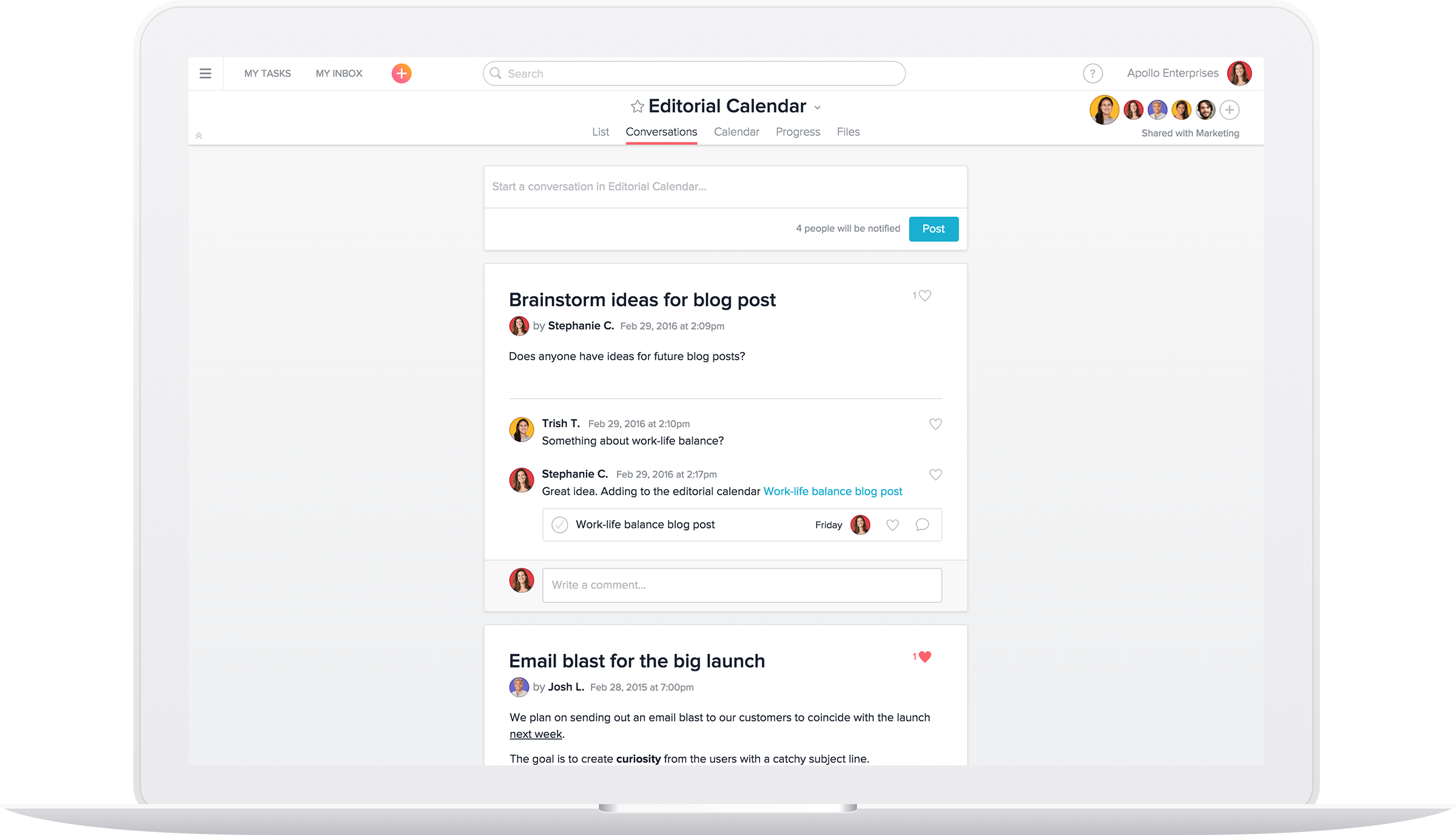
Asana is a web and mobile project management app. With tasks, projects, conversations, and dashboards, Asana lets an entire team know who's doing what by when, enabling workload balancing. Users can also add integrations for GANTT charts, time tracking and more.
$13.49
per month per user
Things
Score 9.0 out of 10
N/A
N/A
$9.99
one-time fee
Pricing
Asana
Things
Editions & Modules
Starter
$13.49
per month per user
Advanced
$30.49
per month per user
Enterprise
Contact Sales
Personal
Free
For iPhone & Watch
$9.99
one-time fee
For iPad
$19.99
one-time fee
For Mac
$49.99
one-time fee
Offerings
Pricing Offerings
Asana
Things
Free Trial
Yes
Yes
Free/Freemium Version
Yes
No
Premium Consulting/Integration Services
Yes
No
Entry-level Setup Fee
Optional
No setup fee
Additional Details
A discount is offered for annual billing.
—
More Pricing Information
Community Pulse
Asana
Things
Features
Asana
Things
Project Management
Comparison of Project Management features of Product A and Product B
Asana
8.4
179 Ratings
9% above category average
Things
-
Ratings
Task Management
9.2179 Ratings
00 Ratings
Resource Management
8.1152 Ratings
00 Ratings
Gantt Charts
9.261 Ratings
00 Ratings
Scheduling
8.4162 Ratings
00 Ratings
Workflow Automation
9.2132 Ratings
00 Ratings
Team Collaboration
9.4178 Ratings
00 Ratings
Support for Agile Methodology
8.57 Ratings
00 Ratings
Support for Waterfall Methodology
8.57 Ratings
00 Ratings
Document Management
8.6150 Ratings
00 Ratings
Email integration
8.6142 Ratings
00 Ratings
Mobile Access
8.8149 Ratings
00 Ratings
Timesheet Tracking
6.16 Ratings
00 Ratings
Change request and Case Management
8.44 Ratings
00 Ratings
Budget and Expense Management
7.277 Ratings
00 Ratings
Professional Services Automation
Comparison of Professional Services Automation features of Product A and Product B
The usability of Asana is broad since it's available in a variety of platforms that are widely used nowadays. I think that it would be great for people who are constantly on the move and switching devices, since it has allowed me to work from my phone, too. I also think that Asana has proven itself to handle a large quantity of work
It's great for everyday use, whether you adhere to the GTD regimen fully or just need a way to quickly capture and sort your tasks. However, it may be less suited if you're looking for a task manager that lets you collaborate with others or if you want to visualize your tasks in other ways, like a Gantt chart.
Through it, we were able to communicate and cooperate with the rest of the team to complete the work in the required manner and at the appropriate time.
It is very user-friendly. Takes a new employee an hour to start figuring out how the system works. That's an important factor. You don't want to encounter the issue where employees need a week to understand how the system works. For example, JIRA, I tried using it for a week and I still don't understand the complicated layout. Asana has a simple interface. Once you see it, you get it type of program.
The interface of Things was good 10 years ago, and has been refined ever since. It's lightweight, while still being readable and showing just the information you need to see. Also, something I haven't seen in any other (of my) app(s) is the keyboard shortcut/launcher, where you start typing a letter, and a dropdown menu lets you quickly jump to a view.
I haven't had to use their support so I can't rate it. The fact that I haven't needed them reflects the ease of use of the product. I would recommend that any new users schedule a complete demo of the product to ensure that they are using it to it's fullest (there's a lot of useful features).
Asana is a top-tier project management software that helps us organize and track projects from start to finish. It allows us to apply tasks/to-dos to multiple projects without duplication, divide complex projects into smaller tasks, and track project progress. It also helps us organize work on Kanban boards or linear lists. It stands out from the crowd in a big way compared to the competition.
I've tried numerous to-do apps, some that never even go out of beta. But I kept returning to Things, mostly for the user experience. It's unobtrusive and fast to use, and it looks fantastic, which is more important than I first realized. To become more organized, my app of choice needs to look organized. Also, many competing solutions are trying to force you into one way of using their app, while Things feels more open to letting you define your way of working with task management.