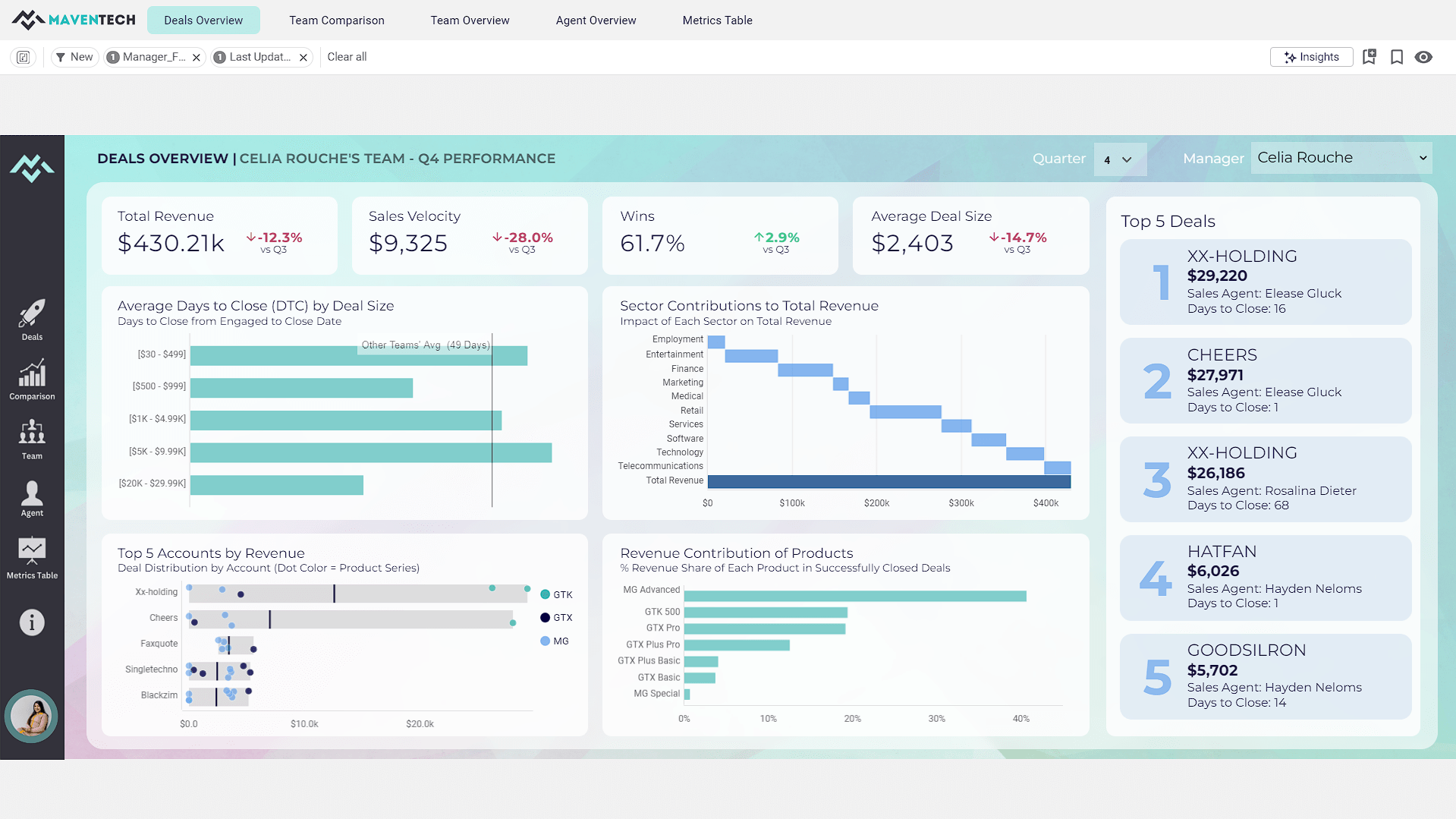
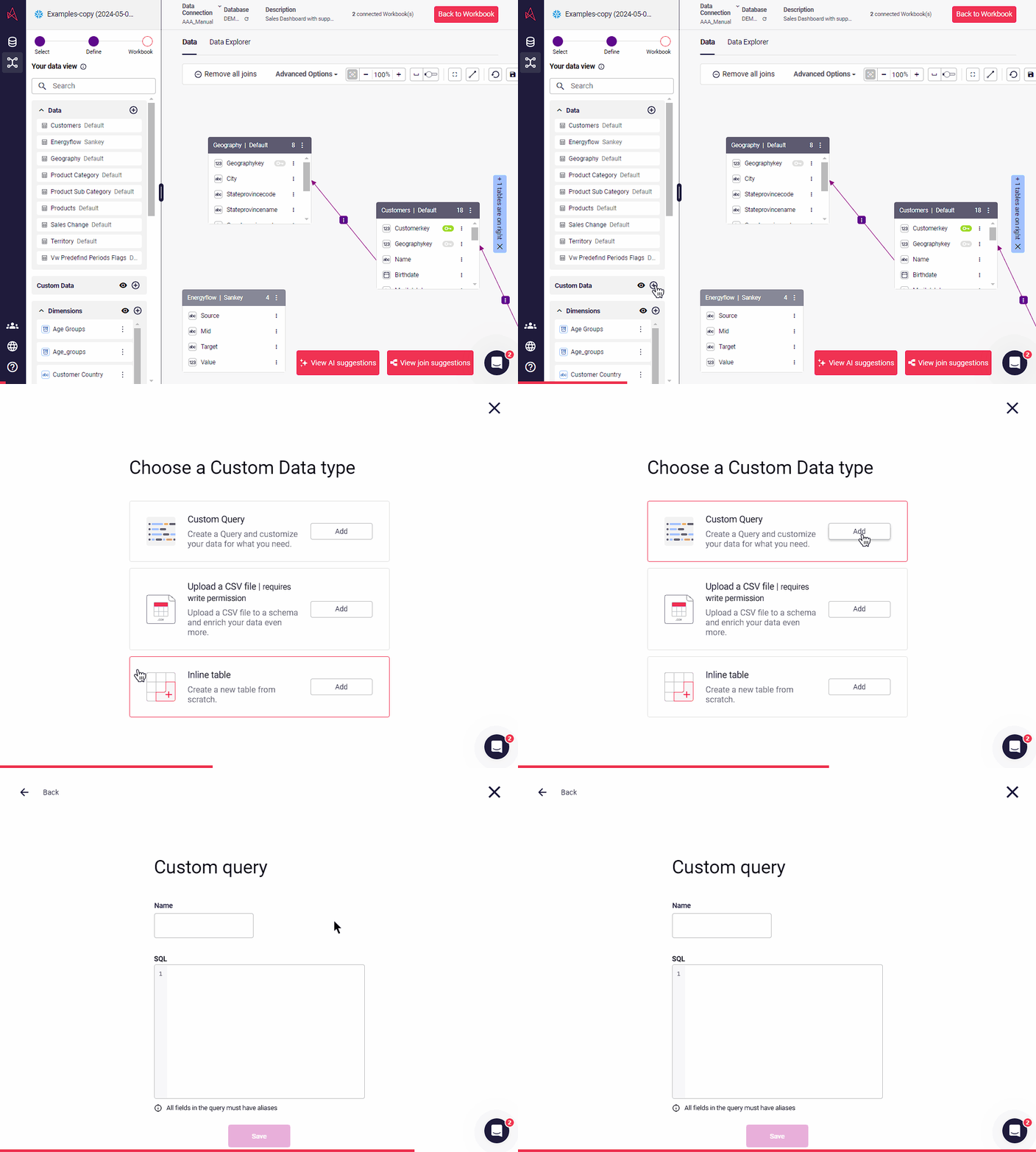
A self-service BI solution, Astrato puts analytics in the hands of every user, enabling them to build their own reports and answer data questions without IT help. Astrato accelerates adoption, speeds up decision-making, and unifies analytics, embedded analytics, data input, and data apps in one platform. With Astrato, Self-Service business users can see and understand data that resides in the Data Cloud (Snowflake, Databricks, BigQuery, Redshift, Dremio,…
$12
per month per user
Microsoft Power BI
Score 8.5 out of 10
N/A
Microsoft Power BI is a visualization and data discovery tool from Microsoft. It allows users to convert data into visuals and graphics, visually explore and analyze data, collaborate on interactive dashboards and reports, and scale across their organization with built-in governance and security.
$168
per year per user
Mathematica
Score 7.0 out of 10
N/A
Wolfram's flagship product Mathematica is a modern technical computing application featuring a flexible symbolic coding language and a wide array of graphing and data visualization capabilities.
$1,520
per year
Pricing
Astrato Analytics
Microsoft Power BI
Wolfram Mathematica
Editions & Modules
No answers on this topic
Power BI Pro
$14
per month (billed annually) per user
Power BI Premium
$24
per month (billed annually) per user
Standard Cloud
$1,520
per year
Standard Desktop
$3,040
one-time fee
Standard Desktop & Cloud
$3,344
one-time fee
Mathematica Enterprise Edition
$8,150.00
one-time fee
Offerings
Pricing Offerings
Astrato Analytics
Microsoft Power BI
Mathematica
Free Trial
Yes
Yes
No
Free/Freemium Version
No
Yes
No
Premium Consulting/Integration Services
Yes
No
No
Entry-level Setup Fee
Optional
No setup fee
No setup fee
Additional Details
—
Power BI Desktop is the data exploration and report authoring experience for Power BI, and is available as a free download.
Discounts available for students and educational institutions. The Network Edition reduce per-user license costs through shared deployment across any number of machines on a local-area network.
To scale PowerBi, we would have needed a staff of technical folks and a substantial budget, and we still probably could not have created the robust SaaS application we did with Astrato Analytics. Astrato Analytics allowed for a staff of two to create and rollout a SaaS …
Astrato is a cloud-native tool with the ability to manage an effortless live connection to modern cloud data warehouses for real time updates. This sets them apart from legacy platforms which are desktop-centric. Astrato is also capable of a level of dashboard graphics quality …
Microsoft Power BI
No answer on this topic
Mathematica
No answer on this topic
Features
Astrato Analytics
Microsoft Power BI
Wolfram Mathematica
BI Standard Reporting
Comparison of BI Standard Reporting features of Product A and Product B
Astrato Analytics
7.9
4 Ratings
4% below category average
Microsoft Power BI
8.2
198 Ratings
0% above category average
Wolfram Mathematica
9.9
6 Ratings
20% above category average
Pixel Perfect reports
8.04 Ratings
8.2169 Ratings
9.84 Ratings
Customizable dashboards
8.54 Ratings
8.7197 Ratings
9.94 Ratings
Report Formatting Templates
7.24 Ratings
7.8180 Ratings
9.96 Ratings
Ad-hoc Reporting
Comparison of Ad-hoc Reporting features of Product A and Product B
Astrato Analytics
7.9
4 Ratings
2% below category average
Microsoft Power BI
7.9
196 Ratings
2% below category average
Wolfram Mathematica
9.9
9 Ratings
24% above category average
Drill-down analysis
8.34 Ratings
8.3193 Ratings
9.98 Ratings
Formatting capabilities
7.04 Ratings
7.7193 Ratings
9.98 Ratings
Integration with R or other statistical packages
7.62 Ratings
7.4143 Ratings
9.97 Ratings
Report sharing and collaboration
8.64 Ratings
8.3191 Ratings
9.99 Ratings
Report Output and Scheduling
Comparison of Report Output and Scheduling features of Product A and Product B
Astrato Analytics
8.8
4 Ratings
7% above category average
Microsoft Power BI
8.0
189 Ratings
3% below category average
Wolfram Mathematica
9.3
8 Ratings
13% above category average
Publish to Web
9.24 Ratings
8.1179 Ratings
9.97 Ratings
Publish to PDF
9.73 Ratings
7.9174 Ratings
9.08 Ratings
Report Versioning
7.94 Ratings
7.7145 Ratings
9.97 Ratings
Report Delivery Scheduling
8.33 Ratings
8.3148 Ratings
8.95 Ratings
Delivery to Remote Servers
00 Ratings
7.9111 Ratings
8.95 Ratings
Data Discovery and Visualization
Comparison of Data Discovery and Visualization features of Product A and Product B
Astrato Analytics provides a feature-rich application that it easy to use for the non-technical user yet robust enough to create a sophisticated SaaS application. Astrato Analytics provides native integration to all the major large cloud data platforms and the implementation is very straight forward. The value provided through their feature-rich platform and competitive pricing is unmatched.
Has significantly improved collation of data and visualisation especially with business across Europe. Has given me the ability to see the Site availability at the click of a button to see which Site is in the "money" and seize opportunities based on Market data
We are the judgement that Wolfram Mathematica is despite many critics based on the paradigms selected a mark in the fields of the markets for computations of all kind. Wolfram Mathematica is even a choice in fields where other bolide systems reign most of the market. Wolfram Mathematica offers rich flexibility and internally standardizes the right methodologies for his user community. Wolfram Mathematica is not cheap and in need of a hard an long learner journey. That makes it weak in comparison with of-the-shelf-solution packages or even other programming languages. But for systematization of methods Wolfram Mathematica is far in front of almost all the other. Scientist and interested people are able to develop themself further and Wolfram Matheamatica users are a human variant for themself. The reach out for modern mathematics based science is deep and a unique unified framework makes the whole field of mathematics accessable comparable to the brain of Albert Einstein. The paradigms incorporated are the most efficients and consist in assembly on the market. The mathematics is covering and fullfills not just education requirements but the demands and needs of experts.
Mathematica is incompatible with other systems for mCAx and therefore the borders between the systems are hard to overcome. Wolfram Mathematica should be consider one of the more open systems because other code can be imported and run but on the export side it is rathe incompatible by design purposes. A better standard for all that might solve the crisis but there is none in sight. Selection of knowledge of what works will be in the future even more focussed and general system might be one the lossy side. Knowledge of esthetics of what will be in the highest demand in necessary and Wolfram is not a leader in this field of science. Mathematics leves from gathering problems from application fields and less from the glory of itself and the formalization of this.
Writeback to the database is simple and straightforward and allows us to build apps in the tool with a level of interation that is not possible with other BI tools
Version control that is built into the workbooks allows us to quickly deploy changes without the fear of losing the older version and maintianing both a historcal updates and the ability to rollback
Easy connectivity to a wide range of data platforms including Snowflake, Databricks, and Google Workspace within the same tenant allows us to leverage data from each of these platforms for specific use cases
Options for data source connections are immense. Not just which sources, but your options for *how* the data is brought in.
Constant updates (this is both good and bad at times).
User friendliness. I can get the data connections set up and draft some quick visuals, then release to the target audience and let them expand on it how they want to.
It allows straightforward integration of analytic analysis of algebraic expressions and their numerical implemented.
Supports varying programmatic paradigms, so one can choose what best fits the problem or task: pure functions, procedural programming, list processing, and even (with a bit of setup) object-oriented programming.
The extensive and rich tools for graphical rendering make it very easy to not just get 2D and 3D renderings of final output, but also to do quick-and-dirty 2D and 3D rendering of intermediate results and/or debugging results.
The product is still young, as a consequence, some features aren't as mature as competitors. Astrato has worked to catch up quickly, by rolling out new features regularly
Better ability to control icons and themes from a central point, instead of having to add/change them on each report
Microsoft Power BI is an excellent and scalable tool. It has a learning curve, but once you get past that, the sky is the limit and you can build from the most simple to the most complex dashboards. I have built everything from simple reports with only a few data points to complex reports with many pages and advanced filtering.
It is a very intuitive system, a pleasure to use, practical and simple, for medium to advanced activities. BI supervisors are delighted with much of the functionality, but highlight some weaknesses that they still have, such as the loading speed in HEIC-type files.
Without a doubt, it is a tool that has become essential in our business routine.
Automating reporting has reduced manual data processing by 50-70%, freeing up analysts for higher-value tasks. A finance team that previously spent 20+ hours per week on Excel-based reports now does it in minutes with Microsoft Power BI's automated Real-time dashboards have shortened decision cycles by 30-40%, enabling leadership to react quickly to sales trends, operational bottlenecks, and customer behavior.
It is a fantastic tool, you can do almost everything related with data and reports, it is a perfect substitutive of Power Point and Excel with a high evolution and flexibility, and also it is very friendly and easy to share. I think all companies should have Power BI (or other BI tool) in their software package and if they are in the MS Suite, for sure Power BI should be the one due to all the benefits of the MS ecosystem.
Wolfram Mathematica is a nice software package. It has very nice features and easy to install and use in your machine. Besides this, there is a nice support from Wolfram. They come to the university frequently to give seminars in Mathematica. I think this is the best thing they are doing. That is very helpful for graduate and undergraduate students who are using Mathematica in their research.
To scale PowerBi, we would have needed a staff of technical folks and a substantial budget, and we still probably could not have created the robust SaaS application we did with Astrato Analytics. Astrato Analytics allowed for a staff of two to create and rollout a SaaS Application in under 60 days and provided hands on support to us as needed. There really is no comparison.
Microsoft Power BI is free. If I didn't want to create a custom platform (i.e. my organization insisted on an existing platform that I *had* to use), I'd use Microsoft Power BI. For any start-up or SMB, I'd just use Claude & Grok to build it quickly, also for free. Would not pay for Tableau or Sigma anymore. Not worth it at all.
We have evaluated and are using in some cases the Python language in concert with the Jupyter notebook interface. For UI, we using libraries like React to create visually stunning visualizations of such models. Mathematica compares favorably to this alternative in terms of speed of development. Mathematica compares unfavorably to this alternative in terms of license costs.