Aurea Process (formerly CX Process) from Aurea Software in Austin is a business process management offering, based on Savvion BPM.
$200,000
per year
Camunda
Score 7.9 out of 10
N/A
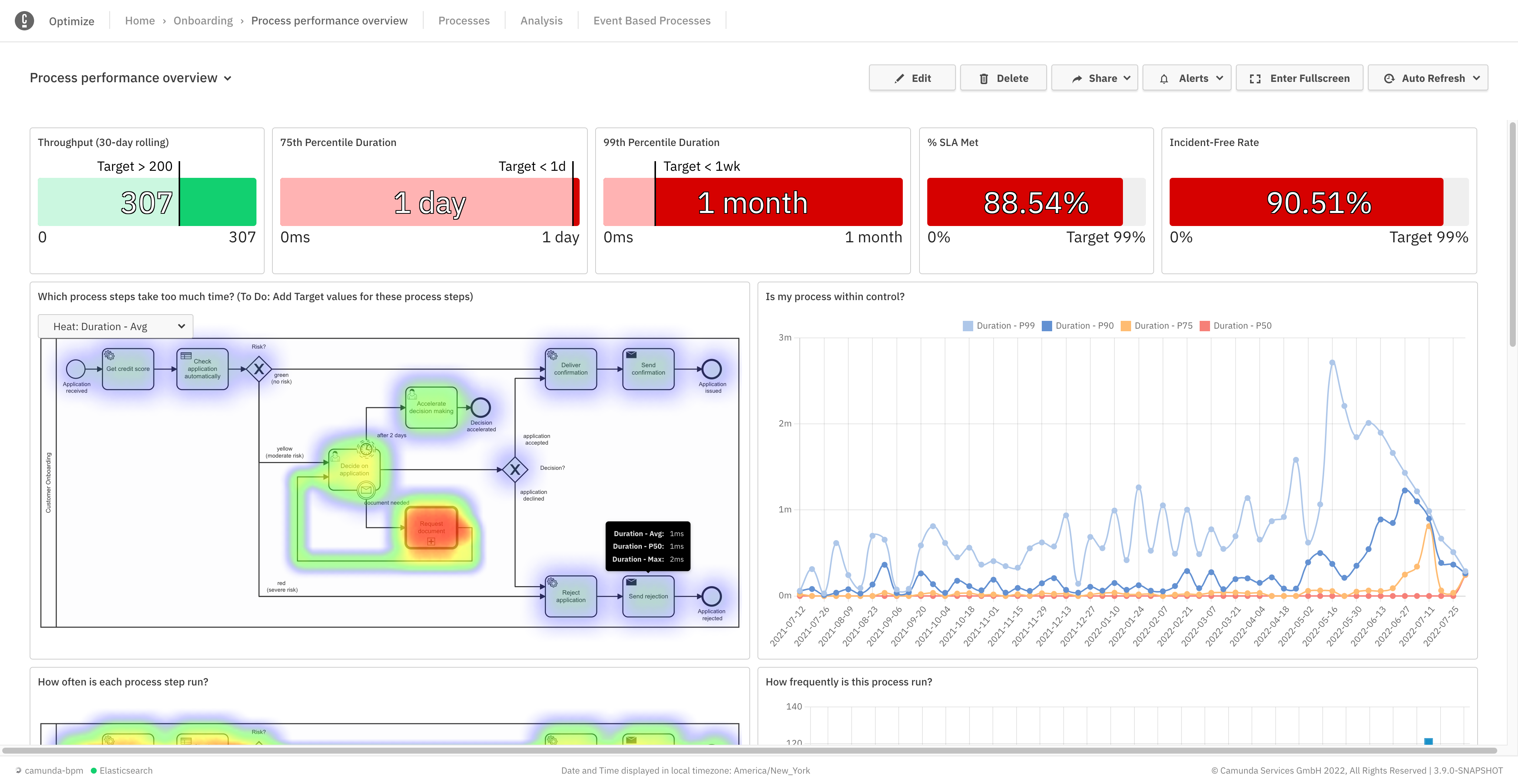
Camunda is a process orchestration tool designed to help organizations design, automate, and improve any process. Built for business and IT collaboration using BPMN and DMN standards, Camunda aims to enable seamless integration across endpoints to transform mission-critical processes.
N/A
SAP BPM
Score 7.0 out of 10
N/A
SAP NetWeaver Business Process Management is a business process management offering and application infrastructure. It supports joint modeling of processes, central process execution via a Java-based engine, provision of interfaces for users, and integration of business rules into processes.
I found the initial setup of NetWeaver is much simpler than other products especially in an SAP environment where we have SAP ERP/HRM/CRM as it can be well integrated with other SAP products. The only drawback is the need/dependency on SAP Portal. It is better suited in an …
The tool has potential. Its capabilities and visual aspects could be considered rather basic but this might improve, particularly if the business intelligence/analytics aspect is leveraged. Once running well, it could allow (perhaps smaller) companies to successfully improve their customers' experiences through digitalizing customer journey - and we all know that customer loyalty goes a long way. However, whether or not the tool is comprehensive enough to deliver this for larger companies with more complex, multi- and omni-channel interactions is yet to be seen...
Camunda Platform is well suited for scenarios where there are different stages in a business flow and the flow is driven by user action at each stage. For example placing of an order on an ecommerce platform. Depending on whether user was able to make the payment or not the workflow would go to dispatch or retry stage. Now the retry stage would trigger further actions like sending follow up emails etc. Likewise, dispatch stage would have a different set of actions. Since every order is important and we need to know where it stands, using Camunda Platform is imperative. Camunda Platform might not be a right choice where just a one off thing needs to be done. For example, uploading of product information by user or periodic processing of heavy images by a worker. These are all either one step processes or periodic automated processes where we can track the status without using a business modeler like Camunda Platform.
It is well suited when we need to integrate business processes with SAP ERP and SAP CRM - the solution can be integrated with business rules/procedures defined in SAP ERP/CRM and NetWeaver can be used to monitor the rules and flag off exceptions. When there are multiple workflows running, it tends to slow down running of these processes. Also, it entirely depends on SAP portal for it to run efficiently.
We have our own tech support for systems, I would say they probably could use more training on it, I don't really think it's anything regarding the SAP system, but more the knowledge they have on the system itself. It seems to take longer for them to fix any issues we may come across.
Lacks good documentation. Training and documentation is geared towards those who are already technically adept. Does not have as many data integrations as other full fledged products. Paid version of Camunda is not as fully fledged as other products.
I found the initial setup of NetWeaver is much simpler than other products especially in an SAP environment where we have SAP ERP/HRM/CRM as it can be well integrated with other SAP products. The only drawback is the need/dependency on SAP Portal. It is better suited in an environment where SAP ERP is running.
As our customers vary in size and maturity, the ROI ranges accordingly.
For younger, smaller businesses this is a useful tool. Digitalization of he customer journey has certainly helped save time and efforts in many cases.
For more mature market players the tool is not always comprehensive enough. Dashboard and report personalization take time and efforts, and sometimes it feels that a dedicated BI tool would be a more suitable solution.
The positive impact is that we are able to ensure the business process is being followed and that results in orders getting processed successfully leading to customer satisfaction and revenue
Another positive impact is that we are able to track any anomalies and any errors in the order flow and retry them so that users don't have a negative experience.
A negative point is that it is an overhead to maintain so there is significant engineering effort getting invested there