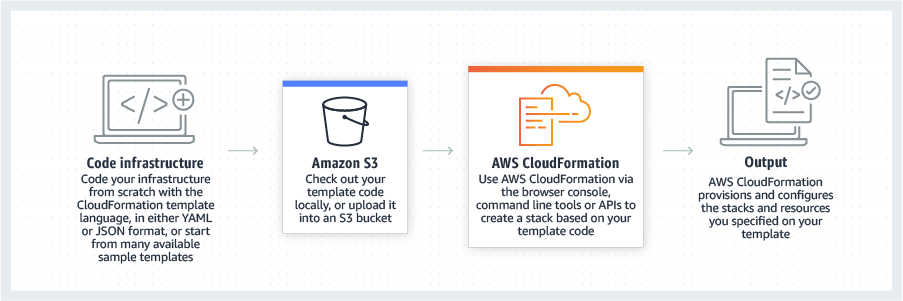
AWS CloudFormation gives developers and systems administrators a way to create and manage a collection of related AWS resources, provisioning and updating them in a predictable fashion. Use AWS CloudFormation’s sample templates or create templates to describe the AWS resources, and any associated dependencies or runtime parameters, required to run an application. Users don’t need to figure out the order for provisioning AWS services or the subtleties of making those dependencies work.…
$0
Cisco Intersight
Score8.9 out of 10
N/A
Cisco Intersight is an operations platform that helps IT operations teams control and automate Cisco UCS, converged, and hyperconverged infrastructure. Intersight consolidates and automates infrastructure lifecycle management from data centers to the edge in one solution delivered as-a-service.
N/A
Pricing
AWS CloudFormation
Cisco Intersight
Editions & Modules
Free Tier - 1,000 Handler Operations per Month per Account
$0.00
Handler Operation
$0.0009
per handler operation
No answers on this topic
Offerings
Pricing Offerings
AWS CloudFormation
Cisco Intersight
Free Trial
Yes
Yes
Free/Freemium Version
Yes
No
Premium Consulting/Integration Services
Yes
No
Entry-level Setup Fee
No setup fee
No setup fee
Additional Details
There is no additional charge for using AWS CloudFormation with resource providers in the following namespaces: AWS::*, Alexa::*, and Custom::*. In this case you pay for AWS resources (such as Amazon EC2 instances, Elastic Load Balancing load balancers, etc.) created using AWS CloudFormation as if you created them manually. You only pay for what you use, as you use it; there are no minimum fees and no required upfront commitments.
When you use resource providers with AWS CloudFormation outside the namespaces mentioned above, you incur charges per handler operation. Handler operations are create, update, delete, read, or list actions on a resource.
Senior Network Engineer in Engineering at London Stock Exchange Group (Financial Services, 10,001+ employees)
Chose Cisco Intersight
Since Cisco Intersight Infrastructure Service is cloud-delivered, there is a great deal of flexibility found in this platform, including the ability to manage infrastructure from anywhere at any time. Cisco is also able to continually upgrade, modify, and enhance this platform, …
A de minimis incentive was given to thank the reviewer for their time. The incentive was not used to bias or drive a particular response, nor was the incentive contingent on a positive endorsement. More Info
I still give it an 8 because it's one of those tools that just quietly does the heavy lifting for you but it can really test your patience when it breaks esp with deep nested stacks. It's perfect for projects where we need clean consistent environments every time. It's less ideal for quick experimental setups like new EC2 configs or Lambda permission tweaks.
A de minimis incentive was given to thank the reviewer for their time. The incentive was not used to bias or drive a particular response, nor was the incentive contingent on a positive endorsement. More Info
It is highly suited for an organisation pushing for a standardised and centralised configuration of settings using policies, profiles and templates. It is highly suited for customers used to legacy UMM that need to refresh their environment, but instead of deploying them in UMM (which is still possible), to take the time and effort to learn Cisco Intersight Infrastructure Service and IMM as well as familiarise themselves with the differences between UMM and IMM, and the issues in UMM which IMM addresses and improves upon. We deployed in UMM initially then transitioned to IMM with the transition too. I cannot think of a scenario where Cisco Intersight Infrastructure Service would not be suited. Even for small-scale deployments, it provides significant benefits. Maybe if you come from another server vendor management environment, the learning curve may feel steep (e.g. many new concepts and constructs that one has to master).
A de minimis incentive was given to thank the reviewer for their time. The incentive was not used to bias or drive a particular response, nor was the incentive contingent on a positive endorsement. More Info
A de minimis incentive was given to thank the reviewer for their time. The incentive was not used to bias or drive a particular response, nor was the incentive contingent on a positive endorsement. More Info
A de minimis incentive was given to thank the reviewer for their time. The incentive was not used to bias or drive a particular response, nor was the incentive contingent on a positive endorsement. More Info
It would be great to not having to create EVERY profile within a deployment. since some items can be done be default, the defaults should be set and the deployment can be much faster.
When adding Rack servers, indicating that the CIMC interface should not being connected before powering on the system and they it will be managed by Cisco Intersight can reduce down times. We had to manually reset our CIMC after disconnecting from our OOBM switches.
A de minimis incentive was given to thank the reviewer for their time. The incentive was not used to bias or drive a particular response, nor was the incentive contingent on a positive endorsement. More Info
Been using Cisco Software as a service (SaaS) platform in a production environment for a large medical and health professionals that has critical healthcare and patients care dependency.
Support team is very helpful getting system updated as needed, and vendor support is fantastic. Also get a dedicated Cisco networking engine to review and advise system health and recommendations.
A de minimis incentive was given to thank the reviewer for their time. The incentive was not used to bias or drive a particular response, nor was the incentive contingent on a positive endorsement. More Info
It's easy enough to get a shared template & apply it. You don't even have to download-then-upload or copy-and-paste, a publicly-accessible url works.
Diving deeper, it has enough powerful capabilities to make the life of a platform / DevOps engineer bearable.
However, you need equally deep knowledge to troubleshoot issues, when they inevitably pop up. This is the same for all IaC technologies, as they are additional abstraction layers on top of the native API provided by the cloud providers.
A de minimis incentive was given to thank the reviewer for their time. The incentive was not used to bias or drive a particular response, nor was the incentive contingent on a positive endorsement. More Info
Usability of Cisco Intersight is highly dependent on the licensing purchased. The default (free) license level provides a lot of value for the minimal amount of effort to implement. The paid license levels provide additional features (detailed inventory, configuration management and deployment, etc.)
A de minimis incentive was given to thank the reviewer for their time. The incentive was not used to bias or drive a particular response, nor was the incentive contingent on a positive endorsement. TR verified that a representative sample of customers was invited. More Info
A de minimis incentive was given to thank the reviewer for their time. The incentive was not used to bias or drive a particular response, nor was the incentive contingent on a positive endorsement. More Info
A de minimis incentive was given to thank the reviewer for their time. The incentive was not used to bias or drive a particular response, nor was the incentive contingent on a positive endorsement. More Info
I have had servers TAC cases open for issues with Cisco Intersight. Some have yet to be resolved. One case that is still open is where the HCL status ( Hardware Compatibility List ) shows not validated when It should be. We have several servers that have the exact same hardware, OS, and the same firmware. One server will show the HCL is not validated but all others will
A de minimis incentive was given to thank the reviewer for their time. The incentive was not used to bias or drive a particular response, nor was the incentive contingent on a positive endorsement. More Info
A de minimis incentive was given to thank the reviewer for their time. The incentive was not used to bias or drive a particular response, nor was the incentive contingent on a positive endorsement. More Info
A de minimis incentive was given to thank the reviewer for their time. The incentive was not used to bias or drive a particular response, nor was the incentive contingent on a positive endorsement. More Info
Cloning a virtual machine creates a virtual machine that is cloning a virtual machine creates a virtual machine that is a copy of the original. The new virtual machine is configured with the same virtual hardware, installed software, and other properties that were configured for the original virtual machine. For information about persistent memory and PMem storage, see the vSphere Cloning a virtual machine creates a virtual machine that is a copy of the original. The new virtual machine is configured with the same virtual hardware, installed software, and other properties that were configured for the original virtual machine. For information. Management guide.For information copy of the original. The new virtual Cloning virtual machine creates a virtual machine that is a copy of the original. The new virtual machine is configured with the same virtual hardware, installed software, and other properties that were configured for the original virtual machine. For information about persistent memory and PMem storage, see the vSphere Resource Management Guide. For information is configured with the same virtual hardware, installed software, and other properties that were configured for the original virtual machine. For information about persistent memory and PMem storage, see the vSphere Resource Management Guide. For information
A de minimis incentive was given to thank the reviewer for their time. The incentive was not used to bias or drive a particular response, nor was the incentive contingent on a positive endorsement. TR verified that a representative sample of customers was invited. More Info
I personally think that Cisco Intersight Infrastructure Service is at the top of its class when it comes to managing data center hardware. The cloud-connected design feels very modern and easy to use. The mobile app is something I wouldn't expect to get in a server management tool. The way it can update, monitor, and manage our servers is very nice. Overall, we are very happy with it.
A de minimis incentive was given to thank the reviewer for their time. The incentive was not used to bias or drive a particular response, nor was the incentive contingent on a positive endorsement. TR verified that a representative sample of customers was invited. More Info
Contract terms is similar to other Cisco subscription model, option from 1 year till 5 years. Billing frequency can be monthly, quarterly, annual or prepaid. I think I would not suggest anything regarding contract terms
A de minimis incentive was given to thank the reviewer for their time. The incentive was not used to bias or drive a particular response, nor was the incentive contingent on a positive endorsement. More Info
A de minimis incentive was given to thank the reviewer for their time. The incentive was not used to bias or drive a particular response, nor was the incentive contingent on a positive endorsement. More Info
The negative thing is that we prefer to use the UCS Manager in our company because this bare metal is integrated into the FI and no extra appliance is required. SaaS is generally not viewed favorably in Germany.
Telling the user that they have to buy Intersight licenses even if they use UCS Manager annoys our customers.
A de minimis incentive was given to thank the reviewer for their time. The incentive was not used to bias or drive a particular response, nor was the incentive contingent on a positive endorsement. More Info