AWS Glue is a managed extract, transform, and load (ETL) service designed to make it easy for customers to prepare and load data for analytics. With it, users can create and run an ETL job in the AWS Management Console. Users point AWS Glue to data stored on AWS, and AWS Glue discovers data and stores the associated metadata (e.g. table definition and schema) in the AWS Glue Data Catalog. Once cataloged, data is immediately searchable, queryable, and available for ETL.
$0.44
billed per second, 1 minute minimum
Azure Data Factory
Score 8.2 out of 10
N/A
Microsoft's Azure Data Factory is a service built for all data integration needs and skill levels. It is designed to allow the user to easily construct ETL and ELT processes code-free within the intuitive visual environment, or write one's own code. Visually integrate data sources using more than 80 natively built and maintenance-free connectors at no added cost. Focus on data—the serverless integration service does the rest.
N/A
Matillion
Score 8.5 out of 10
N/A
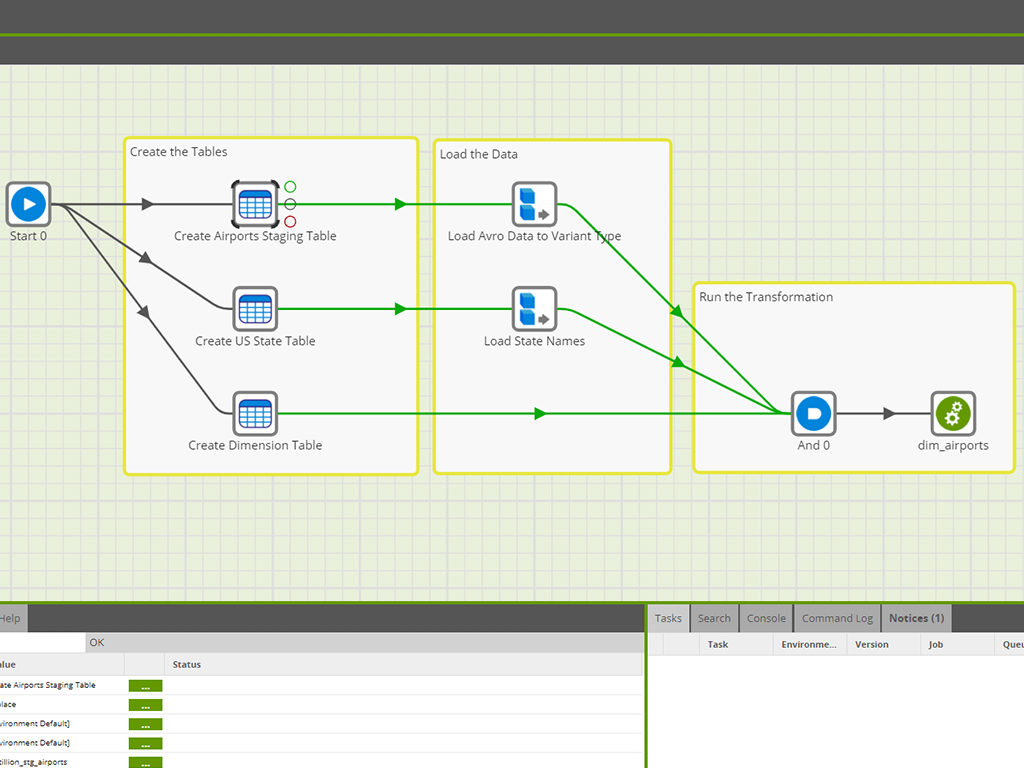
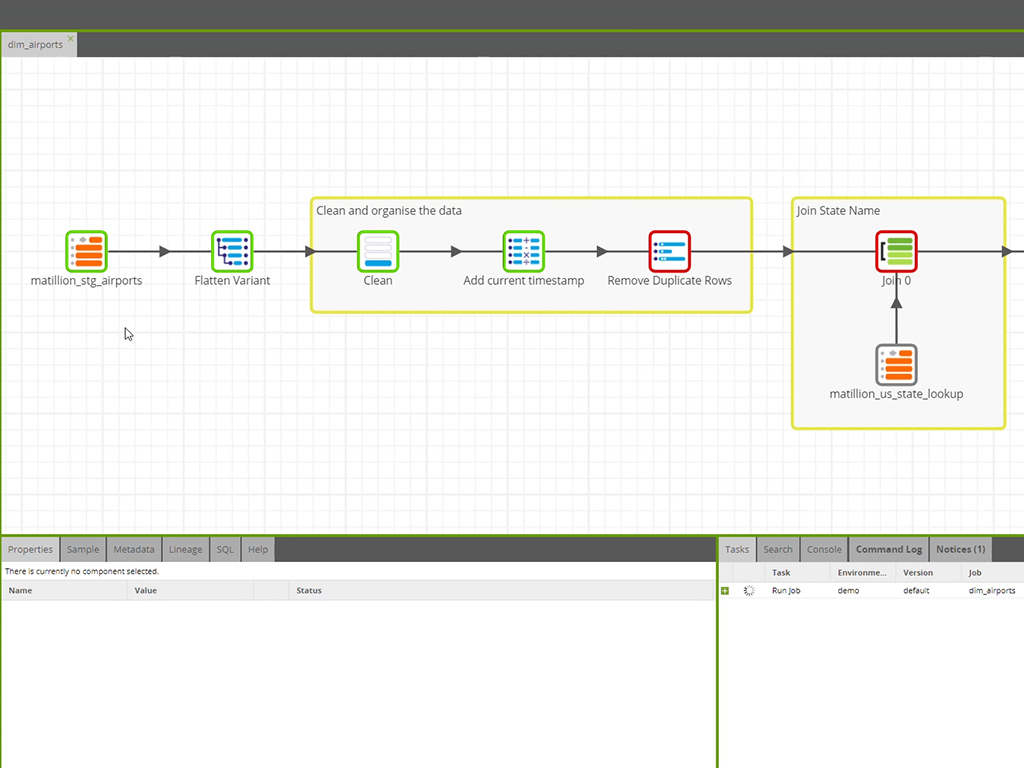
Matillion is a data pipeline platform used to build and manage pipelines. Matillion empowers data teams with no-code and AI capabilities to be more productive, integrating data wherever it lives and delivering data that’s ready for AI and analytics.
$2.50
Pay as you go per user
Pricing
AWS Glue
Azure Data Factory
Matillion
Editions & Modules
per DPU-Hour
$0.44
billed per second, 1 minute minimum
No answers on this topic
Developer: For Individuals
$2.50/credit
Pay as you go per user
Basic
$1000
per month 500 prepaid credits (additional credits: $2.18/credit)
Advanced
$2000
per month 750 prepaid credits (additional credits: $2.73/credit)
Enterprise
Request a Quote
Offerings
Pricing Offerings
AWS Glue
Azure Data Factory
Matillion
Free Trial
No
No
Yes
Free/Freemium Version
No
No
No
Premium Consulting/Integration Services
No
No
Yes
Entry-level Setup Fee
No setup fee
No setup fee
No setup fee
Additional Details
—
—
Billed directly via cloud marketplace on an hourly basis, with annual subscriptions available depending on the customer's cloud data warehouse provider.
We are already in AWS services, so AWS glue is the first choice for us. But for the comparison of ETL job making and process time, it's way faster for other services.
Azure Data Factory fits well into our overall systems architecture where we already utilize largely Azure services and also Microsoft based products in the on-premises environment. I think cost structure is also very competitive with Azure Data Factory. Most services provide a …
Azure Data Factory helps us automate to schedule jobs as per customer demands to make ETL triggers when the need arises. Anyone can define the workflow with the Azure Data Factory UI designer tool and easily test the systems. It helped us automate the same workflow with …
Matillion provided much more flexibility than the other products we tested, at a much lower price point. Other products, in my view, had a cleaner/simpler UI but I also felt that they offered much less functionality. A key design pattern we had to deliver was to perform delta …
We decided to move forward with Matillion because it was the best tool among tools that support both ingesting data from a source system to a target database and running transformation workflows on it afterwards. Fivetran and Airbyte only support data ingestion and we had our …
The Matillion selection was not my decision. But I think it's a good enough choice. It is especially valuable that the team can learn Matillion easily and that the project can be understood by the entire team with the visual environment instead of complex ETLs.
Removes most of the complexity around setting up and preparing things. If you could describe with words what needs to be done to move data from A to B, the implementation in Matillion would probably be the most similar in terms of simplicity of understanding what you are doing …
Matillion is much easier to set up and easier to work for the team. Offers a lot more connections which are easier to set up. Environment variables make it easy to set up once and job creation is easy. We use Metadata tables to just loop through the list of tables that need to …
When compared with other technologies , Matillion was cost effective , more scalable and flexible in terms of complexity and components. The licensing cost of Matillion was also less and the flexibility with components helps in implementing complex business logics. The training …
Matillion has better documentation, is easier to pick up on, and is better supported. Glue doe shave pyspark though and might handle Big Data more effectively.
It is much easier to use in terms of GUI capabilities. The only reason we would use an ETL tool other than our own manually written SQL scripts, is to be able to allow other engineers to use it without having one domain expert stuck on the inner working of complex scripts. So …
At that time, ~3 years ago, none of the competitors were as easy to start using as Matillion. As our team was not so experienced with ETL, Matillion was the best and easiest way to get our hands dirty with defining pipelines.
It has a drag-&-drop graphical UI, which makes it easy to connect all the components together. It's very fast to set up from cloud marketplace. It supports many data sources and it also provides a customizable data source component.
One of AWS Glue's most notable features that aid in the creation and transformation of data is its data catalog. Support, scheduling, and the automation of the data schema recognition make it superior to its competitors aside from that. It also integrates perfectly with other AWS tools. The main restriction may be integrated with systems outside of the AWS environment. It functions flawlessly with the current AWS services but not with other goods. Another potential restriction that comes to mind is that glue operates on a spark, which means the engineer needs to be conversant in the language.
Best scenario is for ETL process. The flexibility and connectivity is outstanding. For our environment, SAP data connectivity with Azure Data Factory offers very limited features compared to SAP Data Sphere. Due to the limited modelling capacity of the tool, we use Databricks for data modelling and cleaning. Usage of multiple tools could have been avoided if adf has modelling capabilities.
Great: Need to query simpler APIs, or utilize well known services such as GSheets etc.? Matillion has got some of the best and easiest to use connectors out there. Not so great: Do you need have a competent CI/CD flow that you will be able to update / compare from Matillion as well as other sources at the same time? Good luck, you will need to be extra careful, as you might have to have a deeper dive into your servers Terminal each time you have a git conflict.
It is extremely fast, easy, and self-intuitive. Though it is a suite of services, it requires pretty less time to get control over it.
As it is a managed service, one need not take care of a lot of underlying details. The identification of data schema, code generation, customization, and orchestration of the different job components allows the developers to focus on the core business problem without worrying about infrastructure issues.
It is a pay-as-you-go service. So, there is no need to provide any capacity in advance. So, it makes scheduling much easier.
Granularity of Errors: Sometimes, Azure Data Factory provides error messages that are too generic or vague for us, making it challenging to pinpoint the exact cause of a pipeline failure. Enhanced error messages with more actionable details would greatly assist us as users in debugging their pipelines.
Pipeline Design UI: In my experience, the visual interface for designing pipelines, especially when dealing with complex workflows or numerous activities, can become cluttered. I think a more intuitive and scalable design interface would improve usability. In my opinion, features like zoom, better alignment tools, or grouping capabilities could make managing intricate designs more manageable.
Native Support: While Azure Data Factory does support incremental data loads, in my experience, the setup can be somewhat manual and complex. I think native and more straightforward support for Change Data Capture, especially from popular databases, would simplify the process of capturing and processing only the changed data, making regular data updates more efficient
Matillion is brilliant at importing data -- it would be amazing to have more ways to export data, from emailed exports to API pushes.
Any Python that takes more than a few lines of code requires an external server to run it. It would be great to have more integration (perhaps in a connected virtual environment) to easily integrate customized code.
Troubleshooting server logs requires quite a bit of technical expertise. More human readable detailed error handling would be greatly appreciated.
With the current experience of Matillion, we are likely to renew with the current feature option but will also look for improvement in various areas including scalability and dependability. 1. Connectors: It offers various connectors option but isn't full proof which we will be looking forward as we grow. 2. Scalability: As usage increase, we want Matillion system to be more stable.
While easy to set up and manage monitoring for large datasets, its complexity can be a barrier for new users. Integration with AWS Ecosystem, Managed Monitoring, Dashboards and monitoring tools for AWS Glue are generally easy to set up and maintain, Automated Data Pipelines. Automates data pipeline creation, making it efficient for certain data integration
So far product has performed as expected. We were noticing some performance issues, but they were largely Synapse related. This has led to a shift from Synapse to Databricks. Overall this has delayed our analytic platform. Once databricks becomes fully operational, Azure Data Factory will be critical to our environment and future success.
We are able to bring on new resources and teach them how to use Matillion without having to invest a significant amount of time. We prefer looking for resources with any type of ETL skill-set and feel that they can learn Matillion without problem. In addition, the prebuilt objects cover more than 95% of our use cases and we do not have to build much from scratch.
Amazon responds in good time once the ticket has been generated but needs to generate tickets frequent because very few sample codes are available, and it's not cover all the scenarios.
We have not had need to engage with Microsoft much on Azure Data Factory, but they have been responsive and helpful when needed. This being said, we have not had a major emergency or outage requiring their intervention. The score of seven is a representation that they have done well for now, but have not proved out their support for a significant issue
Overall, I've found Matillion to be responsive and considerate. I feel like they value us as a customer even when I know they have customers who spend more on the product than we do. That speaks to a motive higher than money. They want to make a good product and a good experience for their customers. If I have any complaint, it's that support sometimes feels community-oriented. It isn't always immediately clear to me that my support requests are going to a support engineer and not to the community at large. Usually, though, after a bit of conversation, it's clear that Matillion is watching and responding. And responses are generally quick in coming.
AWS Glue is a fully managed ETL service that automates many ETL tasks, making it easier to set AWS Glue simplifies ETL through a visual interface and automated code generation.
Azure Data Factory helps us automate to schedule jobs as per customer demands to make ETL triggers when the need arises. Anyone can define the workflow with the Azure Data Factory UI designer tool and easily test the systems. It helped us automate the same workflow with programming languages like Python or automation tools like ansible. Numerous options for connectivity be it a database or storage account helps us move data transfer to the cloud or on-premise systems.
Fivetran offers a managed service and pre-configured schemas/models for data loading, which means much less administrative work for initial setup and ongoing maintenance. But it comes at a much higher price tag. So, knowing where your sweet spot is in the build vs. buy spectrum is essential to deciding which tool fits better. For the transformation part, dbt is purely (SQL-) code-based. So, it is mainly whether your developers prefer a GUI or code-based approach.
We're using Matillion on EC2 instances, and we have about 20 projects for our clients in the same instance. Sometimes, we're struggling to manage schedules for all projects because thread management is not visible, and we can't see the process at the instance level.
We are using GLUE for our ETL purpose. it’s ease with other our AWS services makes our ROI, 100% ROI.
One missing piece was compatibility with other data source for which we found a work around and made our data source as S3 only, so our dependencies on other data source is also reducing