Azure Analysis Services vs. IBM Cognos Analytics

Overview
ProductRatingMost Used ByProduct SummaryStarting Price
Azure Analysis Services
Score 8.6 out of 10
N/A
Azure Analysis Services delivers enterprise-grade BI semantic modeling capabilities with the scale, flexibility, and management benefits of the cloud. Azure Analysis Services helps transform complex data into actionable insights. Azure Analysis Services is built on the analytics engine in Microsoft SQL Server Analysis Services.N/A
IBM Cognos Analytics
Score 7.4 out of 10
N/A
IBM Cognos is a full-featured business intelligence suite by IBM, designed for larger deployments. It comprises Query Studio, Reporting Studio, Analysis Studio and Event Studio, and Cognos Administration along with tools for Microsoft Office integration, full-text search, and dashboards.
$11.25
per month per user
Pricing
Azure Analysis ServicesIBM Cognos Analytics
Editions & Modules
No answers on this topic
On Demand - Standard
USD 11.25
per month per user
On Demand - Premium
USD 44.90
per month per user
Offerings
Pricing Offerings
Azure Analysis ServicesIBM Cognos Analytics
Free Trial
NoYes
Free/Freemium Version
NoNo
Premium Consulting/Integration Services
NoYes
Entry-level Setup FeeNo setup feeOptional
Additional Details
More Pricing Information
Community Pulse
Azure Analysis ServicesIBM Cognos Analytics
Features
Azure Analysis ServicesIBM Cognos Analytics
BI Standard Reporting
Comparison of BI Standard Reporting features of Product A and Product B
Azure Analysis Services
8.6
8 Ratings
5% above category average
IBM Cognos Analytics
7.6
131 Ratings
7% below category average
Pixel Perfect reports8.88 Ratings7.5121 Ratings
Customizable dashboards8.77 Ratings7.8127 Ratings
Report Formatting Templates8.58 Ratings7.6123 Ratings
Ad-hoc Reporting
Comparison of Ad-hoc Reporting features of Product A and Product B
Azure Analysis Services
8.8
8 Ratings
9% above category average
IBM Cognos Analytics
7.5
131 Ratings
7% below category average
Drill-down analysis8.96 Ratings6.9128 Ratings
Formatting capabilities8.77 Ratings7.8130 Ratings
Integration with R or other statistical packages8.77 Ratings7.493 Ratings
Report sharing and collaboration9.08 Ratings8.2124 Ratings
Report Output and Scheduling
Comparison of Report Output and Scheduling features of Product A and Product B
Azure Analysis Services
9.0
8 Ratings
9% above category average
IBM Cognos Analytics
8.2
129 Ratings
0% below category average
Publish to Web9.08 Ratings8.327 Ratings
Publish to PDF8.97 Ratings7.8123 Ratings
Report Versioning9.37 Ratings8.626 Ratings
Report Delivery Scheduling9.08 Ratings8.4125 Ratings
Delivery to Remote Servers8.57 Ratings8.112 Ratings
Data Discovery and Visualization
Comparison of Data Discovery and Visualization features of Product A and Product B
Azure Analysis Services
9.0
7 Ratings
12% above category average
IBM Cognos Analytics
7.0
118 Ratings
13% below category average
Pre-built visualization formats (heatmaps, scatter plots etc.)9.46 Ratings7.7113 Ratings
Location Analytics / Geographic Visualization9.07 Ratings7.5108 Ratings
Predictive Analytics8.66 Ratings6.5104 Ratings
Pattern Recognition and Data Mining00 Ratings6.241 Ratings
Access Control and Security
Comparison of Access Control and Security features of Product A and Product B
Azure Analysis Services
9.3
8 Ratings
9% above category average
IBM Cognos Analytics
7.4
123 Ratings
14% below category average
Multi-User Support (named login)9.27 Ratings7.0120 Ratings
Role-Based Security Model9.38 Ratings7.1119 Ratings
Multiple Access Permission Levels (Create, Read, Delete)9.38 Ratings6.7118 Ratings
Single Sign-On (SSO)9.47 Ratings8.2102 Ratings
Report-Level Access Control00 Ratings7.948 Ratings
Mobile Capabilities
Comparison of Mobile Capabilities features of Product A and Product B
Azure Analysis Services
8.6
7 Ratings
11% above category average
IBM Cognos Analytics
6.4
103 Ratings
19% below category average
Responsive Design for Web Access8.47 Ratings6.697 Ratings
Mobile Application9.33 Ratings6.587 Ratings
Dashboard / Report / Visualization Interactivity on Mobile8.35 Ratings6.593 Ratings
Application Program Interfaces (APIs) / Embedding
Comparison of Application Program Interfaces (APIs) / Embedding features of Product A and Product B
Azure Analysis Services
8.8
7 Ratings
13% above category average
IBM Cognos Analytics
7.4
83 Ratings
4% below category average
REST API8.96 Ratings7.180 Ratings
Javascript API8.76 Ratings7.377 Ratings
iFrames8.85 Ratings8.39 Ratings
Java API8.77 Ratings6.911 Ratings
Themeable User Interface (UI)8.34 Ratings7.110 Ratings
Customizable Platform (Open Source)9.33 Ratings7.87 Ratings
User Ratings
Azure Analysis ServicesIBM Cognos Analytics
Likelihood to Recommend
9.0
(9 ratings)
7.7
(148 ratings)
Likelihood to Renew
-
(0 ratings)
8.1
(30 ratings)
Usability
-
(0 ratings)
7.3
(9 ratings)
Availability
-
(0 ratings)
8.6
(4 ratings)
Performance
-
(0 ratings)
9.0
(5 ratings)
Support Rating
-
(0 ratings)
1.0
(9 ratings)
In-Person Training
-
(0 ratings)
8.7
(4 ratings)
Online Training
-
(0 ratings)
8.0
(4 ratings)
Implementation Rating
-
(0 ratings)
7.0
(7 ratings)
Configurability
-
(0 ratings)
7.0
(3 ratings)
Ease of integration
-
(0 ratings)
5.7
(5 ratings)
Product Scalability
-
(0 ratings)
2.7
(4 ratings)
Vendor post-sale
-
(0 ratings)
7.0
(1 ratings)
Vendor pre-sale
-
(0 ratings)
7.0
(1 ratings)
User Testimonials
Azure Analysis ServicesIBM Cognos Analytics
Likelihood to Recommend
Microsoft
We would have many technical issues and glitches with previous similar providers but found that Azure Analysis Services can simply handle our workload and memory better. I remember we lost an account due to cloud issues not fully saving or corrupting some files. Granted, this is rare with any cloud but haven't had that issue with the same load of memory with Azure Analysis Services.
Read full review
IBM
Well suited: Financial reporting - It can handle complex, pixel perfect, muti-page reports with scheduled delivery to stakeholders (like sales report by region on quarterly periodicity) Operational dashboard across departments - It can combine multiple data sources (ERP, CRM, excels etc) with filters, and embedded AI insights Less appropriate: Live dashboards - As stated earlier as well, IBM Cognos Analytics doesn't suit well for live dashboards or event driven data. For ex: live web traffic data or IOT device data, etc Data science - Although IBM Cognos Analytics is great tool for data exploration but it should not be used as a substitute for Python or R, which has edge over advanced modelling and stats based workflows like predictive modelling or clustering
Read full review
Pros
Microsoft
  • Providing role based access or we can say privilege based on the role to the user if it is integrated with Azure active directory and hence securing the access to sensitive data.
  • We use to run different type of analytics services to get the better result which is hectic if done manually or with human efforts.
  • We also use to collect bulk of data with the help of this tool and run customized test cases for better efficiency of result and better decision making. The result are very crucial and helps in taking big decision.
  • It supports different or we can say heterogeneous database vendors like the Oracle, SQL, and hence make the task easy.
Read full review
IBM
  • We can make dozens of dispatchers all focusing on different types of workloads.
  • Friendly user interface, without the need for coding or complicated editing.
  • Highly functionality reporting tools.
  • We can easily create trigger when a certain threshold are met sending reports or alerts to needed parties.
Read full review
Cons
Microsoft
  • There is very least content available on Microsoft docs and the Internet to get through with AAS.
  • i faced lots of connection issues while implementation.
  • The need for serious platform experience or expertise.
Read full review
IBM
  • IBM Cognos Analytics enables customer data segmentation, which is essential for marketing, improving and streamlining purchasing behavior and preferences. This helps companies create more targeted and effective marketing campaigns.
  • Our clients Through data analysis, we can identify and observe trends in the behavior of other clients, allowing us to anticipate needs and adjust strategies to avoid consequences.
Read full review
Likelihood to Renew
Microsoft
No answers on this topic
IBM
For an existing solution, renewing licenses does provide a good return on investment. Additionally, while rolling out scorecards and dashboards with little adhoc capabilities, to end users, cognos is very easily scalable. It also allows to create a solution that has a mix of OLAP and relational data-sources, which is a limitation with other tools. Synchronizing with existing security setup is easy too.
Read full review
Usability
Microsoft
No answers on this topic
IBM
We have a strong user base (3500 users) that are highly utilizing this tool. Basic users are able to consume content within the applied security model. We have a set of advanced users that really push the limits of Cognos with Report and Query Studio. These users have created a lot of personal content and stored it in 'My Reports'. Users enjoy this flexibility.
Read full review
Reliability and Availability
Microsoft
No answers on this topic
IBM
Reports can typically be viewed through any browser that can access the server, so the availability is ultimately up to what the company utilizing it is comfortable with allowing, though report development tends to be more picky about browsers and settings as mentioned above. It also has an optional iPad app and general mobile browsing support, but dashboards lack the mobile compatibility. What keeps it from getting a higher score is the desktop tools that are vital to the development process. The compatibility with only Windows when the server has a wide range of compatibility can be a real sore point for a company that outfits its employees exclusively with Mac or Linux machines. Of course, if they are planning on outsourcing the development anyways, it's a rather moot point
Read full review
Performance
Microsoft
No answers on this topic
IBM
Overall no major complaints but it doesn't handle DMR (Dimensionally Modeled for Relational) very well. DMR modelling is a capability that IBM Cognos Framework Manager provides allowing you to specify dimensional information for relational metadata and allows for OLAP-style queries. However, the capability is not very efficient and, for example, if I'm using only 2 columns on a 20-column model, the software is not smart enough to exclude 18 columns and the query side gets progressively larger and larger until it's effectively unusable.
Read full review
Support Rating
Microsoft
No answers on this topic
IBM
Why is their web application not working as fast as you think it should? They never know, and it is always a a bunch of shots in the dark to find out. Trying to download software from them is like trying to find a book at the library before computers were invented.
Read full review
In-Person Training
Microsoft
No answers on this topic
IBM
Onsite training provided by IBM Cognos was effective and as expected. They did not perform training with our data which was a bit difficult for our end-users.
Read full review
Online Training
Microsoft
No answers on this topic
IBM
The online courses they offer are thorough and presented in such a way that someone who isn't already familiar with the general design methodologies used in this field will be capable of making a good design. The training environments are provided as a fully self contained virtual machine with everything needed already to create the environments. We've had some persisting issues with the environments becoming unavailable, but support has been responsive when these issues arise and straightening them out for us
Read full review
Implementation Rating
Microsoft
No answers on this topic
IBM
Make sure that any custom tables that you have, are built into your metadata packages. You can still access them via SQL queries in Cognos, but it is much easier to have them as a part of the available metadata packages.
Read full review
Alternatives Considered
Microsoft
The platform has vast number of features and modules. The UI is sleek and once you get to use to it, you will be able to do a lot of stuff. Also support for data sources is more in Azure Analysis Services.
Read full review
IBM
Power BI is stronger for quick ad-hoc analysis and dashboards, but IBM Cognos Analytics is better when consistency, precision, and mass distribution matter. Tableau is best for interactive analysis, while IBM Cognos Analytics is better for standardized, repeatable enterprise reporting. Sigma shines for customizable dashboards and drill-down analysis while IBM Cognos Analytics holds an edge in data discovery and visualization.
Read full review
Scalability
Microsoft
No answers on this topic
IBM
The Cognos architecture is well suited for scalability. However, the architecture must be designed with scalability in mind from day one of the implementation. We recently upgraded from 10.1 to 10.2.1 and took the opportunity to revamp our architecture. It is now poised for future growth and scalability.
Read full review
Return on Investment
Microsoft
  • The tool has helped us a lot for taking critical decision which has resulted in the increase of profit of organization by 18 percent.
  • Return on investment is 70 percent as we are unable to utilize the tool with full functionalities, so we are still testing some of the use cases.
  • Human effort has been reduced and task has become automated hence helped in cost management
Read full review
IBM
  • We use the tool for data modeling as it helps in predictive data analysis for complex data, which is very similar to real-life scenarios.
  • Options of customizing & scheduling reports as per our requirements basis.
  • Has mobile application which works seamless.
  • API integration is not upto the mark with very limited options.
  • Licensing & Maintenance can go from cheap to expensive depending on the scope.
Read full review
ScreenShots

IBM Cognos Analytics Screenshots

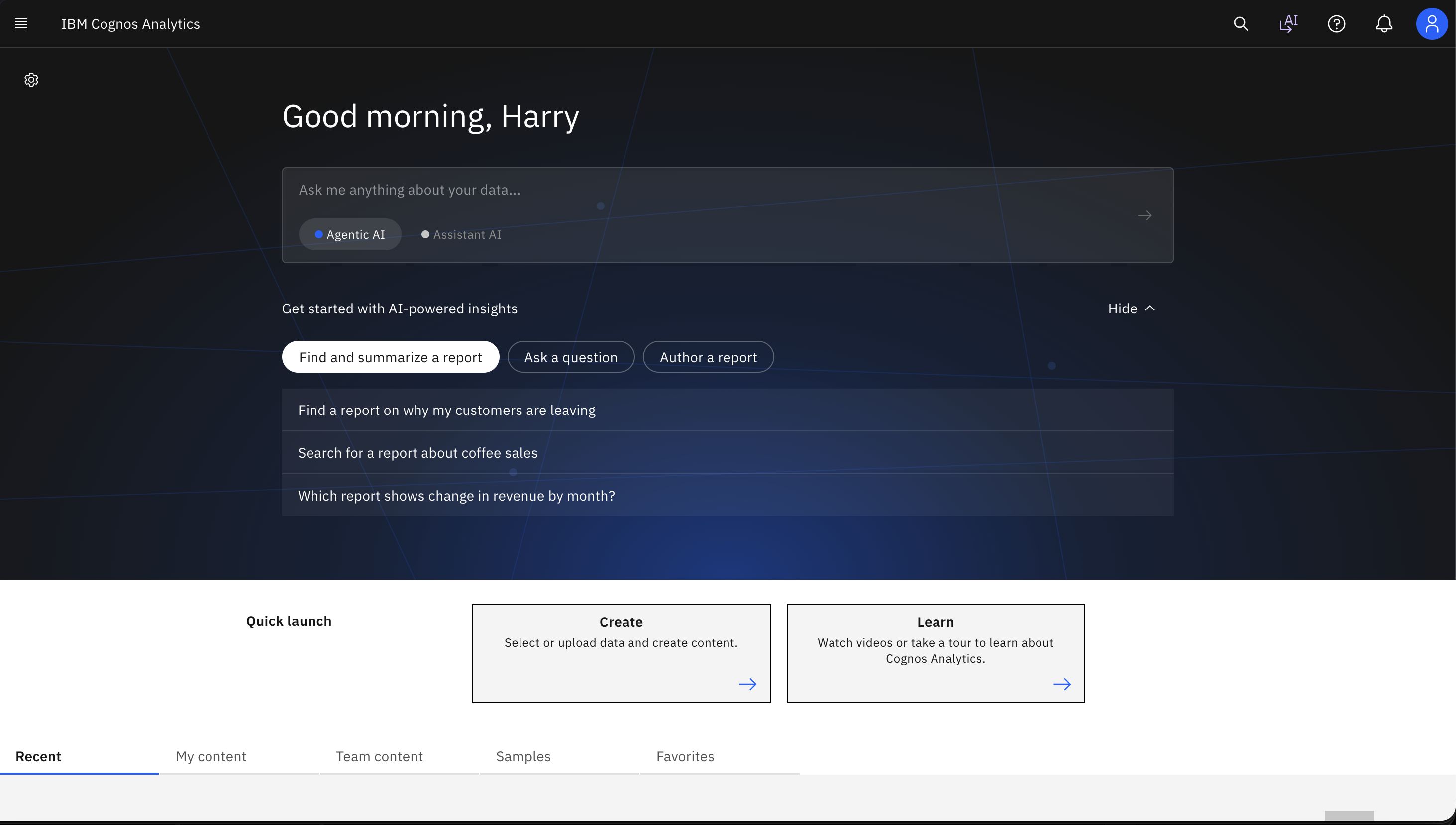
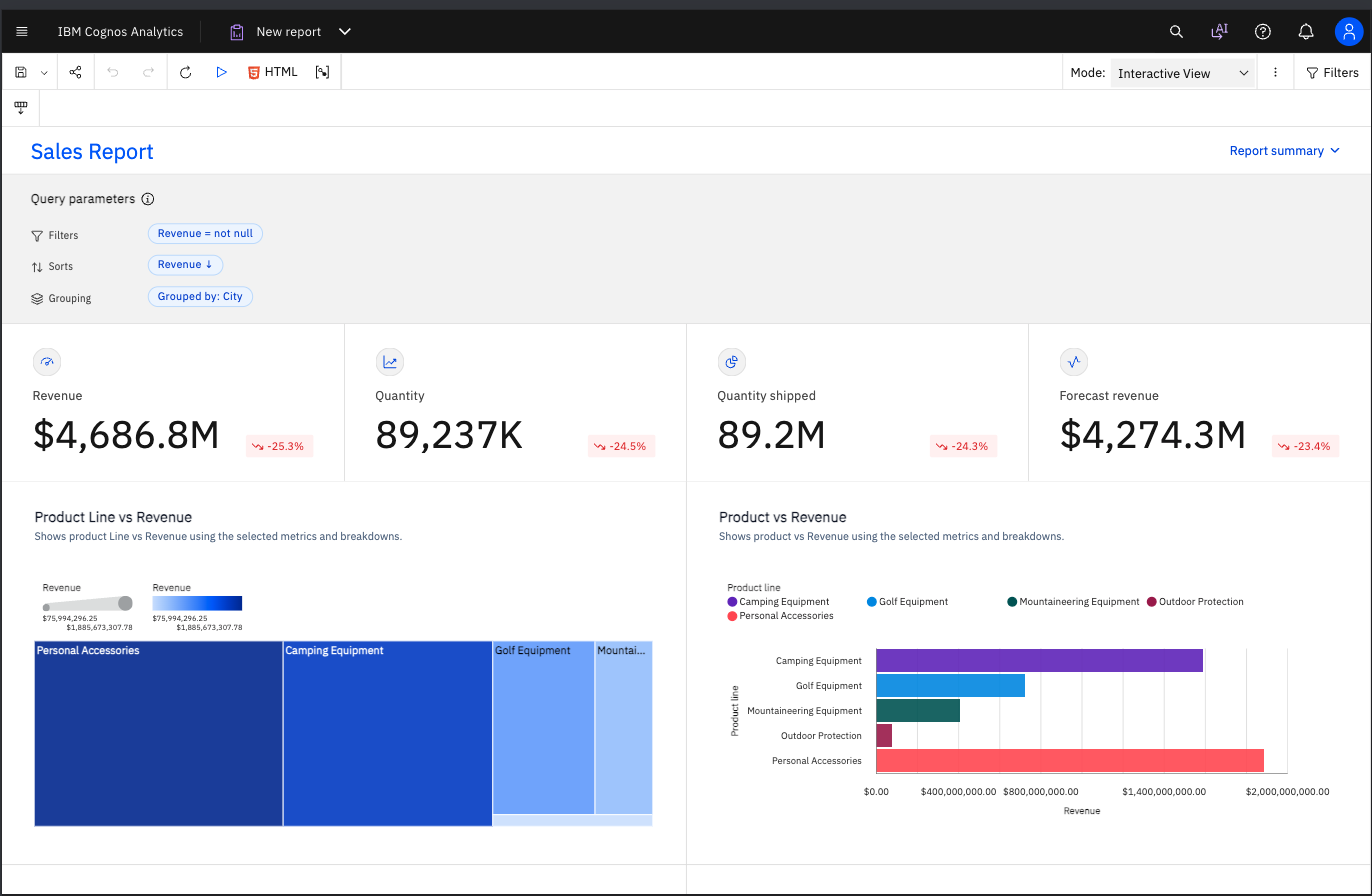
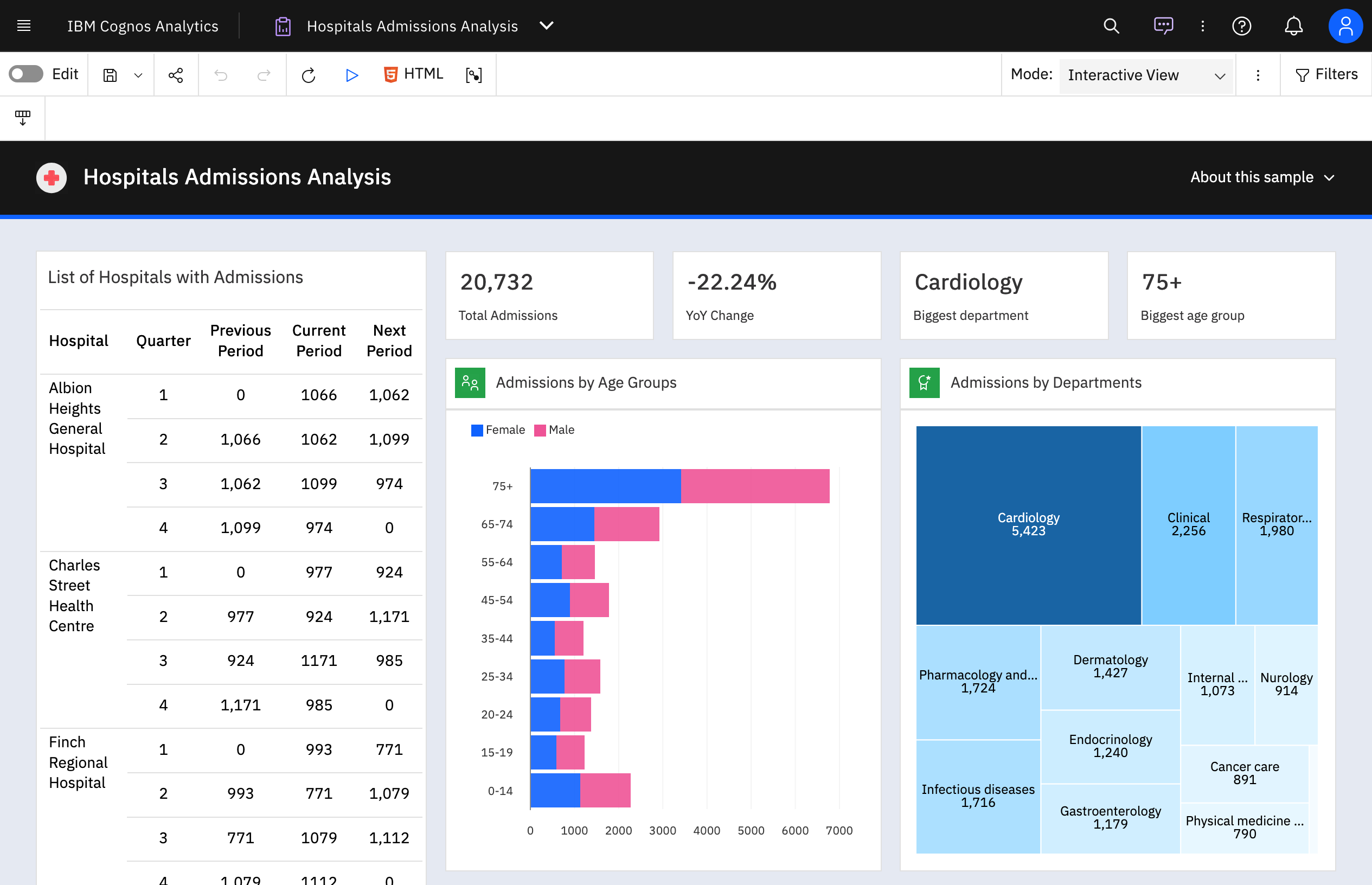
Screenshot of a natural language query, used in IBM Cognos Analytics to get AI-powered insights from data.Screenshot of AI-generated insights and forecasts that can be added with just a click of a button.Screenshot of a dashboard that can be generated automatically using IBM Cognos Analytics by uploading or selecting data.Screenshot of an AI-generated dashboard from a spreadsheet that was just uploaded. This offers a great starting point for the creative process.Screenshot of where to import data to IBM Cognos Analytics from CSV files and spreadsheets. Users can connect to cloud or on-premises data sources, including SQL databases, Google BigQuery, Amazon, and Redshift.Screenshot of Cognos Analytics Dashboard