Microsoft's Azure Application Gateway is a platform-managed, scalable, and highly available application delivery controller as a service with integrated web application firewall.
N/A
Azure Functions
Score 8.8 out of 10
N/A
Azure Functions enables users to execute event-driven serverless code functions with an end-to-end development experience.
$18
per month approximately
NGINX
Score 9.1 out of 10
Mid-Size Companies (51-1,000 employees)
NGINX, a business unit of F5 Networks, powers over 65% of the world's busiest websites and web applications. NGINX started out as an open source web server and reverse proxy, built to be faster and more efficient than Apache. Over the years, NGINX has built a suite of infrastructure software products o tackle some of the biggest challenges in managing high-transaction applications. NGINX offers a suite of products to form the core of what organizations need to create…
For building scalable and highly available applications, Azure Application Gateway does most of the job on behalf of you; automatically load-balancing traffic from a number of users to a number of back-end servers. This ensure scalability and availability. The in-built security is great as can be expected from Microsoft, and user has a variety of tools for monitoring the health of the load-balancing function as well as the health of back end servers behind it.
They're great to embed logic and code in a medium-small, cloud-native application, but they can become quite limiting for complex, enterprise applications.
Nginx is well-suited for any web server scenarios, such as web applications, backend or reverse proxy for both application and HTTP requests, and distribution. It is less appropriate for Windows-based applications that run directly on a Windows Server host. In any case, it is very easy to manage, through separate conf files for each application or site you want to host with it.
They natively integrate with many triggers from other Azure services, like Blob Storage or Event Grid, which is super handy when creating cloud-native applications on Azure (data wrangling pipelines, business process automation, data ingestion for IoT, ...)
They natively support many common languages and frameworks, which makes them easily approachable by teams with a diverse background
They are cheap solutions for low-usage or "seasonal" applications that exhibits a recurring usage/non-usage pattern (batch processing, montly reports, ...)
My biggest complaint is that they promote a development model that tightly couples the infrastructure with the app logic. This can be fine in many scenarios, but it can take some time to build the right abstractions if you want to decouple you application from this deployment model. This is true at least using .NET functions.
In some points, they "leak" their abstraction and - from what I understood - they're actually based on the App Service/Web App "WebJob SDK" infrastructure. This makes sense, since they also share some legacy behavior from their ancestor.
For larger projects, their mixing of logic, code and infrastructure can become difficult to manage. In these situations, good App Services or brand new Container Apps could be a better fit.
Customer support can be strangely condescending, perhaps it's a language issue?
I find it a little weird how the release versions used for Nginx+ aren't the same as for open source version. It can be very confusing to determine the cross-compatibility of modules, etc., because of this.
It seems like some (most?) modules on their own site are ancient and no longer supported, so their documentation in this area needs work.
It's difficult to navigate between nginx.com commercial site and customer support. They need to be integrated together.
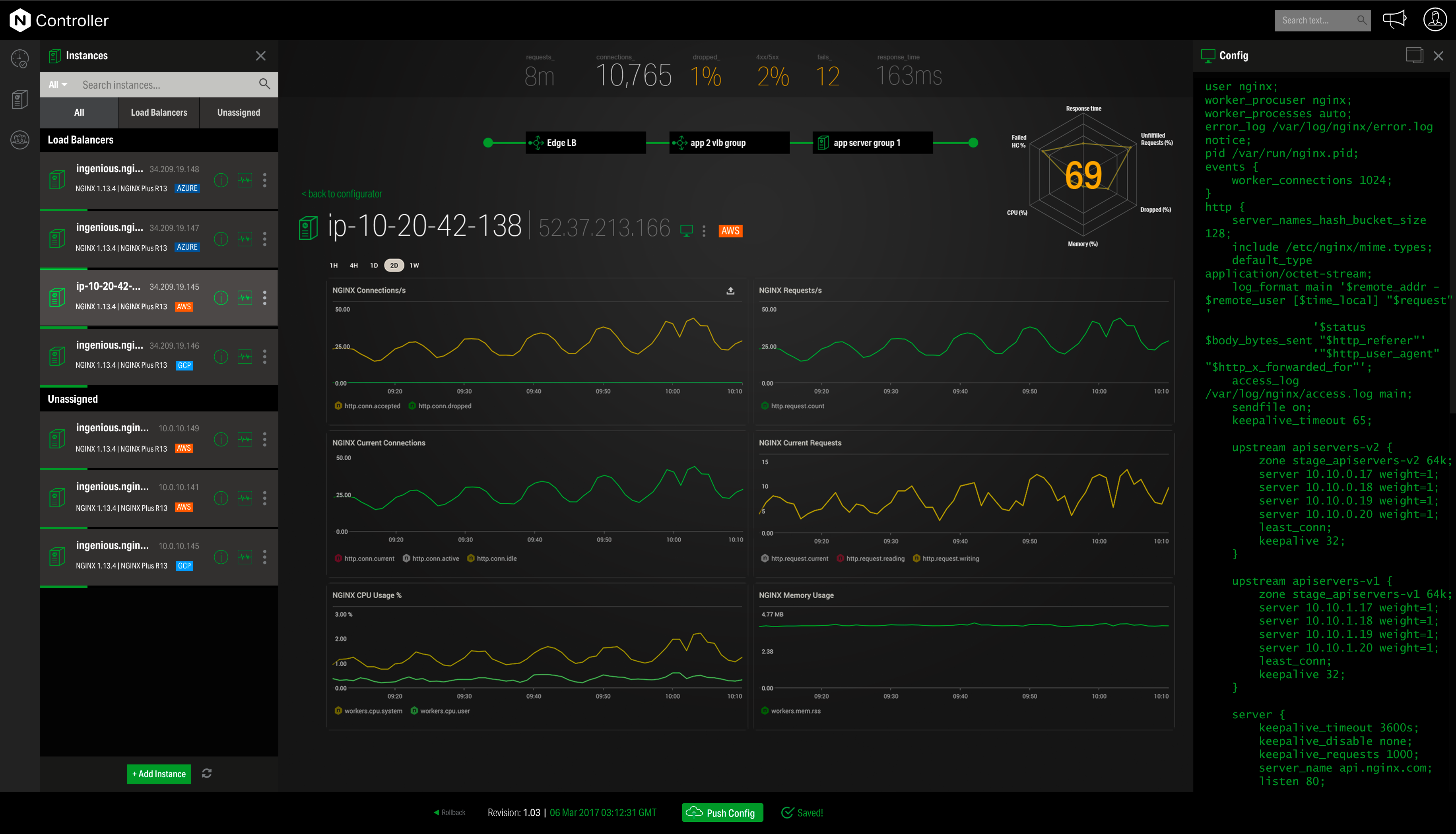
I'd love to see more work done on nginx+ monitoring without requiring logging every request. I understand that many statistics can only be derived from logs, but plenty should work without that. Logging is not an option in many environments.
Most of the Application Gateway's features and services can be managed and re-configured via either the Azure Portal GUI or via the Azure Cloud Shell, thus allowing both CLI modes, i.e. Azure CLI (Bash) and Azure Powershell. The v2 version of Application Gateway has significantly improved performance during initial configuration or during re-configuration changes, thus making it much more usable for IT admins, as compared to v1.
This tool is really easy to use and configure. Consumes very less system resources. It is highly modular and configurable. You can easily use it with other tools like certbot for SSLs. You can configure basic security with configuration and headers
Community support is great, and they've also had a presence at conferences. Overall, there is no shortage of documentation and community support. We're currently using it to serve up some WordPress sites, and configuring NGINX for this purpose is well documented.
Other load balancing tools in Azure (Azure LB and Azure Traffic Manager) are limited in their functionality in comparison with the Azure Application Gateway, and also, they don't provide security features. Azure Firewall, although it has security features, is more expensive, and most importantly, it's not a load balancer at all.
This is the most straightforward and easy-to-implement server less solution. App Service is great, but it's designed for websites, and it cannot scale automatically as easily as Azure Functions. Container Apps is a robust and scalable choice, but they need much more planning, development and general work to implement. Container Instances are the same as Container Apps, but they are extremely more limited in termos of capacity. Kubernetes Service si the classic pod container on Azure, but it requires highly skilled professional, and there are not many scenario where it should be used, especially in smaller teams.
I have found that [NGINX] seems to perform better throughout the years with less issues although I've used Apache more. I would definitely recommend [NGINX] for any high volume site and I've seen this to usually be the case from most provided web hosts who will pick [NGINX] over alternatives
They allowed me to create solutions with low TCO for the customer, which loves the result and the low price, that helped me create solutions for more clients in less time.
You can save up to 100% of your compute bill, if you stay under a certain tenant conditions.
By using Nginx, we can host multiple web services on a single server, keeping our infrastructure costs lower.
Nginx maintains our HTTPS connections, allowing us to keep our promise to our customers that their data is safe in transit.
Due to Nginx's extremely low failure rate, our web addresses always return something meaningful, even when individual services go down. In sense, this means we are "always online" and allows us to maintain brand and support our customers even in the face of catastrophe.