Microsoft's Azure Data Factory is a service built for all data integration needs and skill levels. It is designed to allow the user to easily construct ETL and ELT processes code-free within the intuitive visual environment, or write one's own code. Visually integrate data sources using more than 80 natively built and maintenance-free connectors at no added cost. Focus on data—the serverless integration service does the rest.
N/A
Looker
Score 8.4 out of 10
N/A
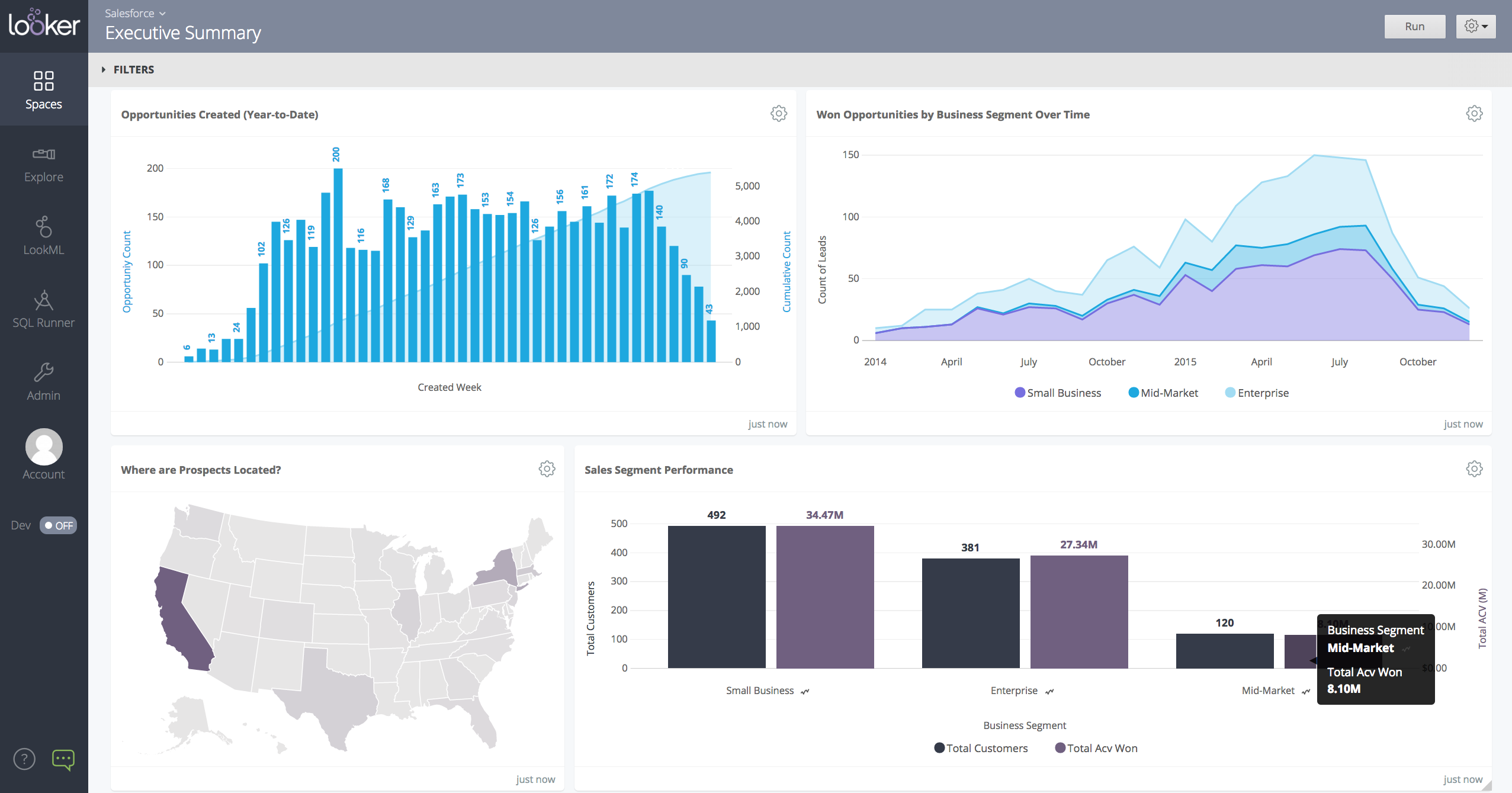
Looker is a BI application with an analytics-oriented application server that sits on top of relational data stores. It includes an end-user interface for exploring data, a reusable development paradigm for data discovery, and an API for supporting data in other systems.
N/A
Pricing
Azure Data Factory
Looker
Editions & Modules
No answers on this topic
No answers on this topic
Offerings
Pricing Offerings
Azure Data Factory
Looker
Free Trial
No
Yes
Free/Freemium Version
No
No
Premium Consulting/Integration Services
No
Yes
Entry-level Setup Fee
No setup fee
Required
Additional Details
—
Must contact sales team for pricing.
More Pricing Information
Community Pulse
Azure Data Factory
Looker
Features
Azure Data Factory
Looker
Data Source Connection
Comparison of Data Source Connection features of Product A and Product B
Azure Data Factory
8.5
10 Ratings
3% above category average
Looker
-
Ratings
Connect to traditional data sources
9.010 Ratings
00 Ratings
Connecto to Big Data and NoSQL
8.010 Ratings
00 Ratings
Data Transformations
Comparison of Data Transformations features of Product A and Product B
Azure Data Factory
7.8
10 Ratings
3% below category average
Looker
-
Ratings
Simple transformations
8.710 Ratings
00 Ratings
Complex transformations
7.010 Ratings
00 Ratings
Data Modeling
Comparison of Data Modeling features of Product A and Product B
Azure Data Factory
6.3
10 Ratings
21% below category average
Looker
-
Ratings
Data model creation
4.57 Ratings
00 Ratings
Metadata management
5.58 Ratings
00 Ratings
Business rules and workflow
6.010 Ratings
00 Ratings
Collaboration
7.09 Ratings
00 Ratings
Testing and debugging
6.310 Ratings
00 Ratings
Data Governance
Comparison of Data Governance features of Product A and Product B
Azure Data Factory
5.7
10 Ratings
33% below category average
Looker
-
Ratings
Integration with data quality tools
4.310 Ratings
00 Ratings
Integration with MDM tools
7.09 Ratings
00 Ratings
BI Standard Reporting
Comparison of BI Standard Reporting features of Product A and Product B
Azure Data Factory
-
Ratings
Looker
7.6
133 Ratings
8% below category average
Pixel Perfect reports
00 Ratings
6.7109 Ratings
Customizable dashboards
00 Ratings
8.4132 Ratings
Report Formatting Templates
00 Ratings
7.6114 Ratings
Ad-hoc Reporting
Comparison of Ad-hoc Reporting features of Product A and Product B
Azure Data Factory
-
Ratings
Looker
7.2
131 Ratings
11% below category average
Drill-down analysis
00 Ratings
6.8127 Ratings
Formatting capabilities
00 Ratings
6.9129 Ratings
Integration with R or other statistical packages
00 Ratings
6.255 Ratings
Report sharing and collaboration
00 Ratings
8.8130 Ratings
Report Output and Scheduling
Comparison of Report Output and Scheduling features of Product A and Product B
Azure Data Factory
-
Ratings
Looker
8.1
127 Ratings
2% below category average
Publish to Web
00 Ratings
7.8105 Ratings
Publish to PDF
00 Ratings
8.2112 Ratings
Report Versioning
00 Ratings
7.983 Ratings
Report Delivery Scheduling
00 Ratings
8.5109 Ratings
Data Discovery and Visualization
Comparison of Data Discovery and Visualization features of Product A and Product B
Best scenario is for ETL process. The flexibility and connectivity is outstanding. For our environment, SAP data connectivity with Azure Data Factory offers very limited features compared to SAP Data Sphere. Due to the limited modelling capacity of the tool, we use Databricks for data modelling and cleaning. Usage of multiple tools could have been avoided if adf has modelling capabilities.
When data drives potential for new orders, Looker earns its place in our tech stack. If, on the other hand, we are hoping for pipeline generation, Looker is useful if you are willing to repeatedly go check customer utilizations .... it is not appropriate if you are hoping to automate data analysis for this purpose.
Show visited pages - sessions, pageviews - which programs are viewed the most.
Displays session source/medium views to see where users are coming from.
It shows the video titles, URLs, and event counts so we can monitor the performance of our videos.
It gives a graphic face to the numbers, such as using bar charts, pie graphs, and other charts to show user trends or which channels are driving engagement.
Our clients like to see the top pages visited for a month.
I like the drop-and-drag approach, and building charts is a little easier than it was before.
Granularity of Errors: Sometimes, Azure Data Factory provides error messages that are too generic or vague for us, making it challenging to pinpoint the exact cause of a pipeline failure. Enhanced error messages with more actionable details would greatly assist us as users in debugging their pipelines.
Pipeline Design UI: In my experience, the visual interface for designing pipelines, especially when dealing with complex workflows or numerous activities, can become cluttered. I think a more intuitive and scalable design interface would improve usability. In my opinion, features like zoom, better alignment tools, or grouping capabilities could make managing intricate designs more manageable.
Native Support: While Azure Data Factory does support incremental data loads, in my experience, the setup can be somewhat manual and complex. I think native and more straightforward support for Change Data Capture, especially from popular databases, would simplify the process of capturing and processing only the changed data, making regular data updates more efficient
I give it this rating because it deems as effective, I am able to complete majority of my tasks using this app. It is very helpful when analyzing the data provided and shown in the app and it's just overall a great app for Operational use, despite the small hiccups it has (live data).
So far product has performed as expected. We were noticing some performance issues, but they were largely Synapse related. This has led to a shift from Synapse to Databricks. Overall this has delayed our analytic platform. Once databricks becomes fully operational, Azure Data Factory will be critical to our environment and future success.
Looker is relatively easy to use, even as it is set up. The customers for the front-end only have issues with the initial setup for looker ml creations. Other "looks" are relatively easy to set up, depending on the ETL and the data which is coming into Looker on a regular basis.
Somehow resources heavy, both on server and client. I recommned at least 50Mbs data rate and high performance desktop comouter to be abke to run comolex tasks and configure larger amount of data. On the other hand, the client does not need to worry when viewing, the performance is usually ok
We have not had need to engage with Microsoft much on Azure Data Factory, but they have been responsive and helpful when needed. This being said, we have not had a major emergency or outage requiring their intervention. The score of seven is a representation that they have done well for now, but have not proved out their support for a significant issue
Never had to work with support for issues. Any questions we had, they would respond promptly and clearly. The one-time setup was easy, by reading documentation. If the feature is not supported, they will add a feature request. In this case, LDAP support was requested over OKTA. They are looking into it.
Azure Data Factory helps us automate to schedule jobs as per customer demands to make ETL triggers when the need arises. Anyone can define the workflow with the Azure Data Factory UI designer tool and easily test the systems. It helped us automate the same workflow with programming languages like Python or automation tools like ansible. Numerous options for connectivity be it a database or storage account helps us move data transfer to the cloud or on-premise systems.
Looker Studio, you can easily report on data from various sources without programming. Looker Studio is available at no charge for creators and report viewers. Enterprise customers who upgrade to Looker Studio Pro will receive support and expanded administrative features, including team content management. So it's good.
Looker has a poignant impact on our business's ROI objectives. As an advertising exchange we have specific goals for daily requests and fill, and having premade Looks to monitor this is an integral piece of our operational capability
To facilitate an efficient monthly billing cycle in our organization, Looker is essential to track estimated revenue and impression delivery by publisher. Without the Looks we have set up, we would spend considerably more time and effort segmenting revenue by vertical.
Looker's unique value proposition is making analytical tools more digestible to people without conventional analytical experience. Other competing tools like Tableau require considerably more training and context to successfully use, and the ability to easily plot different visualizations is one of its greatest selling points.