Azure DevOps Server (formerly Team Foundation Server, or TFS) is the on-premise version of Azure DevOps. To license Azure DevOps Server an Azure DevOps license and a Windows operating system license (e.g. Windows Server) for each machine running Azure DevOps Server.
N/A
IBM Engineering Lifecycle Management
Score 5.2 out of 10
N/A
IBM Engineering Lifecycle Management (ELM) is an end-to-end engineering solution used to manage system requirements to design, workflow, and test management, extending the functionality of ALM tools for better complex-systems development.
N/A
Ranorex
Score 8.0 out of 10
N/A
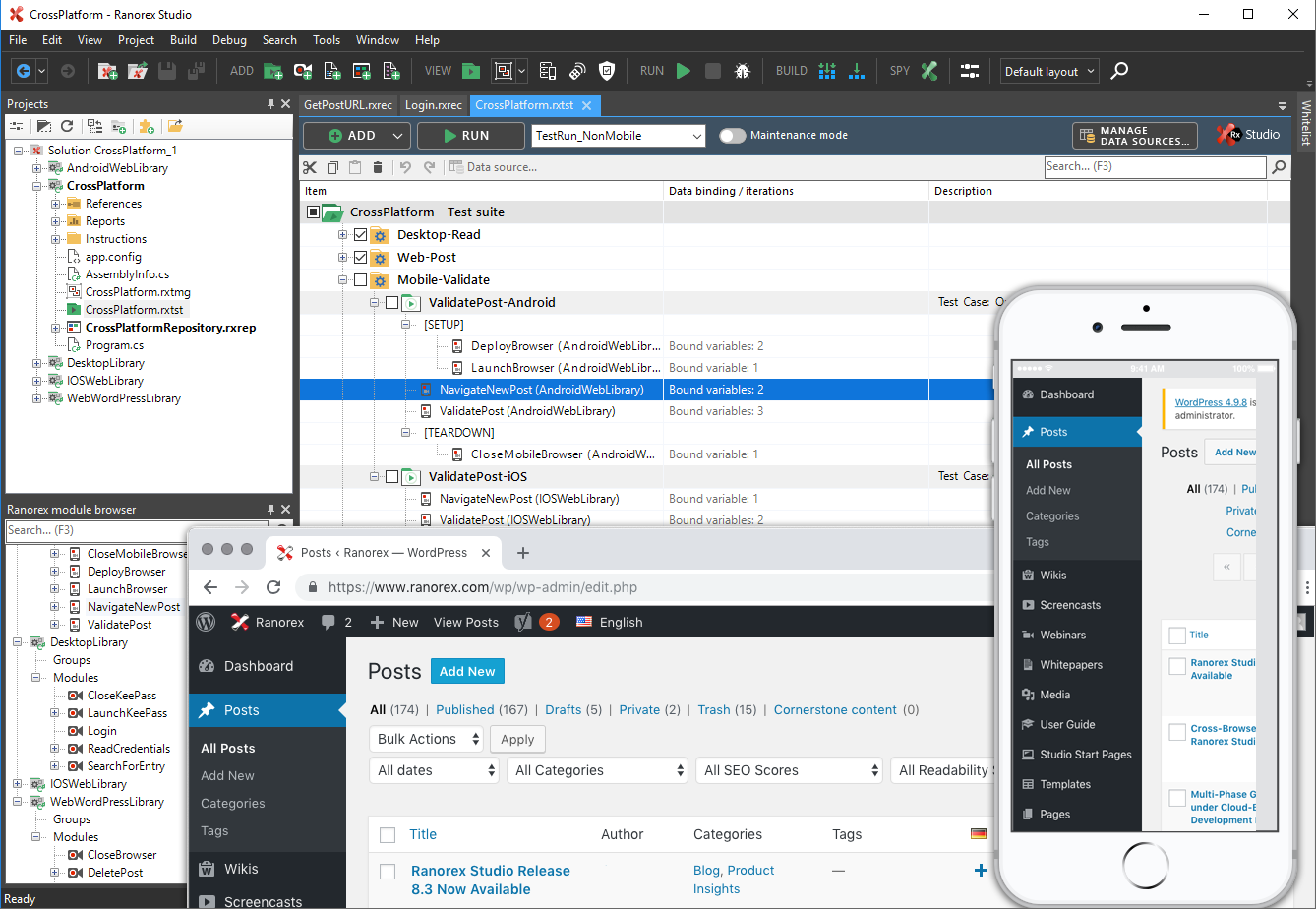
Over 14,000+ users worldwide automate tests with Ranorex Studio, which promises to enable rapid delivery of high-quality desktop, mobile, and web applications. The vendor says that with over 10 years in test automation, Ranorex Studio supports automating functional UI tests for even the most challenging technologies, from legacy applications to the latest web and mobile platforms. Ranorex Studio is an all-in-one tool that empowers everyone on the team. Key benefits and…
$890
per additional endpoint
Pricing
Azure DevOps Server
IBM Engineering Lifecycle Management
Ranorex
Editions & Modules
No answers on this topic
No answers on this topic
Runtime Floating Licnse
$890
per additional endpoint
Premium Node-Locked License
$2,990
per installation
Premium Floating License
$4,990
per concurrent user
Offerings
Pricing Offerings
Azure DevOps Server
IBM Engineering Lifecycle Management
Ranorex
Free Trial
No
No
Yes
Free/Freemium Version
Yes
No
No
Premium Consulting/Integration Services
No
No
Yes
Entry-level Setup Fee
No setup fee
No setup fee
Optional
Additional Details
—
—
All licenses are perpetual and include 12 months of maintenance and email support. A runtime floating license requires at least one premium license for test creation. Please contact our sales team for information about possible volume discounts and options for enterprise support. Consulting, integration and training services are available from our partners worldwide.
JIRA is simpler and much more intuitive, especially when bundled with Confluence.
TFS is obvious choice if working with Microsoft technologies and has superb API.
Azure DevOps is good to use if you are all-in on the Microsoft Azure stack. It's fully integrated across Azure so it is a point-and-click for most of what you will need to achieve. If you are new to Azure make sure you get some outside experience to help you otherwise it is very easy to overcomplicate things and go down the wrong track, or for you to manually create things that come out of the box.
The software is robust enough to handle highly complex software development or other product development and can be used well beyond the range to do what a client needs. However, because of the inability to hold its users to proper best practices, things can get wildly out of hand and cascade over the years, creating unnecessary technical debt. The system has a lot of usable features, but they don't funnel users toward the correct processes and practices.
Personally I rate it a 10 from my own experience, but from a company perspective, I would drop that to perhaps an 8. This is because while I have fun while finding it extremely easy to use and comprehensive enough, there have been times that relative to the project currently in works, Ranorex has not performed due to its shortcomings. If asked though I would certainly fully recommend Ranorex to a potential user, especially to someone less skilled in this field.
I feel like it is too heavy sometimes and updating is not very straight forward. For example, if I want to change an incident ticket (IN) to a service request (SR) and add some comment for the change, I have to first change the IN to SR, then click refresh which takes a few seconds, then add a comment. If I forget the refresh step, my comment will be discarded without warning like my ticket is not in the latest status. This also happens when somebody else changes the ticket during my edit as I can not lock the ticket exclusively.
Language support is limited, c# and Vb.net only if i remember correctly compared to other tools which allow many more. This addition would certainly be appreciated if added on in a company like mine with a variety of differently skilled individuals
Paid license. This is not always preferred. A free version without a limited trial but maybe limited features would be appreciated.
Because we are a Microsoft Gold Partner we utilize most of their software and we have so much invested in Team Foundation Server now it would take a catastrophic amount of time and resources to switch to a different product.
At the moment we are required by contract to continue to use the IBM DOORS software for our current client. Given that it can be expensive, if we were to use it after our current client's needs were met, we would have to secure other projects in order to justify the continued use of the software.
For standard users the interface is friendly. but if you are a manager some tools are a little confusing to use, like the query system that you always need to create from scratch. Templates should be more helpful for queries and for standard procedures that you need to duplicate PBIs over time. The search history of Work Items is a little painful to use.
The UI is terrible and not intuitive. Users need training in order to complete tasks. Much like SAP, it's not the clearest tool. The tracing feature is especially complicated because you must write the scripts yourself. There is a learning curve. Also, even the setup, installation, and logging in each time takes a considerable amount of time.
I have not had to use the support for Azure DevOps Server. There have never been any issues where I was not able to figure it out or quickly resolve. Our Scrum Master has used support before though, and the service has always been prompt and clear with a customer-focus
It does a basic job and has the potential to complete some robust reporting tasks, however, it really is a clunky piece of software with a terrible user interface that makes using it routinely quite unpleasant. Many of our legacy and maintenance projects still use DOORS but our department and company use many alternatives and are looking for better tools.
I suppose my experience is sort of mixed. Help documents are substantially helpful. I personally have not got the quickest responses from Ranorex support but at the same time, they are pretty good with updating their users frequently with info about their product/s and features. The community is really where I find support and I suppose that could look to be an extension of the product itself.
In my opinion, DevOps covers the development process end to end way better than Jira or GitHub. Both competitors are nice in their specific fields but DevOps provides a more comprehensive package in my opinion. It is still crazy to see that the whole suite can be used for free. The productivity increase we realized with DevOps is worth real money!
It was easier to do all the change management-related activities, even configurations were handled very effectively. New process definitions and initiatives made it easier for better project deliverables. Effective resource allocations and better reporting and defect management. The overall cost of the tool is great too and well within budget.
It has streamlined the pipeline and project management for our agile effort.
It has helped our agile team get organized since that is a new methodology being leveraged within the Enterprise.
The calendar has improved visibility into different OOOs across the project team since we all come from different departments across the larger organization.
It's part of CLM suite so it can be used to manage the whole lifecycle with tight integration with development module (Rational Team Concert) and quality module (Rational Quality Manager).
Comprehensive reports and dashboards provide better visibility.