BMC AMI DevX is an integrated software platform that provides mainframe development teams with modern Application Development and DevOps capabilities. The solution connects traditional mainframe environments with contemporary development practices through components for source code management, testing, debugging, and analytics.
N/A
Buddy
Score 9.0 out of 10
N/A
Buddy (formerly Springloops) is a SVN/Git source code management tool focused on web development teams. It allows users to code in parallel and share code safely concentrating on results, not on lost changes or overwritten files. With quick deployments, users get rapid collaboration in protected space.
$75
per month
Tricentis qTest
Score 8.5 out of 10
N/A
Tricentis qTest (formerly QASymphony) provides enterprise-level agile testing tools giving businesses visibility and control needed to ensure application quality in fast-paced development environments. Tricentis and QASymphony merged in summer 2018.
I love these tools! However, my company has not yet transitioned from SCLM to a modern repository, and this is causing most of our developers to remain within TSO for all their development. It's been a slow adoption up to this point, but we are moving toward more modernization this year and next, so with any luck, we'll see usage pick up. Success depends on the speed at which your management is willing to move.
Springloops is the best tool for deployment to any environment. Especially, the auto-deployment feature on development servers is essential for the early stages of development. The built-in source control mechanisms are a perfect combination of ease of use and a rich feature set that allows the development team to have an easier and more complete view of each part of the project. A section that is lacking is time tracking - but then this is not the main usage of the service.
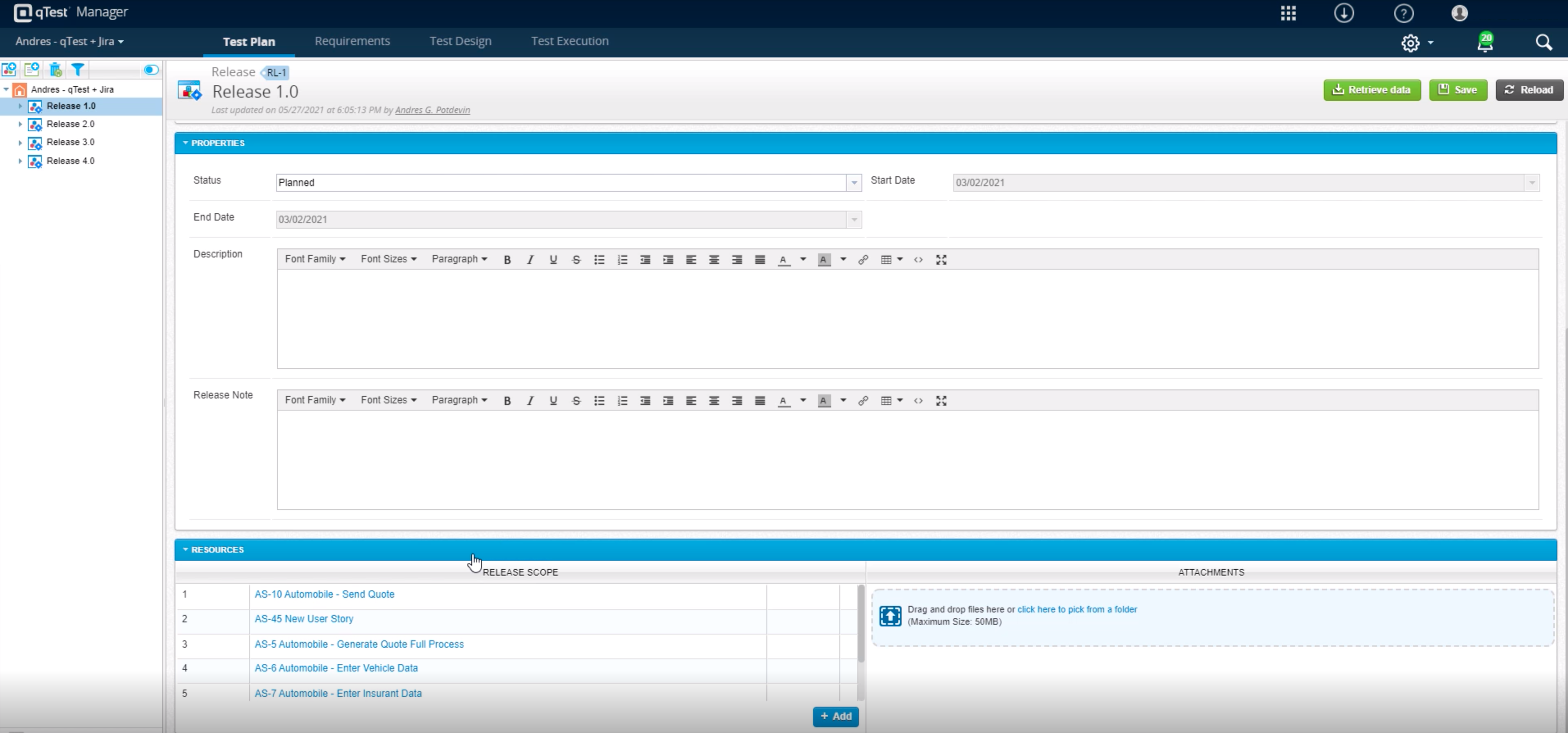
Tricentis qTest integrates seamlessly with Jira, making it ideal for teams that manage user stories and defects in Jira while keeping test cases and execution in qTest. When paired with automation tools like tosca, Selenium, or WebdriverIO, qTest is excellent for aggregating both manual and automated test results in one place.
The tool I use is fairly intuitive. It doesn't take long to be using it full time.
Changing the layout/view is fairly easy. This allows it to fit individual preferences.
It is helpful to be able to view specific windows in full screen. Usually, I have it set up to view multiple windows, but sometimes, I just want to view one window in full-screen mode.
the debug utility is very useful. Place stopping points is easy and one can set parameters as to when you stop at a line of code. Changing the data on the fly is easy and usefull. The interface is easy to use and make sense.
As a fresher, when I started using qTest it was very handy and easy to understand.
It helps us trace the test cases that are used to test the quality in a single location
The main thing is its integration with JIRA as soon as we create a ticket we would be getting all the requirements in the qTest so it became easy for me
In requirements , we can't add multiple test cases at once, or search multiple cases at once, need to do one by one. Here actually qtest needs to improve.
Linking cloud hosted qtest and on-premise TOSCA is very difficult especially when you are working with client system with security wall. It requires tunnelling software which is not recommended.
Apart from being a great versioning control system Springloops offers the options to automatically deploy code to multiple systems. This feature alone is a determining factor to renew Springloops over and over again. Another important factor is that it offers a full set of tools that help the team during the development cycle. No switching between time-tracking to project management. This is a real time-saver.
Easy to use, automatic deployments, comments on projects are only a few factors. Multiple servers per project is another must-have feature. User permissions and rights offer granular control on access to the system
It successfully balances deep enterprise functionality with a clean and modern interface. One of its strongest points is the intuitive, folder based navigation, which makes organizing test case and cycles feel natural. Learning curve is relatively shallow for the new team members to become productive without extensive onboarding. Also the deep integration with JIRA is a significant boost to its usability.
Support has been amazing compared to Optim. Further, new features are very regular with File-AID - I can't remember the last time Optim had a significant update. File-AID support is very receptive to feature requests and reported bugs, including sending out hotfixes quickly.
I rarely use it but when I need it the team is there. During the initial steps of Springloops, I had close contact with one of the founders. He provided support to me over Skype! He didn't have to but he did. We had a couple of long talks about some issues I was facing. He has there regardless of time. It was a great experience
The installation teams for these products have never complained about any difficulties during the integration of this range of tools into our IT system.
The names may have changed over the years, but anyone who has been around for a while will recognize them. For Software Configuration Management, I have used TSO/ISPF/SCLM, Panvalet, ChangeMan, Librarian, Endevor, and now Code Pipeline. All of them met the basic requirements. All of them had their advantages and disadvantages. Code Pipeline, however, stands head and shoulders above the rest in simplicity, completeness, effectiveness, efficiency, and elegance.
Springloops has a built-in feature that is lacking from Bitbucket (at least on the out-of-the-box functionality). Deployment of projects to various servers/development stages. The process is so easy and painless that even remote servers can act as local environments. This is a feature that differentiates Springloops from other solutions that require other tools to perform the same task.
All of them offer formidable solutions in the test management realm, but each one caters to different niche and need. qTest distinguishes itself with its deep integration capabilities, especially with Agile and DevOps tools, enabling streamlined CI/CD process. Its modern, user-centric interface contrasts with ALM's more dated appearance and complex setup. While TestRail provides a clean user experience and caters to a broad spectrum of business, qTest's scalability, from SMBs to large enterprises, stands out. PractiTest's cloud-based solution is geared towards mid-sized companies, but qTest's flexibility, advanced analytics, and robust reporting grant teams actionable insights. qTest' approach to a more holistic test management closely aligning with modern software development practices
Possitive impact. It is main product suite to enable devops in the mainframe applications team. All developers use these on day-to-day work.
Negative impact: Recent usability issues caused disappointment in the application teams. It became hard motivate the development community to increase usage.