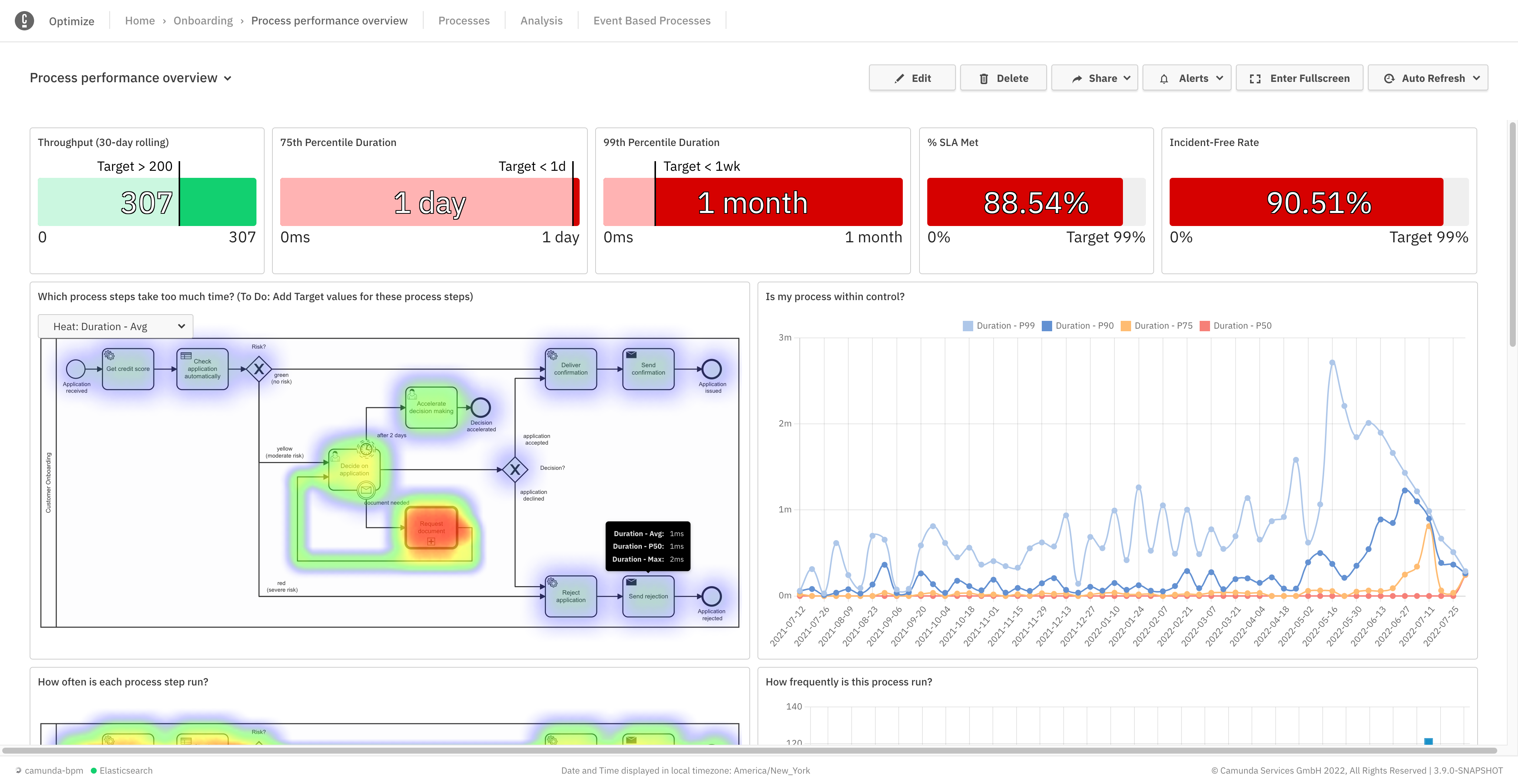
Camunda is a process orchestration tool designed to help organizations design, automate, and improve any process. Built for business and IT collaboration using BPMN and DMN standards, Camunda aims to enable seamless integration across endpoints to transform mission-critical processes.
N/A
Celonis
Score9.3 out of 10
N/A
Celonis is a Process Intelligence platform that helps companies improve their operations, customer experience, and sustainability. The company’s technology provides a digital twin of a company’s processes, giving everyone in the organization a common language and the ability to identify and capture value.
N/A
Pricing
Camunda
Celonis
Editions & Modules
Self-Managed Enterprise
Contact Sales
per year
SaaS Enterprise
Contact Sales
per year
No answers on this topic
Offerings
Pricing Offerings
Camunda
Celonis
Free Trial
Yes
No
Free/Freemium Version
Yes
Yes
Premium Consulting/Integration Services
Yes
Yes
Entry-level Setup Fee
No setup fee
Required
Additional Details
—
Snap is Celonis' free-to-use, cloud-based process mining solution, with over 3500 registrants and users. It includes most major features of Celonis, including all functionality found in common process mining tools. It also includes pre-built connectors to ServiceNow and pre-built content to get users started quickly on their process mining journey.
Camunda Platform is well suited for scenarios where there are different stages in a business flow and the flow is driven by user action at each stage. For example placing of an order on an ecommerce platform. Depending on whether user was able to make the payment or not the workflow would go to dispatch or retry stage. Now the retry stage would trigger further actions like sending follow up emails etc. Likewise, dispatch stage would have a different set of actions. Since every order is important and we need to know where it stands, using Camunda Platform is imperative. Camunda Platform might not be a right choice where just a one off thing needs to be done. For example, uploading of product information by user or periodic processing of heavy images by a worker. These are all either one step processes or periodic automated processes where we can track the status without using a business modeler like Camunda Platform.
A de minimis incentive was given to thank the reviewer for their time. The incentive was not used to bias or drive a particular response, nor was the incentive contingent on a positive endorsement. More Info
Celonis is helping [...] to gain greater transparency and control over complex business processes by connecting data across systems and revealing how work is actually executed. The platform supports proactive risk identification, value‑based process improvements, and more reliable delivery across the R&D value chain. With great support from the Celonis team in Copenhagen, we are enabling R&D teams to make data‑driven decisions, optimise performance, and continuously improve how [...] delivers value to patients.
A de minimis incentive was given to thank the reviewer for their time. The incentive was not used to bias or drive a particular response, nor was the incentive contingent on a positive endorsement. More Info
A de minimis incentive was given to thank the reviewer for their time. The incentive was not used to bias or drive a particular response, nor was the incentive contingent on a positive endorsement. More Info
Helping reduce the complexity to support adoption throughout the business - received feedback that Celonis can only be used by Celonis SMEs, as the interface looks too complex
Can we go faster with less? Both from the Celonis side and NN side feels like if we involved less stakeholders we could achieve more
To get the most from Celonis we need to get the people who are closest to the process comfortable enough so they can draw insights from themselves - Celonis are good are drawing insights, but naturally sometimes misses the business context
A de minimis incentive was given to thank the reviewer for their time. The incentive was not used to bias or drive a particular response, nor was the incentive contingent on a positive endorsement. More Info
We have been able to leverage Celonis [greatly] because of the commitment and support we receive from our data scientist. I strongly believe that we would not be able to accomplish this without her assistance. Moreover, when we escalate matters, the product development is engaged and commits resources to make sure our initiatives/business cases are supported.
A de minimis incentive was given to thank the reviewer for their time. The incentive was not used to bias or drive a particular response, nor was the incentive contingent on a positive endorsement. More Info
It is a great tool but also requires a lot of work to get it into a useable fashion. Part of this is on our end as we don't have the dedicated analyst function yet to really become self-sufficient with Celonis. It also uncovers a lot of data issues or at the very least, multiple rounds of development and data validation are required before getting to a position where the business users feel comfortable with the data being reflected. This is fairly normal with any data-related development effort and perhaps not unique to Celonis.
A de minimis incentive was given to thank the reviewer for their time. The incentive was not used to bias or drive a particular response, nor was the incentive contingent on a positive endorsement. More Info
We submit tickets to Celonis through product support. No assistance is generally provided, have to wait and the ticket is then escalated to product support in Germany. Many times we submit the ticket and the support desk asks us the same questions back where they should already have this information.
A de minimis incentive was given to thank the reviewer for their time. The incentive was not used to bias or drive a particular response, nor was the incentive contingent on a positive endorsement. More Info
Lacks good documentation. Training and documentation is geared towards those who are already technically adept. Does not have as many data integrations as other full fledged products. Paid version of Camunda is not as fully fledged as other products.
A de minimis incentive was given to thank the reviewer for their time. The incentive was not used to bias or drive a particular response, nor was the incentive contingent on a positive endorsement. More Info
The major reason to choose Celonis is that it has enhanced decision-making in filtering the candidates. The frontend designer has nice graphics and has well-designed self-service. I particularly enjoy the visual editor, which allows you to create complicated PQL without having to write any code, as well as the numerous filtering choices, including process mining options.
A de minimis incentive was given to thank the reviewer for their time. The incentive was not used to bias or drive a particular response, nor was the incentive contingent on a positive endorsement. More Info
The positive impact is that we are able to ensure the business process is being followed and that results in orders getting processed successfully leading to customer satisfaction and revenue
Another positive impact is that we are able to track any anomalies and any errors in the order flow and retry them so that users don't have a negative experience.
A negative point is that it is an overhead to maintain so there is significant engineering effort getting invested there
A de minimis incentive was given to thank the reviewer for their time. The incentive was not used to bias or drive a particular response, nor was the incentive contingent on a positive endorsement. More Info
The previous IFRS 9 calculation method was reaching its end of life—Celonis is a direct replacement for us.
When rebuilding our logic from the old system to the new, it gave us a much-needed opportunity to revamp and standardise company codes and, in some cases, even pick up some errors.
A de minimis incentive was given to thank the reviewer for their time. The incentive was not used to bias or drive a particular response, nor was the incentive contingent on a positive endorsement. More Info