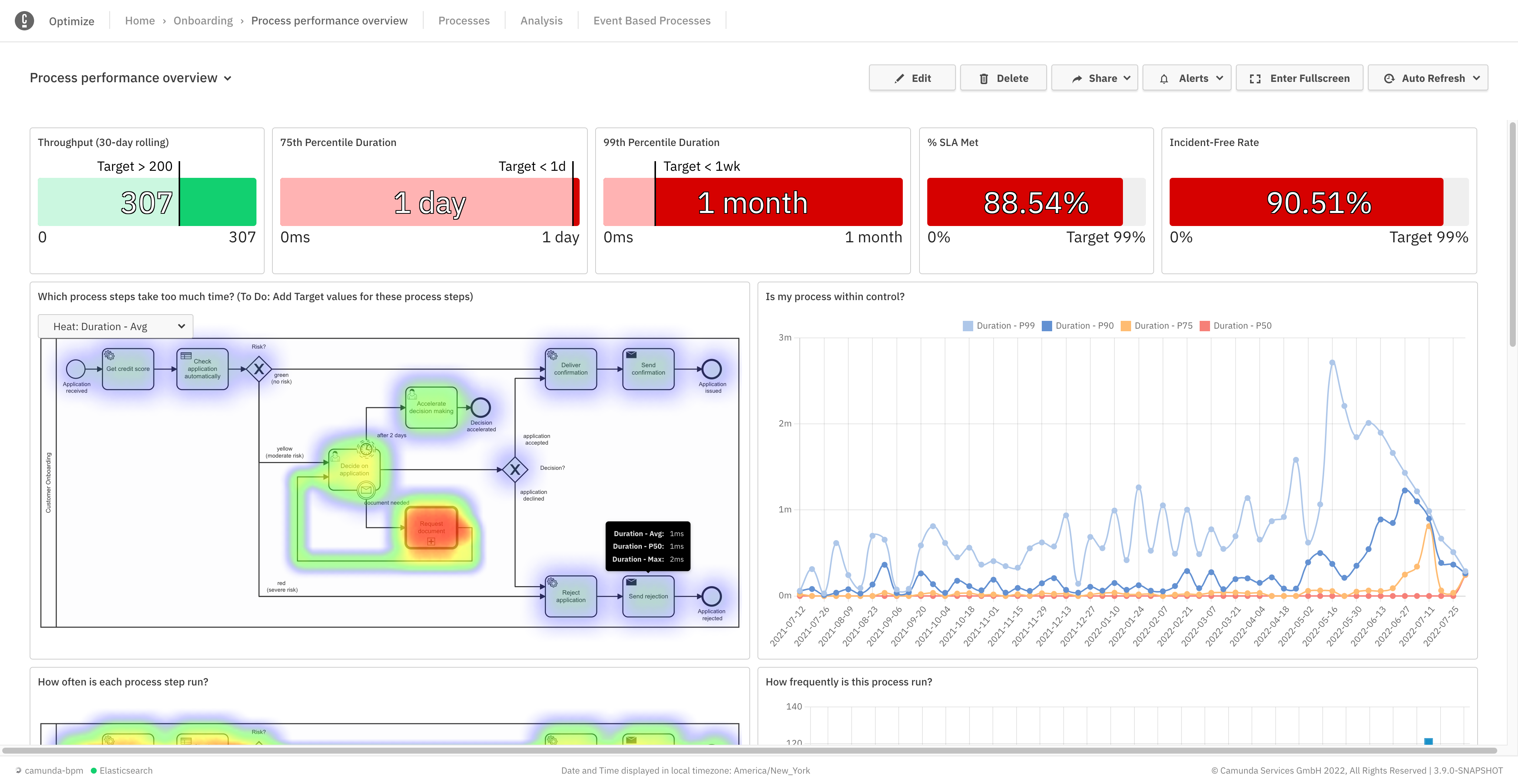
Camunda is a process orchestration tool designed to help organizations design, automate, and improve any process. Built for business and IT collaboration using BPMN and DMN standards, Camunda aims to enable seamless integration across endpoints to transform mission-critical processes.
N/A
Plone
Score10 out of 10
N/A
Plone is a free and open source content management system built on top of the Zope application server. Plone can be used for any kind of website, including blogs, internet sites, webshops, and internal websites.
N/A
Pricing
Camunda
Plone
Editions & Modules
Self-Managed Enterprise
Contact Sales
per year
SaaS Enterprise
Contact Sales
per year
No answers on this topic
Offerings
Pricing Offerings
Camunda
Plone
Free Trial
Yes
No
Free/Freemium Version
Yes
No
Premium Consulting/Integration Services
Yes
No
Entry-level Setup Fee
No setup fee
No setup fee
Additional Details
—
—
More Pricing Information
Features
Camunda
Plone
Customization
Comparison of Customization features of Camunda and Plone
Feature
Camunda
9.0
1 Ratings
21% above category average
Plone
-
Ratings
API for custom integration
9.01 Ratings
00 Ratings
Reporting & Analytics
Comparison of Reporting & Analytics features of Camunda and Plone
Feature
Camunda
8.0
1 Ratings
2% above category average
Plone
-
Ratings
Dashboards
8.01 Ratings
00 Ratings
Standard reports
7.01 Ratings
00 Ratings
Custom reports
9.01 Ratings
00 Ratings
Process Engine
Comparison of Process Engine features of Camunda and Plone
Feature
Camunda
8.5
2 Ratings
15% above category average
Plone
-
Ratings
Process designer
9.02 Ratings
00 Ratings
Process simulation
9.01 Ratings
00 Ratings
Business rules engine
7.02 Ratings
00 Ratings
SOA support
9.02 Ratings
00 Ratings
Process player
9.02 Ratings
00 Ratings
Form builder
5.02 Ratings
00 Ratings
Model execution
10.02 Ratings
00 Ratings
Business Process Automation
Comparison of Business Process Automation features of Camunda and Plone
Feature
Camunda
9.0
1 Ratings
28% above category average
Plone
-
Ratings
Business Process Modeling
9.01 Ratings
00 Ratings
Decision Modeling
9.01 Ratings
00 Ratings
Security
Comparison of Security features of Camunda and Plone
Feature
Camunda
-
Ratings
Plone
10.0
5 Ratings
19% above category average
Role-based user permissions
00 Ratings
10.05 Ratings
Platform & Infrastructure
Comparison of Platform & Infrastructure features of Camunda and Plone
Feature
Camunda
-
Ratings
Plone
10.0
5 Ratings
25% above category average
API
00 Ratings
10.05 Ratings
Internationalization / multi-language
00 Ratings
10.05 Ratings
Web Content Creation
Comparison of Web Content Creation features of Camunda and Plone
Feature
Camunda
-
Ratings
Plone
9.4
6 Ratings
18% above category average
WYSIWYG editor
00 Ratings
10.06 Ratings
Code quality / cleanliness
00 Ratings
10.05 Ratings
Admin section
00 Ratings
10.05 Ratings
Page templates
00 Ratings
10.05 Ratings
Library of website themes
00 Ratings
5.05 Ratings
Mobile optimization / responsive design
00 Ratings
10.05 Ratings
Publishing workflow
00 Ratings
10.05 Ratings
Form generator
00 Ratings
10.05 Ratings
Web Content Management
Comparison of Web Content Management features of Camunda and Plone
Camunda Platform is well suited for scenarios where there are different stages in a business flow and the flow is driven by user action at each stage. For example placing of an order on an ecommerce platform. Depending on whether user was able to make the payment or not the workflow would go to dispatch or retry stage. Now the retry stage would trigger further actions like sending follow up emails etc. Likewise, dispatch stage would have a different set of actions. Since every order is important and we need to know where it stands, using Camunda Platform is imperative. Camunda Platform might not be a right choice where just a one off thing needs to be done. For example, uploading of product information by user or periodic processing of heavy images by a worker. These are all either one step processes or periodic automated processes where we can track the status without using a business modeler like Camunda Platform.
A de minimis incentive was given to thank the reviewer for their time. The incentive was not used to bias or drive a particular response, nor was the incentive contingent on a positive endorsement. More Info
The larger your organization, the more appropriate Plone will be. This is not to say that Plone is a worse choice for small websites, only that the minimum investment for a Plone site is certainly higher than for other platforms. If you already use Plone for your site and are looking for a redesign or an overhaul, I would only advise switching to a different platform such as WordPress or Drupal if your organization is downsizing. For any other situation, Plone is the natural choice for your growth.
Plone is a folder-based system, organising content in a similar way desktop-users are doing for the last two decades. No need to teach non-tech customers some relational-database like paradigm for content management.
Plone is secure. It is the most secure CMS you can get your hands on.
Plone is flexible, and makes fast development easy.
Not everything is configurable or editable by Plone, and when you need to adjust or add custom pieces in, you need to deal with Zope. Zope has an ugly, confusing and difficult UI and structure as a backend.
Using 3rd party products is difficult to do - there are a few different ways to get them installed, all of which take a bit of luck to get right.
Building custom products for Plone is not fun. You've got to deal with an archaic framework to tie in that is not well documented (there is documentation about many things, but not great documentation and there are a lot of holes in the documentation).
Compared to the amount of Plone sites, users and customizations we have in our organization, the amount of support requests and training needed is really small.
The new user interface in Plone 6 is even better, it is super fast, has lots of different blocks for enhancing the page, has flexible layout system and is easy to extend with more features.
Our Plone sites are very robust. We have critical systems on Plone and we have been running sites on Plone for over 20 years with very little unexpected downtime.
Plone is very intensive in its operations, and if not configured well it can be slow. However it is designed and built with speed in mind and with proper use of coding, templates and caching can perform extremely well under high loads. It is capable of scaling to very high load availability environments with no specific coding requirements.
Lacks good documentation. Training and documentation is geared towards those who are already technically adept. Does not have as many data integrations as other full fledged products. Paid version of Camunda is not as fully fledged as other products.
A de minimis incentive was given to thank the reviewer for their time. The incentive was not used to bias or drive a particular response, nor was the incentive contingent on a positive endorsement. More Info
Drupal: Plone is cheaper, so with Drupal is more complex to reach the required ROI. However, Drupal has a lower learning curve WordPress: For our necessities it has a more expensive learning curve than plone. Joomla, is easier to use. However, it have some issues on security and web content where Plone is much better
A de minimis incentive was given to thank the reviewer for their time. The incentive was not used to bias or drive a particular response, nor was the incentive contingent on a positive endorsement. More Info
The positive impact is that we are able to ensure the business process is being followed and that results in orders getting processed successfully leading to customer satisfaction and revenue
Another positive impact is that we are able to track any anomalies and any errors in the order flow and retry them so that users don't have a negative experience.
A negative point is that it is an overhead to maintain so there is significant engineering effort getting invested there
A de minimis incentive was given to thank the reviewer for their time. The incentive was not used to bias or drive a particular response, nor was the incentive contingent on a positive endorsement. More Info
The impact Plone has had at the University of Oshkosh is as follows: this software allows student workers to learn about IT departments and CMS's in a user-friendly way. It gives many students great jobs that look great on their resumes.
Since there are great training manuals for Plone, there is increased employee efficient in the workplace. Training doesn't take long, and if there's ever a question, the Plone manual is a great tool to refer to.
If an employee using Plone quits, its easy to find someone to replace them with quick training and great resources.