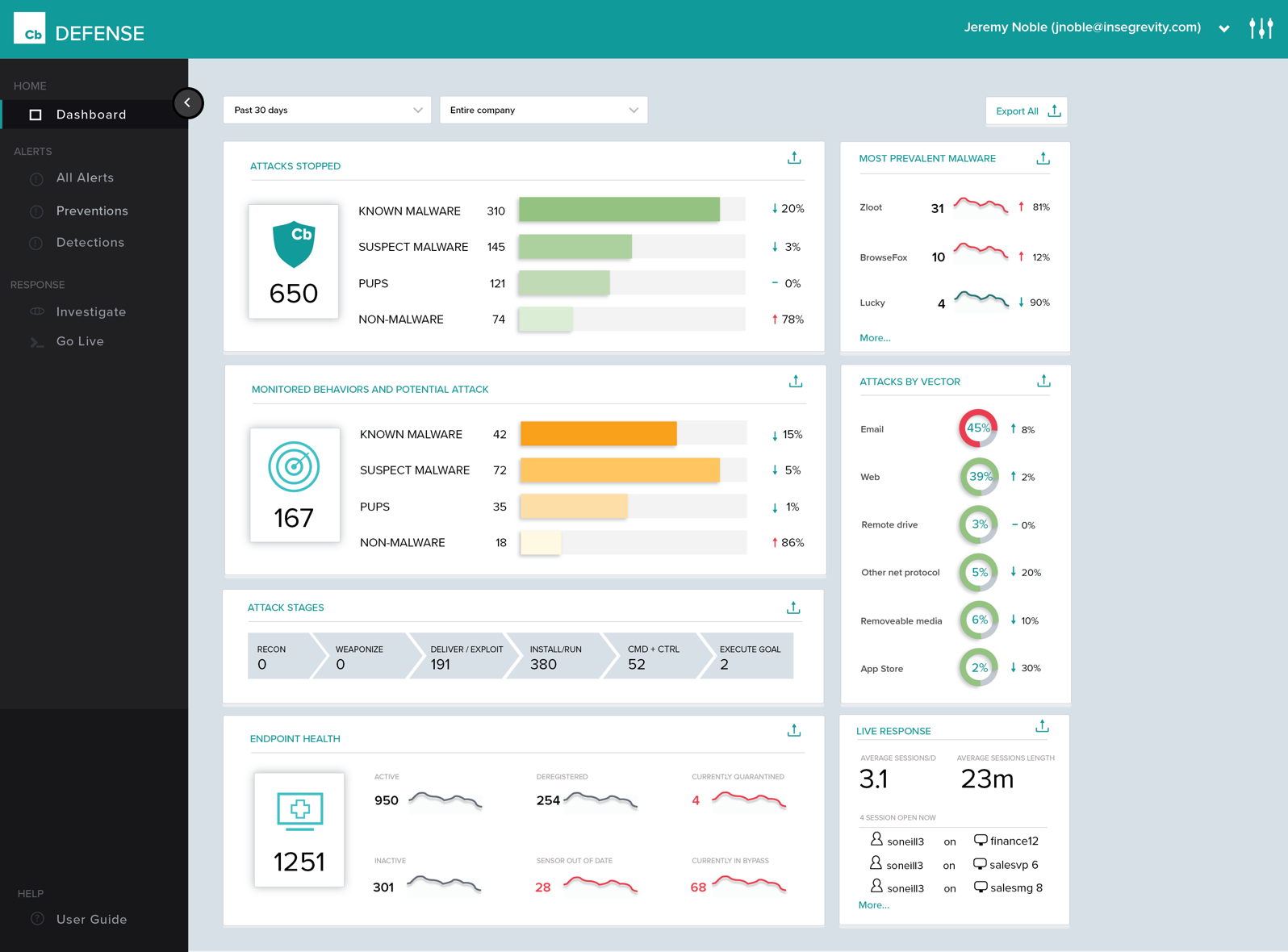
Carbon Black Endpoint is an endpoint security and "next-gen antivirus (NGAV)" that uses machine learning and behavioral models to analyze endpoint data and uncover malicious activity to stop all types of attacks before they reach critical systems.
N/A
Huntress
Score9.5 out of 10
N/A
Huntress is a security platform that surfaces hidden threats, vulnerabilities, and exploits.
The platform helps IT resellers protect their customers from persistent footholds, ransomware and other attacks.
Cloud Project Manager in Information Technology at Total Technology Resources (Information Technology & Services, 11-50 employees)
Chose Huntress
Carbon Black was much more expensive and had a bit more buy-in than we were able to sell companies on. The portal was not as simplified. The services are similar in execution, and we did not find Carbon Black lacking, but Huntress is easy to use, easy to deploy, and a better …
A de minimis incentive was given to thank the reviewer for their time. The incentive was not used to bias or drive a particular response, nor was the incentive contingent on a positive endorsement. More Info
CIO (Chief Information Officer) in Information Technology at MicroAge (Information Technology & Services, 11-50 employees)
Chose Huntress
Firstly from a business model, [VMware] Carbon Black [Cloud Managed Detection] was not outfitted for the MSP where Huntress is very MSP-friendly from an affordably easy point to entry to value for money licensing. Carbon Black TS is not bad in anyway, well, that we found, but …
A de minimis incentive was given to thank the reviewer for their time. The incentive was not used to bias or drive a particular response, nor was the incentive contingent on a positive endorsement. More Info
Cb Defense has been working very well in our organization. It is giving us much better insight into the applications that people are running on their systems (without authorization). This software is also great because it provides visibility into systems that are remote (off the network but still have Internet access). The out of band feature is great to help ensure that the systems are protected even when a user is traveling.
A de minimis incentive was given to thank the reviewer for their time. The incentive was not used to bias or drive a particular response, nor was the incentive contingent on a positive endorsement. More Info
Huntress is great for a managed service provider to provide a better cybersecurity stack to their endpoints/customers. Some smaller clients cannot afford high-priced SOC services but require SOC-level protection. Along with a couple of other layers of security, Huntress provides peace of mind for the MSP that if a threat were to arise, they would be notified with specific instructions for dealing with that threat.
A de minimis incentive was given to thank the reviewer for their time. The incentive was not used to bias or drive a particular response, nor was the incentive contingent on a positive endorsement. More Info
History of Process Execution, really anything that happens in the system is easily seen within the Dashboard. I can determine if a bad actor has infected the system, be it malware, backdoor, rootkit, Trojan, then from that point, I can put the system into Quarantine.
Being able to quarantine the system from the Dashboard. With these type of tools, pulling the power and running a hard drive image is not needed. Put the system in quarantine, start the analysis. A year ago, the network engineer might move the system into a VLAN that has no access to anything, except the system performing the remote analysis... Now I do not have to rely on anyone to move a system, power it down, pull the drive, or image the drive. I can just start the analysis right from my workstation.
The Live Response, again goes hand in hand with the quarantine feature.
By now, I am sure you see a process. Its simple, and easy and all done from a cloud-based console, called the dashboard. .. deploy the agent, create the policy, and active live response, set up email alerts, and monitor your endpoints... you are now ready to perform a triage in the event of an infection. We have step 1, step 2, step 3... but, just remember, things do happen, nothing is perfect, but this product has its advantages.
A de minimis incentive was given to thank the reviewer for their time. The incentive was not used to bias or drive a particular response, nor was the incentive contingent on a positive endorsement. More Info
Using the latest industry knowledge of threats that have been ongoing, but not previously known and projecting it back in time against their installed endpoints to identify machines that are vulnerable or breached and when it these events occurred
Very quiet. If they alert, it is a thing.
Very good at remediation.
They communicate extremely well when it matters.
While there are the most extensive products more often than not they are the first to alert us to a threat.
A de minimis incentive was given to thank the reviewer for their time. The incentive was not used to bias or drive a particular response, nor was the incentive contingent on a positive endorsement. More Info
Policy management can be cumbersome. It is simple to set up a single policy but you have no way to apply the rules to multiple groups. If you need to set up the same rule to multiple policies, you need to type it over again.
Agent updates can be very slow to deploy. We use a mix of rolling out updates via the web console and our management appliance. It can take several weeks to update all agents.
We can be confused on why a rule will apply to a file. Sometimes something is blocked but we don't understand why.
A de minimis incentive was given to thank the reviewer for their time. The incentive was not used to bias or drive a particular response, nor was the incentive contingent on a positive endorsement. More Info
A de minimis incentive was given to thank the reviewer for their time. The incentive was not used to bias or drive a particular response, nor was the incentive contingent on a positive endorsement. More Info
The console of the product is very easy to use. It provides great detailed information about all aspects of things occurring on the endpoint. It was easy to deploy and set up. The centralized cloud-based interface has made it easy to add two domains and manage them under a single pane with multiple admins. The only reason I wouldn't give it a higher score is a little bit of lag between updated info from the clients and also the lack of accountability in the deployment process. You set the deployment up for multiple machines and can't easily see if it was successful and/or it takes a while to see if it succeeded or failed.
A de minimis incentive was given to thank the reviewer for their time. The incentive was not used to bias or drive a particular response, nor was the incentive contingent on a positive endorsement. More Info
We dropped SentinelOne in favor of Huntress because the UI was much more simplistic for the tier 1 techs to maintain. It beats the old web design model of three clicks to where you want to go. It is very intuitive. No one needs training to figure out how to navigate its console.
A de minimis incentive was given to thank the reviewer for their time. The incentive was not used to bias or drive a particular response, nor was the incentive contingent on a positive endorsement. More Info
First, I need to disclose that our support is provided by SecureWorks. We purchased CB Defense from them, and they provide 24x7 monitoring and notification services for the solution and its deployment on our endpoints. To date, we are very pleased with this arrangement
A de minimis incentive was given to thank the reviewer for their time. The incentive was not used to bias or drive a particular response, nor was the incentive contingent on a positive endorsement. More Info
Cb is cloud-based and has a more advanced policy management. It also has better forensics information. Cost was similar, but Cb added cost savings in terms of IT management resources. We also have the ability to talk directly with engineers and have input on feature updates.
A de minimis incentive was given to thank the reviewer for their time. The incentive was not used to bias or drive a particular response, nor was the incentive contingent on a positive endorsement. More Info
Firstly from a business model, [VMware] Carbon Black [Cloud Managed Detection] was not outfitted for the MSP where Huntress is very MSP-friendly from an affordably easy point to entry to value for money licensing. Carbon Black TS is not bad in anyway, well, that we found, but Huntress is a new layer of security that fits between the OS and AV layers to provide additional information, monitoring, and detection. With Huntress backing the MSP, [it] sure does help as well.
A de minimis incentive was given to thank the reviewer for their time. The incentive was not used to bias or drive a particular response, nor was the incentive contingent on a positive endorsement. More Info
A de minimis incentive was given to thank the reviewer for their time. The incentive was not used to bias or drive a particular response, nor was the incentive contingent on a positive endorsement. More Info