CircleCI is a software delivery engine from the company of the same name in San Francisco, that helps teams ship software faster, offering their platform for Continuous Integration and Continuous Delivery (CI/CD). Ultimately, the solution helps to map every source of change for software teams, so they can accelerate innovation and growth.
$0
for up to 6,000 build minutes and up to 5 active users per month
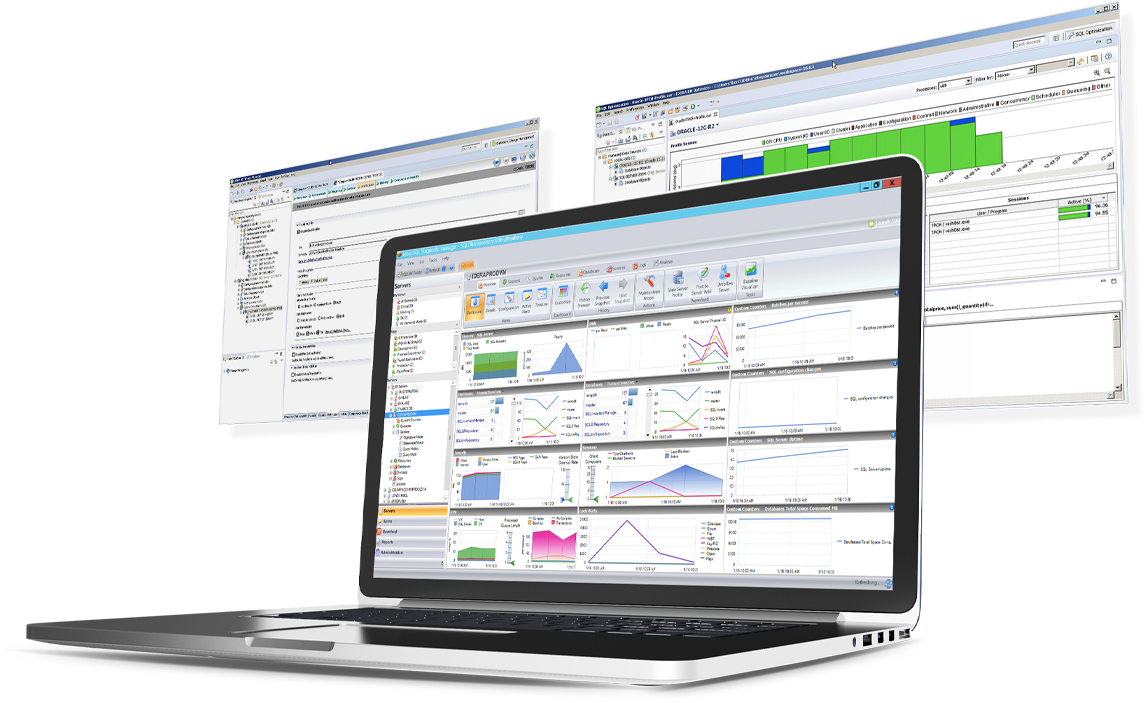
IDERA SQL Diagnostic Manager
Score8 out of 10
N/A
SQL Diagnostic Manager for Microsoft SQL Server helps database administrators to find and fix Microsoft SQL Server performance problems in physical, virtual, and cloud environments. Unlike its competition, it provides effective scalability, advanced SQL query analysis and optimization, prescriptive analysis with corrective SQL scripts, powerful automated alert responses, broad PowerShell integration, complete customization, and extensive support for current and legacy Microsoft SQL Server and…
Based on our experience, CircleCI is well-suited for automating mobile app release cycles. For example, to release an iOS app, you would need to build, sign, and upload it to TestFlight, which requires a dedicated Mac in the office. But with CircleCI, you can have macOS executors, so you don't have to manage a physical build machine. Another benefit is that CircleCI's certified AWS Orbs abstract away complex authentication and deployment logic, allowing us to build, push, and deploy Docker containers to Amazon ECS with minimal configuration and high reliability. CircleCI is less suited for smaller projects where the development and deployment are not that extensive, for example, a static site. Once you have built a static site, you probably won't make any further changes, so there's no point in paying for it.
A de minimis incentive was given to thank the reviewer for their time. The incentive was not used to bias or drive a particular response, nor was the incentive contingent on a positive endorsement. More Info
SQL Server [Business Intelligence] Manager is useful for tracking performance across SSIS, SSRS and SSA and have the data represented in dashboards. It helps improve performance and helps end users. However, several features are redundant for smaller organization that can use the tools that comes with existing Microsoft products. These features also takes time to learn and use.
A de minimis incentive was given to thank the reviewer for their time. The incentive was not used to bias or drive a particular response, nor was the incentive contingent on a positive endorsement. More Info
Automated builds! This is really why you get CircleCI, to automate the build process. This makes building your application far more reliable and repeatable. It can also run tests and verify your application is working as expected.
Simple. Unlike Jenkins, Teamcity, or other platforms, CircleCI doesn't need a lot of setup. It's completely hosted, so there's no infrastructure to set up. The config file does take a bit to understand, but if you follow their example and start with something small and add to it, you can get it up and going quicker than it first looks.
Scales easily. Again, since it's all cloud-based, you don't have to manage or scale infrastructure. Simply subscribe to the number of containers you want, and scaling up just means buying more containers.
A de minimis incentive was given to thank the reviewer for their time. The incentive was not used to bias or drive a particular response, nor was the incentive contingent on a positive endorsement. More Info
SQLdm does a good job of providing information at a high level, but also allows me to drill down to specific queries and events if needed. I don't always need to sift through tons of details to get the information I need. It also gives a very wide range of information from SQL specific metrics, to OS metrics, to VM metrics, all the way up to host server metrics.
I like how the alert and notification system can be customized. For example, if you know a certain server regularly has long-running queries, you can adjust the alert to not fire unless a query has been running for 30 minutes while the rest of the servers fire after 30 seconds. That is very helpful in not being bombarded at dinner with alerts from a server similar to, "I've been at 90% cpu for 26 milliseconds!!!!!!!...and now it's back down to 30%" Good information to know, but not something you need to literally lose sleep over.
I like how you can configure different servers to be monitored differently. For example, you can have a group of servers called DEVELOPMENT that you can turn on heavier monitoring on so you can test how changes in applications might affect the SQL environment, but in the PRODUCTION group, you may only want to enable the heavier analysis and logging when performance issues are actively being reported.
A de minimis incentive was given to thank the reviewer for their time. The incentive was not used to bias or drive a particular response, nor was the incentive contingent on a positive endorsement. More Info
A de minimis incentive was given to thank the reviewer for their time. The incentive was not used to bias or drive a particular response, nor was the incentive contingent on a positive endorsement. More Info
Windows client has some issues. When you have small time intervals for your data collection, it can cause the client to become unresponsive and require you to restart it.
It takes more time to get the web client running than it does to get the windows client running.
The visualizations have been the same for the last eight years--could use a little bit of a refresh.
A de minimis incentive was given to thank the reviewer for their time. The incentive was not used to bias or drive a particular response, nor was the incentive contingent on a positive endorsement. More Info
The reliability & speed, it just works. The ability to spin up macOS runners and Docker containers on demand without managing hardware is a huge win. The Orbs system makes integrating with AWS and Slack incredibly easy, saving us weeks of custom scripting and providing real-time updates in our Slack channel. This makes it easy for us to track and ensures that everyone involved knows the status. Of course, it has drawbacks related to configuration complexity and, in some cases, cost transparency, but overall, it is an industry-standard, robust tool that solves our core infrastructure problems well.
A de minimis incentive was given to thank the reviewer for their time. The incentive was not used to bias or drive a particular response, nor was the incentive contingent on a positive endorsement. More Info
It's pretty snappy, even with using workflows with multiple steps and different docker images. I've seen builds take a long time if it's really involved, but from what I can tell, it's still at least on par if not faster than other build tools.
A de minimis incentive was given to thank the reviewer for their time. The incentive was not used to bias or drive a particular response, nor was the incentive contingent on a positive endorsement. More Info
Unless you have a reasonably large account, you're going to be mainly stuck reading their documentation. Which has improved somewhat over the years but is still extremely limited compared to a platform like Digital Ocean who invested in the documentation and a community to ensure it's kept up to date. If you can't find your answer there, you can be stuck.
A de minimis incentive was given to thank the reviewer for their time. The incentive was not used to bias or drive a particular response, nor was the incentive contingent on a positive endorsement. More Info
Jenkins is usually self-hosted, Travis CI's infrastructure is largely unreliable (lots of tests time out for no discernable reason), and Semaphore encourages you to configure your CI/CD from a web UI. We like CircleCI because its hosted, our tests run largely as expected on their infrastructure, and we can configure it from a config file that we track in GitHub.
A de minimis incentive was given to thank the reviewer for their time. The incentive was not used to bias or drive a particular response, nor was the incentive contingent on a positive endorsement. More Info
IDERA SQL Diagnostic Manager for SQL, Redgate SQL, and MonitorLogicMonitor are similar products to each other. We decided on IDERA SQL Diagnostic Manager for SQL because our experience with locating heavy queries has been very good and it provides real-time monitoring of all servers and databases. It also allows you to have a large volume of historical data which allows you to analyze trends in the databases.
A de minimis incentive was given to thank the reviewer for their time. The incentive was not used to bias or drive a particular response, nor was the incentive contingent on a positive endorsement. More Info
We pay over $5K/ month and we have high expectations for service. Sometimes I feel that we don't get the value, but only sometimes.
We have had to build our own application to keep state and broker releases and deployments. We call our app deployer. I feel that CircleCI could do more to understand our needs and possibly build additional features that would enable us to invest less in build and deployment infrastructure and justify paying more for Circle.
A de minimis incentive was given to thank the reviewer for their time. The incentive was not used to bias or drive a particular response, nor was the incentive contingent on a positive endorsement. More Info
A de minimis incentive was given to thank the reviewer for their time. The incentive was not used to bias or drive a particular response, nor was the incentive contingent on a positive endorsement. More Info