Cisco Stealthwatch is a network behavior analysis product based on technology acquired by Cisco with its Lancope acquisition in 2015.
N/A
Datadog
Score 8.6 out of 10
N/A
Datadog is a monitoring service for IT, Dev and Ops teams who write and run applications at scale, and want to turn the massive amounts of data produced by their apps, tools and services into actionable insight.
$18
per month per host
LogRhythm NextGen SIEM Platform
Score 7.7 out of 10
N/A
The LogRhythm NextGen SIEM Platform, from LogRhythm in Boulder, Colorado, is security information and event management (SIEM) software which includes SOAR functionality via SmartResponse Automation Plugins (a RespondX feature), the DetectX security analytics module, and AnalytiX as a log management solution that centralizes log data, enriches it with contextual details and applies a consistent schema across all data types.
N/A
Pricing
Cisco Secure Network Analytics
Datadog
LogRhythm NextGen SIEM Platform
Editions & Modules
No answers on this topic
Log Management
$1.27
per month (billed annually) per host
Infrastructure
$15.00
per month (billed annually) per host
Standard
$18
per month per host
Enterprise
$27
per month per host
DevSecOps Pro
$27
per month per host
APM
$31.00
per month (billed annually) per host
DevSecOps Enterprise
$41
per month per host
No answers on this topic
Offerings
Pricing Offerings
Cisco Secure Network Analytics
Datadog
LogRhythm NextGen SIEM Platform
Free Trial
No
Yes
No
Free/Freemium Version
No
Yes
No
Premium Consulting/Integration Services
No
No
No
Entry-level Setup Fee
No setup fee
Optional
No setup fee
Additional Details
—
Discount available for annual pricing. Multi-Year/Volume discounts available (500+ hosts/mo).
Few products operate off the Netflow or RAP/SPAN traffic versus the endpoint. Of those products, many operate from the aggregate traffic of uplinks/downlinks, whereas Secure Network Analytics focuses on viewing all traffic to give per-endpoint comprehensive data analytics. SNA is a great product for network visibility and detection, and to preserve that focus, other options such as remediation or quarantined are deferred to other products in the security ecosystem. SNA uses Machine Learning models to determine traffic behavioral compliance, which is a double-edged sword. On one hand, it mitigates zero day attacks changing traffic patterns, but conversely, it requires training to know acceptable traffic patterns. Unfortunately, many adopters of SNA do not spend the time giving it the user input and so the ML models never gets the correct weights and parameters to work from.
Datadog may be better suited for teams that have a more out-of-the-box infrastructure, on the primary platforms Datadog supports. You may also have better results if you have a bigger team dedicated to devops and/or a bigger budget. We found that trying to adapt it to our use case (small team, .NET on AWS Fargate) wasn't feasible. We continually ran into roadblocks that required us to dig through documentation (and at times, having to figure out some documentation was wrong), go back and forth with support, and in my opinion, waste money on excessive and unintended usages due to opaque pricing models and inaccurate usage reports, as well as broken/non-functional rate sampling controls.
Having mostly worked with their on-premises solution, I think it's well-suited for small , medium, and even big organisations. I feel it might be less suited if the customer wants a SIEM with 100% uptime, as it goes down a lot. Or if they want to depend on customer support. I suggest that if you want to go with LR, you have to have your own experienced engineers to work on.
The thing which Datadog does really well, one of them are its broad range of services integrations and features which makes it one step observability solution for all. We can monitor all types of our application, infrastructure, hosts, databases etc with Datadog.
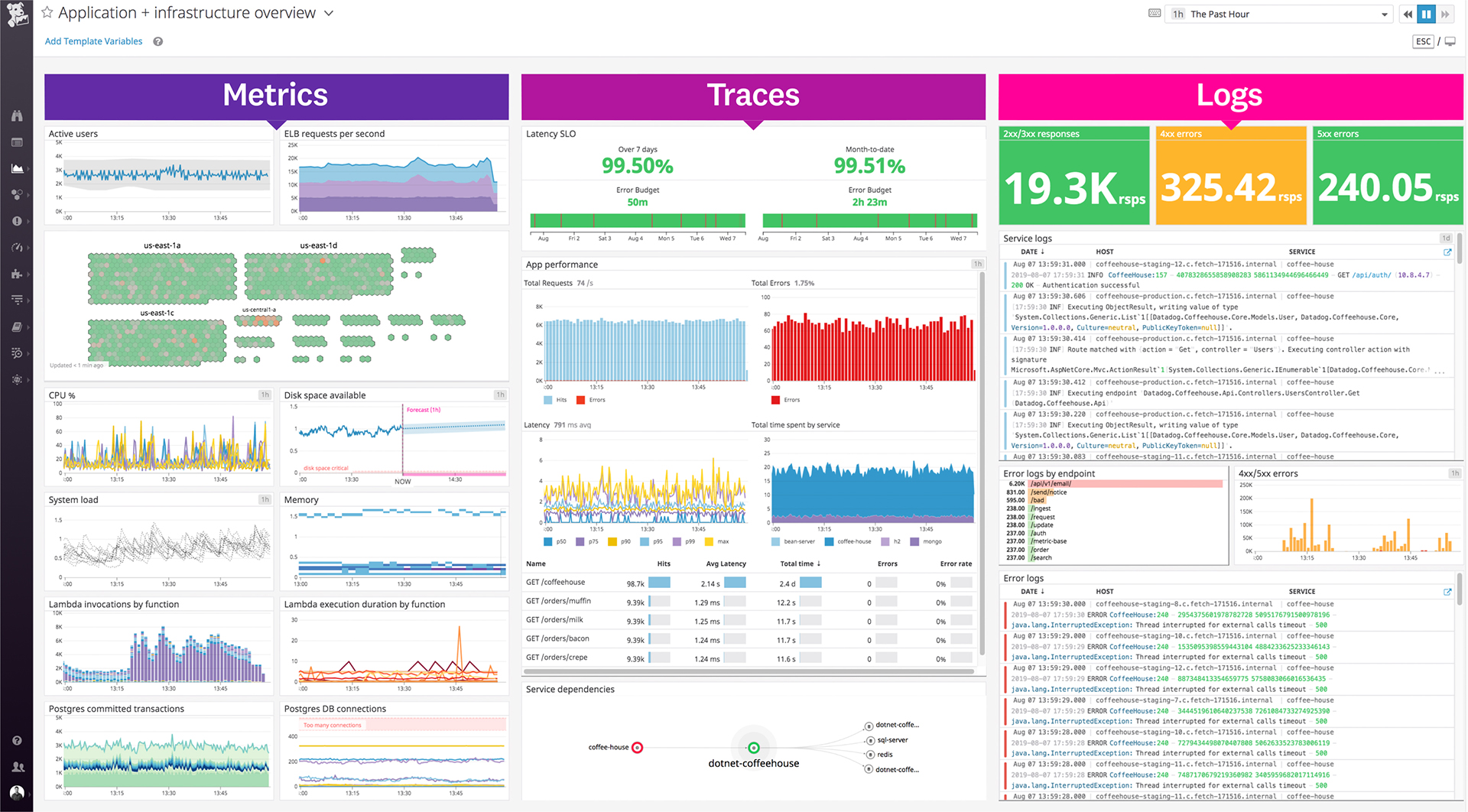
Its custom dashboard feature which helps us to visualize the data in a better way . It supports different types of charts through those charts we can create our dashboard more attractive.
Its AI powered alerting capability though that we can easily identify the root cause and also it has a low noise alerting capability which means it correlated the similar type of issues.
LogRhythm NextGen SIEM Platform has an alarm system that generates tickets based on the event and the way it has been configured in the LogRhythm console. Let's say we have a ticket for a malicious email attachment. The ticket will some information like the source of the log, the source IP, destination IP etc. It can be drilled down to obtain specific information like the recipient, source location, file attachment name, SHA hash of the file, source and destination port, time, mac address of the machine that downloaded it etc. This helps the analysts to go to the root of the cause and take actions easily without manually parsing them.
The second good thing about the LogRhythm NextGen SIEM Platform is that it is very easy to use with its well-structured interface. To use LogRhythm, an user barely require any technical skills. A little overview of IP, CIDR, hash, etc. is enough to get your hands on it. It requires no programming or coding skills, as everything is GUI based. It also provides a beautiful visualization dashboard. There is another beautiful feature that it provides for the classification of events, known as cases. Multiple users working on the same platform can create cases and add events to it. They also help to maintain future reference.
The third good feature is the search tool which is very powerful. For example, sometimes it is hard to find the users who downloaded a malware from the guest wireless of the institution and not the private network. The search tool helps us in searching the user by automatically correlating the MAC address from the current network logs and the previous logs as the MAC address is the same. It is highly scalable for parsing a large number of logs from various sources.
I particularly think this is one of the best software available for log parsing in an organization where non-technical users are working on incident response. This tool has a good amount of flexibility. However, it can only be configured with the LogRhythm NextGen SIEM Platform Console.
In terms of usability, as already mentioned, it is a very easy tool to use, with a GUI based interface.
Some of the jobs can be difficult to setup until you know how they were designed
Unless coupled with other Cisco products, you may not get all of the information you would like to have
If you have a network that already has many issues it may take a lot of time to see the value in the product; it would take time to weed everything which this product will detect for you to use it to find that needle in the haystack
Alert windows cause lag in notifications (e.g. if the alert window is X errors in 1 hour, we won't get alerted until the end of the 1 hour range)
I would appreciate more supportive examples for how to filter and view metrics in the explorer
I would like a more clear interface for metrics that are missing in a time frame, rather than only showing tags/etc. for metrics that were collected within the currently viewed time frame
LogRhythm absolutely needs to provide back end support for threat intelligence lists. Performing a linear search on massive lists of IPs on incoming web traffic can bring the SIEM to its knees.
LogRhythm should drop its entire code base for implementing lists and simply turn them into hash tables to avoid the excessive cost associated with referencing lists in rules. I haven't seen the code, but the performance suggests O(n).
The reporting feature is the worst of all SIEMs, luckily reports are not my primary service offering. LogRhythm should definitely revamp its reporting to be more intuitive.
Cisco Secure Network Analytics is a fantastic tool, but does require some setup and upkeep which may turn off smaller IT Security teams. However, once all the flows are set up and the product is functioning with the proper rules, the insight into your network is fantastic. For us, the product has a significant ROI and will be a product we keep up on.
LogRhythm is focused on SIEM. That is their core business. Cost of operations, feature set and ease of use. The Log Rhythm support team is outstanding. Overall reliability is good. Reporting module needs some improvement and LR is promising that there will be significant improvements in future releases.
Strong and complete tool which gives comprehensive methods to discover cyber security incidents and prevent data leakage. In case of common use of Cisco StealthWatch and Cisco ISE, you will receive [the] ability [to] not just discover cyber security incidents but also dynamically respond to them. This makes StealthWatch one of most valuable products through[out] [the] whole Cisco Security product portfolio.
There are so many features that it can be hard to figure out where you need to go for your own use case. For example, RUM monitoring us buried in a "Digital Experience" sidebar setting when this is one of our key use cases that I sometimes struggle to find in the application. It appears that ECS + Fargate monitoring was recently released which is great because we had to build a lambda reporting solution for ephemeral task monitoring. But this new feature was never on my radar until I starting clicking around the application.
LogRhythm does a rather decent job of making the functionality advanced (allowing for advanced keyword & field searching, use of "AND" as well as "OR" statements in the search bar) while keeping it accessible (by not requiring a specific syntax to do quick searches). This combined with a user interface that has headings and labels that are intuitive is very helpful.
I would rate Cisco Secure Network Analytics’ availability as 8 out of 10. The platform is highly stable and reliable, with users reporting minimal downtime and consistent performance once the system is properly deployed and configured.
Overall winner because it exceeds our expectations by answering all our requirements and at the same time empowers our operations thru other built-in capabilities it has. Visibility is a key to security operations and Cisco StealthWatch really gives us a magnifying glass to check all logs in the network for threat intelligence and threat hunting.
The support team usually gets it right. We did have a rather complicate issue setting up monitoring on a domain controller. However, they are usually responsive and helpful over chat. The downside would be I don’t think they have any phone support. If that is important to you this might not be a good fit.
While LogRhythm support is generally quick to respond, the initial response is usually from a first line support engineer with general knowledge of the product. Any advanced or complex issues have always required the assistance of a higher tier of support, directly or indirectly. For a few occasions we actually used our PS hours to work on the issue.
Implementation of the product can be tedious, especially fine tuning its rules to customize it to your environment. However, after that is done, CSNA is a very useful and flexible product that would enhance the security posture of any corporate network.
I wasn't involved in the decision-making when it happened. It was a couple of years ago, but I can't think of the vendor's name. They used to be here at Cisco Live. But it was another NetFlow vendor, but they were strictly NetFlow and all they did was just a net flow and the Secure Network Analytics has like some of the security anomaly detection stuff built into it. And that was kind of a deciding factor of wanting more of the security focus of the net flow. The net flow was a bonus, but the security stuff was what we were looking for.
Our logs are very important, and Datadog manages them exceptionally well. We frequently use Datadog services for our investigations. Use case: Monitor your apps, infrastructure, APIs, and user experience.
Key features:
Logs, metrics, and APM (Application Performance Monitoring)
Real-time alerting and dashboards
Supports Kubernetes, AWS, GCP, and other integrations
RUM (Real User Monitoring) and Synthetics
✅ Best for backend, server, and distributed systems monitoring.
LogRhythm was simpler to set up and configure as well as extract information from. It also was less intrusive in terms of how many appliances were needed to implement. We were up and running within 5 hours to start accepting log sources. We selected LogRhythm as well since support is based in the USA in Colorado.
It is a little pricey - in my organization, with budget cuts, I eventually had to replace it with an open source product (NTOP). While it works well for visibility, it simply isn't the same. If you can afford it, don't bother looking anywhere else - just get it.
Being able to detect, pivot out, and remmediate from one console was awesome.