ClickHelp is an online documentation tool from the company of the same name headquartered in Yerevan, Armenia, used by software companies to create user manuals, knowledge bases, FAQs, tutorials, etc., and publish them instantly in their portal.
$194
per month
Paligo
Score 8.7 out of 10
N/A
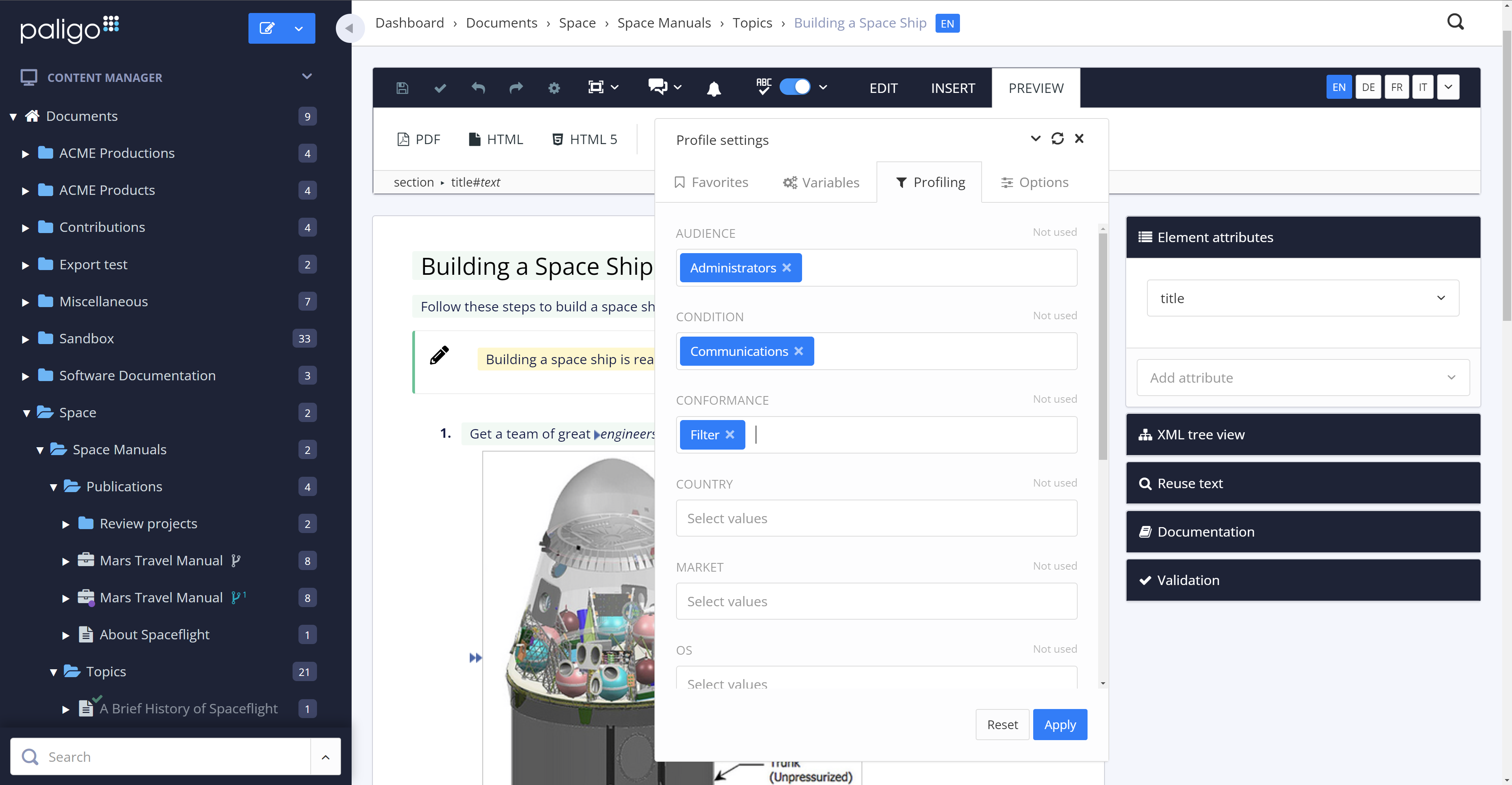
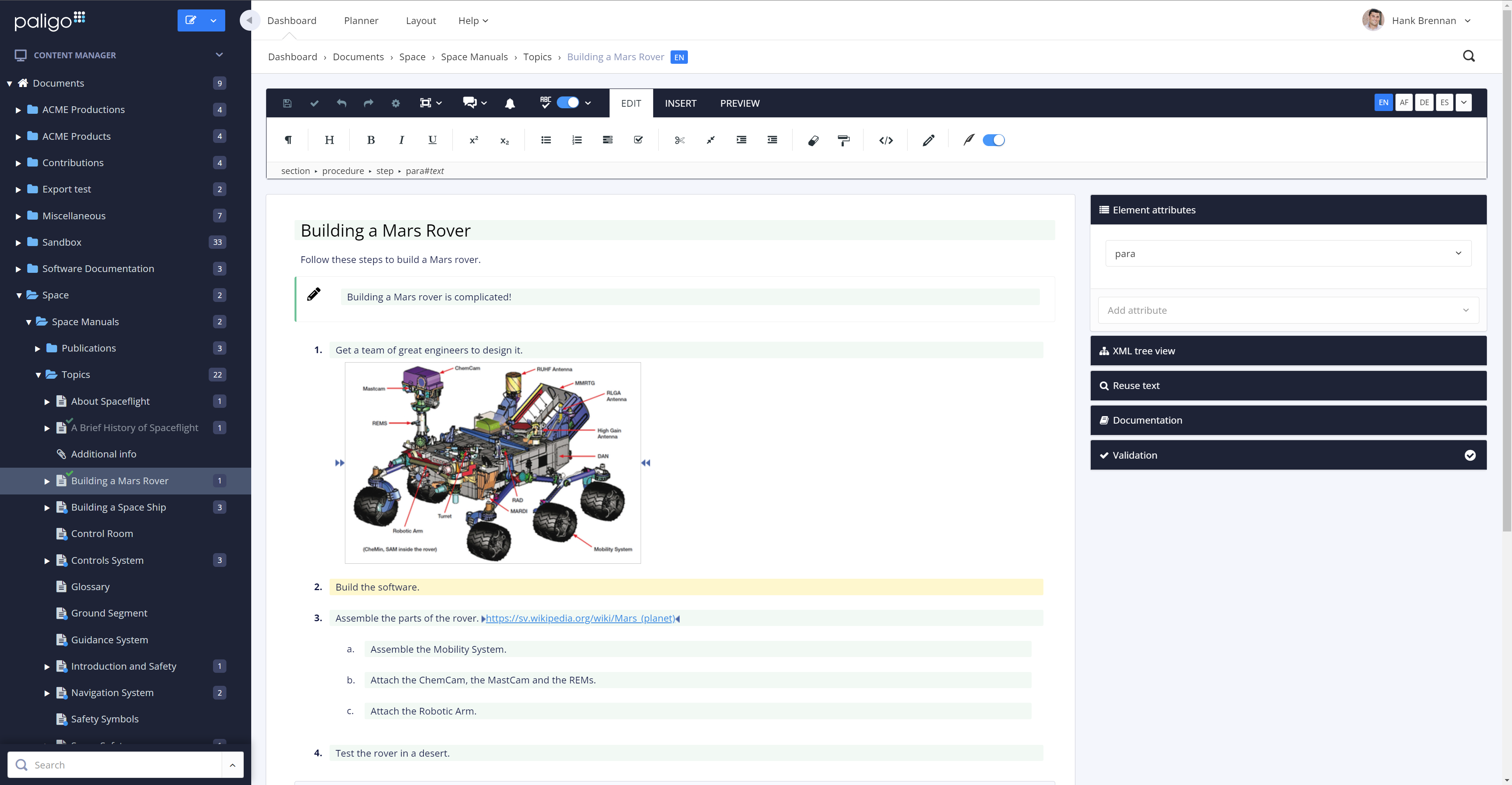
Paligo is a component content management system (CCMS) that helps teams manage complex technical documentation through structured authoring, content reuse, and controlled publishing.
ClickHelp is great for both big and small documentation teams. The platform is not too complex to overwhelm a small team, and neither is it too simple for a well-advanced documentation team. Scale ClickHep depending on your documentation needs, and the features are simple to understand. I also appreciate the extensive documentation that is available for new users to ClickHelp. The ClickHelp knowledgebase provides answers to every scenario, use case, feature, and functionality. The ClickHelp support team is also very responsive.
One of the biggest strengths is the structured authoring, which not only gives clean content for users but is also well-suited for providing AI content. I also make good use of content reuse, which simplifies maintenance and documentation updates when features change. The taxonomy has allowed me to create versioned documentation on our site that correlates with customers' installed software versions. We're switching over to using the API for publishing to our website and that will be a nice switch from the publication structure we've used previously. The tool doesn't, at this time, allow me to connect it to a custom GPT or create one that would be based on our style guide. There also isn't an MCP server option to work better with my Claude configurations.
The review mode is super convenient. Comparing a snapshot of the previous versions with the current one clearly outlines the respective changes and reduces the necessary content to review tremendously.
The option to reuse text fragments is another handy feature. Text fragments will be updated whenever the original text fragment is altered is also extremely helpful.
Managing a content's structure was never easier. An intuitive drag & drop functionality allows you to design your document's structure however you like.
You can also fork content, in addition to reuse text fragments. This is another helpful option that no longer requires you to create repetetive chapters over and over.
The See Also element should be able to automatically update when a new topic is added. Currently, we have to manually remove and re-add the element to do that.
Ability to host image files externally (eg. S3, Dropbox), like it is done for videos. This will help save storage.
Image files from imported projects are always duplicated, perhaps a bug, but it needs to be looked into.
The amount of CSS/JS required to customize a site's appearance can be cumbersome
Product documentation can be lacking, specifically with integrations; in some cases, support offered no real help when trying to solve a problem with an integrated service
Some features require extensive development experience to use, which can sometimes be an obstacle to less-experienced team members
Reuse feature was the main reason for selection Paligo. It is the most powerful feature for us as now we have only one source of content that is used in all other documents through reuse. Makes it very easy when we need to update the content (in some cases at least once a quarter) and batch publishing makes it very easy to publish 100s of documents in one click
All the support requests I've submitted have been resolved in one way or another. Sometimes it takes some back and forth, which is to be expected. This is where being on a different continent becomes a drawback. Since we became Enterprise users, we've also had an additional level of help and support from a dedicated account manager in the US, and the resolutions seem to come more quickly
ClickHelp provides an extensive array of features compared to what we used previously. The WYSIWYG editor is so simple, yet brings with it really cool content editing elements. Publishing content is straightforward with ClickHelp. I can publish a part of a document for partial updates, or create a new publication. I get to host multiple versions of one product documentation based on the software versions we support. The analytics provided is also very insightful.
We moved from Flare to Paligo. One of the main reasons was the fact that Paligo is a cloud product. Collaboration with anyone outside of our team was more difficult with Flare. Also, maintaining a server for Flare content was going to become an issue, and overall I felt the Flare desktop product was prone to errors and issues. The flexibility of assigning Paligo licenses was a huge factor, as was the stability of the cloud platform.
We are able to cater to all our end-users regardless of the software version they are using, simply because we are able to provide multiple product documentation versions.
Our documentation publishing time was reduced significantly due to the smooth process on ClickHelp.
With one platform where all our product documentation can be housed, we are expanding technical documentation to other products.
I am not involved in the financial decisions for my company regarding Paligo; the decision to migrate our content to this environment predates my hiring. However, I know that the migration effort from WordPress to Paligo was an initially heavy lift, but any content migration effort would be. I believe that ultimately, getting our content out of WordPress was a positive move, and I look forward to seeing what Paligo will help us accomplish in the future. Sorry, no hard numbers from me. :)