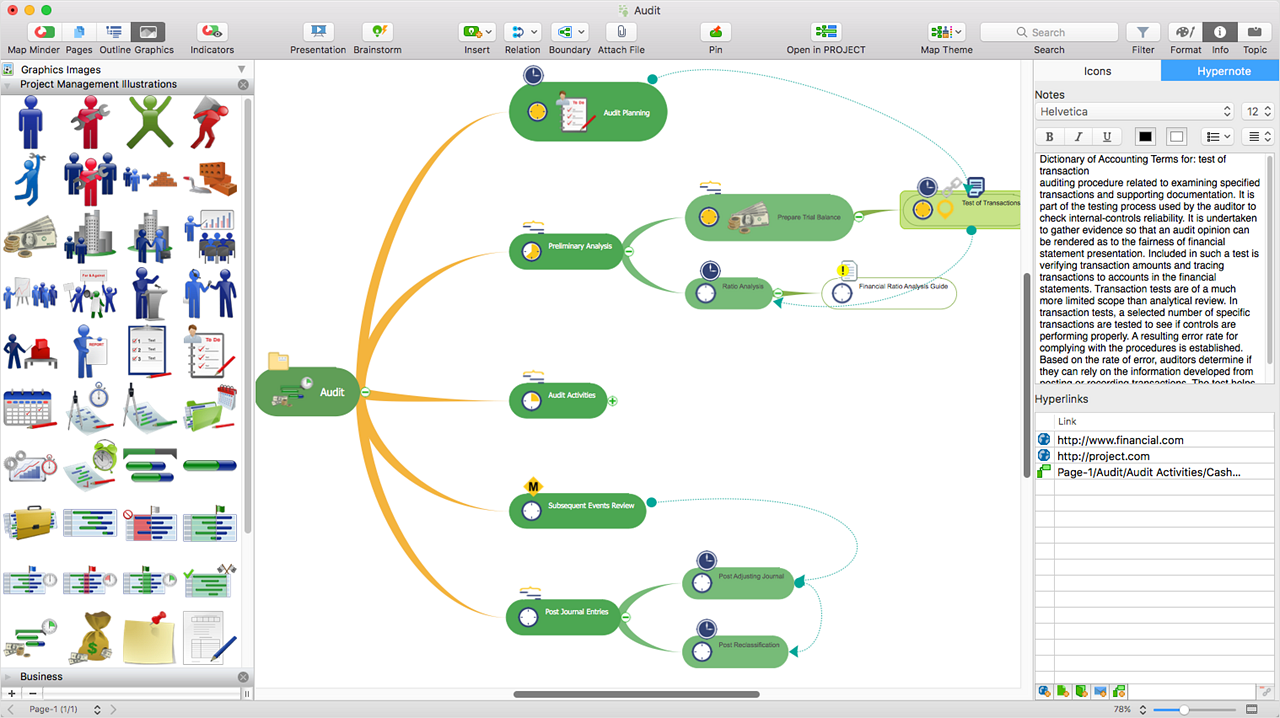
ConceptDraw MINDMAP is l mind mapping software application that can also resolve tasks for project management. According to the vendor, multiple shortcuts help users create new topics, re-arrange
them and highlight important points, and export to various
file formats. Enrich your mind map with in-built visual…
N/A
draw.io
Score 7.7 out of 10
N/A
draw.io is an online diagramming tool with integrations with Jira, Google, and Confluence available free online or at cost depending on integration chosen.
$5
per month
OmniGraffle
Score 9.7 out of 10
N/A
OmniGraffle is a wireframing tool for Mac users.
N/A
Pricing
ConceptDraw MINDMAP
draw.io
OmniGraffle
Editions & Modules
No answers on this topic
Up to 10 Users
$5
per month
Up to 20 Users
$11
per month
Up to 50 Users
$27.50
per month
Up to 75 Users
$41.25
per month
Up to 100 Users
$55
per month
Up to 200 Users
$95
per month
Up to 500 Users
$152.50
per month
Up to 750 Users
$190
per month
Up to 1,000 Users
$227.50
per month
Up to 2,000 Users
$377.50
per month
Up to 5,000 Users
$827.50
per month
Up to 10,000
1,577.50
per month
No answers on this topic
Offerings
Pricing Offerings
ConceptDraw MINDMAP
draw.io
OmniGraffle
Free Trial
Yes
No
No
Free/Freemium Version
No
No
No
Premium Consulting/Integration Services
No
No
No
Entry-level Setup Fee
$199 per seat
No setup fee
No setup fee
Additional Details
Price varies for Individual, Commercial, Academic, Nonprofit and Government
Best tool for brainstorming ideas and gathering requirements with an easy way to connect the information. The other software which we tried had limited options and were more time consuming. The pricing model of ConceptDraw MINDMAP is simple and straightforward. Apart from …
Draw.io is a solid, no-additional-cost (included with G-Suite) substitute for OmniGraffle for our use case. The client can view and collaborate on documents produced with draw.io without us having to go through an export process, or the client having to own an additional piece …
Because we're primarily a Mac shop, Visio was a non-starter. (It's monstrously complex compared to OmniGraffle, which works against the quick-and-dirty just-enough-documentation ideal common on agile teams.) We've used draw.io on internal projects and when coordinating with …
Organising results of brainstorming session for threat and error management solutions is how we mostly use ConceptDraw MINDMAP. Another common use is for dynamic note taking while attending conferences or classes. It can also be used to prepare notes when giving classes. We also used it sometimes for accident investigation analysis, building diagrams of probable causes leading to the event.
draw.io can be more suitable for technical documentation for architectures, flow diagrams/charts, and conceptual images of an application infrastructure. However, this tool is not made for business intelligence work nor for dashboarding to monitor the technical components. From the administrative standpoint, this is not well suited for agile ceremony structures like retrospective boards or planning or even quarterly planning boards. The strength of draw.io lies strongly in being a lightweight diagramming tool.
Omnigraffle is great for documentation, mapping, flowcharting, and other technical diagramming scenarios. It's simple enough to bang out a quick illustration and powerful enough to build complex blueprints for complicated technical systems. If you need cross-platform compatibility, though, you're probably better off looking elsewhere. If you want complex integration with data sources (ala Visio's SQL Server integration for shape metadata), OmniGraffle also falls short — but those scenarios are few and far between in my experience.
Draw.io offers a lot of shapes and customizability of how the diagrams are laid out. We've been able to create a lot of different things with it, and have barely scratched the surface of the sorts of things that we could do.
Draw.io is fairly intuitive in the way that you draw shapes and connect shapes together, I was able to figure it out without a tutorial.
Draw.io is fast and performant for me compared with some of the alternatives.
OmniGraffle is fairly simple to use, but the one thing I think it does best is working with curved lines, particularly if you are using some of the available arc templates. Drop an arc onto your page, then tell it the dimensions it needs to be, and viola! Done. Manipulating the arcs is as simple as clicking and dragging offset points.
OmniGraffle has also done an excellent job in stirring up the creative minds of many people who create templates and tools to work with OmniGraffle (not that Microsoft hasn't done so either), and managed to get the bulk of those into well organized repositories.
What it all boils down to for me is: it just works. One doesn't need to have a computer science degree to work with it either. It is as simple or complex as you want it to be.
I'd love to be able to keep more than one of the different tool tabs open at a time.
The stencils are amazing. Would be great if a whole lot more of the free ones came standard as opposed to having to download them from Graffletopia or other sites.
The UI is intuitive. It allows a new user to start diagramming almost instantly. Manipulating elements, linking them together, etc. are all easy to do. Draw.io nevertheless a broad variety of diagram templates to help get started and also of shapes to use in diagrams. Some situations can make it a bit tricky to use, such as when having multiple shapes on top of each other (e.g. shapes placed within swimlanes) but that's a minor issue.
Support team is one of the best in ConceptDraw MINDMAP, the response was quick and solution for the problem is clear with best ticketing management. The right customer approach gives you hassle free interaction with support team.
The support for draw.io is pretty decent, considering it is a free website. I had a question one time when I was trying to do something, so I sent an email to their support email and got a response fairly quickly with an answer to my question. They also have some excellent support tools on their support website for helping you get more familiar with their program, and I found that very helpful.
As we were already using PROJECT, it became obvious that ConceptDraw MINDMAP was the product to use. The integration between those two products is very convenient and useful. The fact that ConceptDraw MINDMAP solutions was usable on Mac OS was also a pre requisite for us. We did not use any other Mind Map software.
draw.io is open-source and free for many uses, which means minimal upfront cost and good value.It works in the browser, also has a desktop version (so you can use offline) which helps teams that may not always be online or want local backups. Useful when you want a diagram tool that “just works” without huge ecosystem lock-in.For organisations that value control, less vendor-dependency, this is a plus.
While these other tools are great for what they are, OmniGraffle’s solid focus on and support for diagramming makes it our tool of choice for communicating workflows and concept relationships, creating documentation, and creating other diagrams. Its libraries allow us to create designs quickly, and its ease of use enables us to use the tool widely across the company without much time or effort spent on onboarding.
Omnigraffle isn't an expensive software tool, so there isn't really any negative from the perspective of raw cost. Thinking in terms of time spent using it on a project - what you create in omnigraffle will inevitably lead to a dead end. It's useful only as documentation. There are other tools like Sketch that integrate into prototyping software and can create useable visual assets for applications in addition to being able to create wireframes.