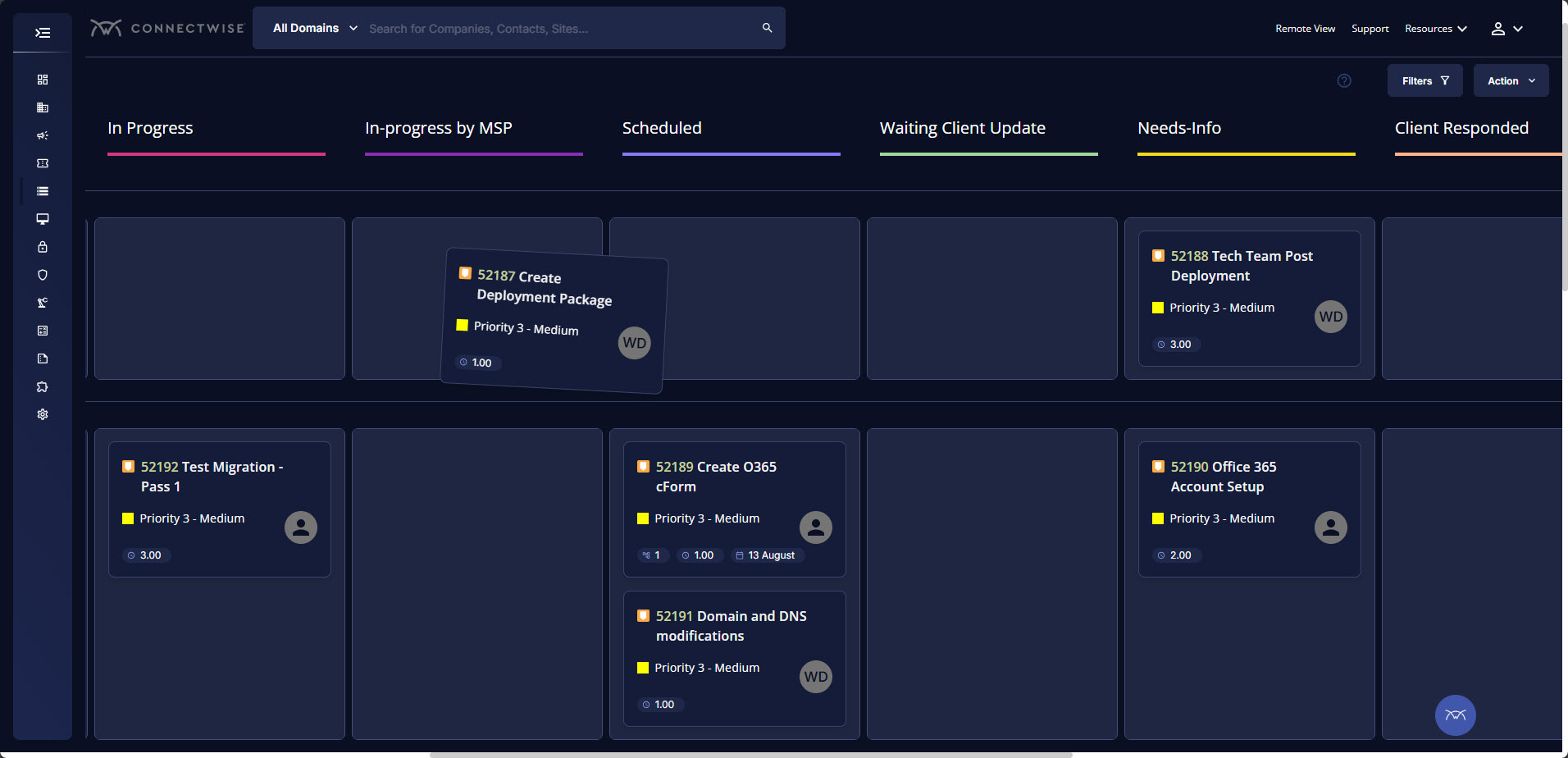
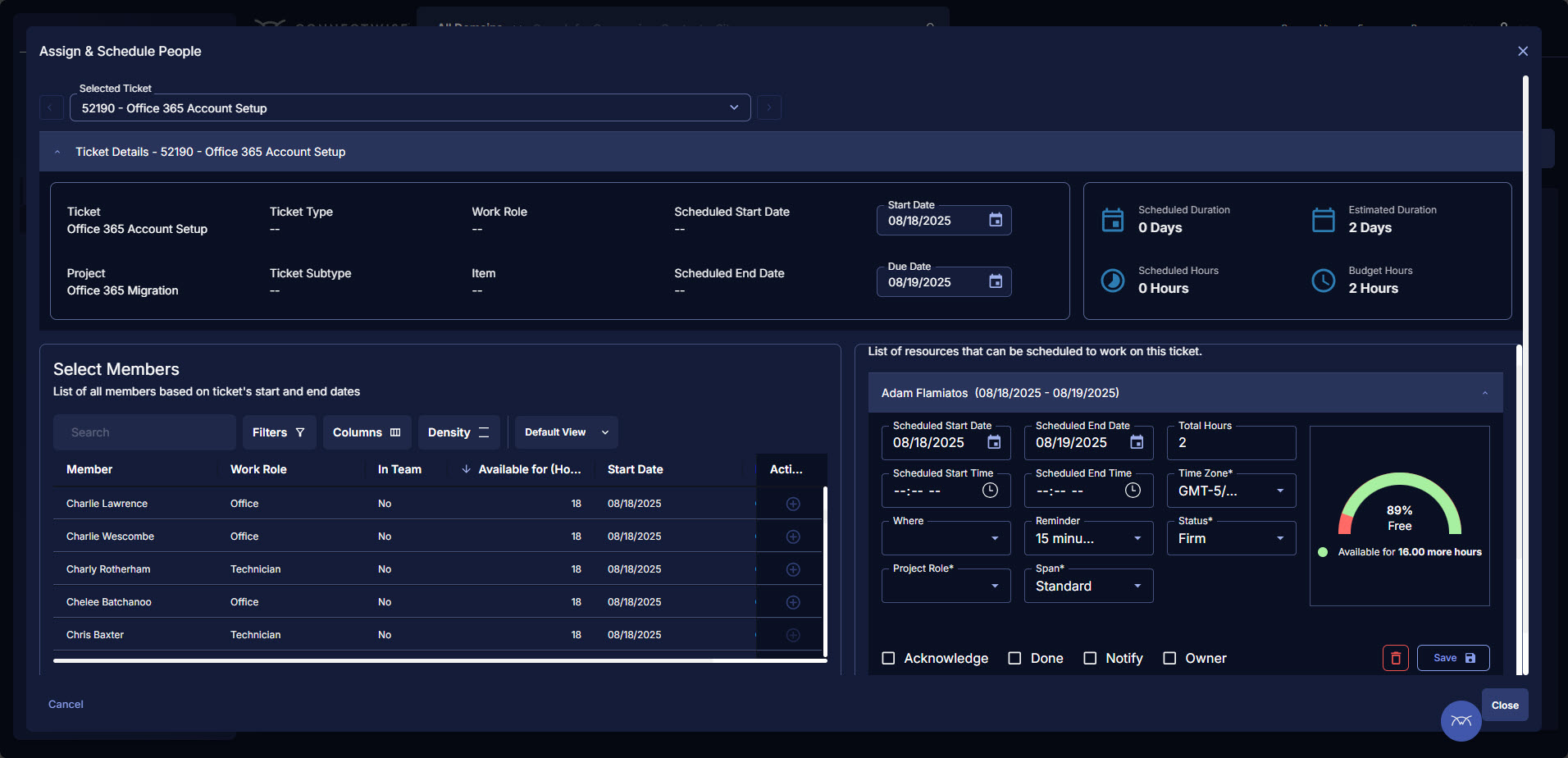
ConnectWise PSA (formerly Manage) is a business management platform for companies that sell, service, and support technology. The platform is cloud-based and integrates automation, help desk and customer service, sales, marketing, project management, and business analytics. It is the hub of the ConnectWise suite.
$35
Per Tech Per Month
Plotly Dash
Score 8.0 out of 10
N/A
Plotly headquartered in Montreal creates data visualization and UI tools for ML, data science, engineering, and the sciences with language support for Python, R, Julia, and JS. Plotly's Dash aims to empower teams to build data science and ML apps that put Python, R, and Julia in the hands of business users. The vendor states that full stack apps that would typically require a front-end, backend, and dev ops team can be built and deployed in hours by data scientists with Dash.
N/A
Spotfire
Score 8.2 out of 10
N/A
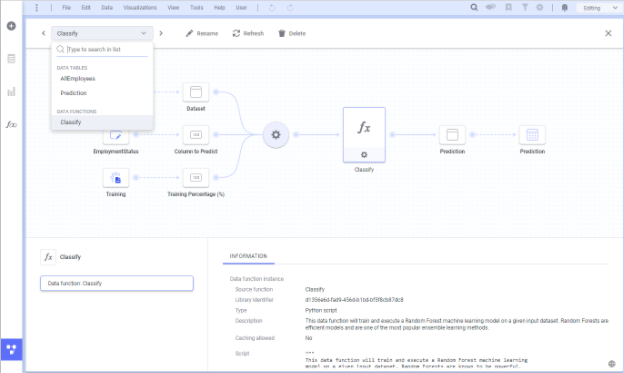
Spotfire, formerly known as TIBCO Spotfire, is a visual data science platform that combines visual analytics, data science, and data wrangling, so users can analyze data at-rest and at-scale to solve complex industry-specific problems.
N/A
Pricing
ConnectWise PSA
Plotly Dash
Spotfire
Editions & Modules
Subscription
$35.00
Per Tech Per Month
No answers on this topic
No answers on this topic
Offerings
Pricing Offerings
ConnectWise PSA
Plotly Dash
Spotfire
Free Trial
No
No
Yes
Free/Freemium Version
No
No
No
Premium Consulting/Integration Services
No
No
Yes
Entry-level Setup Fee
No setup fee
No setup fee
No setup fee
Additional Details
—
—
For Enterprise engagements, contact Spotfire directly for a custom price quote.
More Pricing Information
Community Pulse
ConnectWise PSA
Plotly Dash
Spotfire
Features
ConnectWise PSA
Plotly Dash
Spotfire
Incident and problem management
Comparison of Incident and problem management features of Product A and Product B
ConnectWise PSA
8.8
89 Ratings
7% above category average
Plotly Dash
-
Ratings
Spotfire
-
Ratings
Organize and prioritize service tickets
9.489 Ratings
00 Ratings
00 Ratings
Expert directory
6.950 Ratings
00 Ratings
00 Ratings
Subscription-based notifications
8.462 Ratings
00 Ratings
00 Ratings
ITSM collaboration and documentation
8.169 Ratings
00 Ratings
00 Ratings
Ticket creation and submission
9.989 Ratings
00 Ratings
00 Ratings
Ticket response
9.788 Ratings
00 Ratings
00 Ratings
Self Help Community
Comparison of Self Help Community features of Product A and Product B
ConnectWise PSA
7.8
83 Ratings
3% below category average
Plotly Dash
-
Ratings
Spotfire
-
Ratings
External knowledge base
8.768 Ratings
00 Ratings
00 Ratings
Internal knowledge base
7.078 Ratings
00 Ratings
00 Ratings
Multi-Channel Help
Comparison of Multi-Channel Help features of Product A and Product B
ConnectWise PSA
9.3
86 Ratings
15% above category average
Plotly Dash
-
Ratings
Spotfire
-
Ratings
Customer portal
8.081 Ratings
00 Ratings
00 Ratings
IVR
10.021 Ratings
00 Ratings
00 Ratings
Social integration
10.028 Ratings
00 Ratings
00 Ratings
Email support
9.681 Ratings
00 Ratings
00 Ratings
Help Desk CRM integration
8.876 Ratings
00 Ratings
00 Ratings
Platform Connectivity
Comparison of Platform Connectivity features of Product A and Product B
ConnectWise PSA
-
Ratings
Plotly Dash
8.9
3 Ratings
6% above category average
Spotfire
7.2
8 Ratings
15% below category average
Connect to Multiple Data Sources
00 Ratings
8.43 Ratings
7.88 Ratings
Extend Existing Data Sources
00 Ratings
9.33 Ratings
7.48 Ratings
Automatic Data Format Detection
00 Ratings
8.43 Ratings
7.88 Ratings
MDM Integration
00 Ratings
9.52 Ratings
6.05 Ratings
Data Exploration
Comparison of Data Exploration features of Product A and Product B
ConnectWise PSA
-
Ratings
Plotly Dash
9.0
4 Ratings
6% above category average
Spotfire
9.1
8 Ratings
7% above category average
Visualization
00 Ratings
9.04 Ratings
9.08 Ratings
Interactive Data Analysis
00 Ratings
9.04 Ratings
9.28 Ratings
Data Preparation
Comparison of Data Preparation features of Product A and Product B
ConnectWise PSA
-
Ratings
Plotly Dash
6.2
2 Ratings
27% below category average
Spotfire
7.4
8 Ratings
10% below category average
Interactive Data Cleaning and Enrichment
00 Ratings
4.42 Ratings
7.28 Ratings
Data Transformations
00 Ratings
8.52 Ratings
8.08 Ratings
Data Encryption
00 Ratings
3.92 Ratings
7.05 Ratings
Built-in Processors
00 Ratings
8.02 Ratings
7.55 Ratings
Platform Data Modeling
Comparison of Platform Data Modeling features of Product A and Product B
ConnectWise PSA
-
Ratings
Plotly Dash
8.4
2 Ratings
0% above category average
Spotfire
7.6
8 Ratings
10% below category average
Multiple Model Development Languages and Tools
00 Ratings
9.02 Ratings
7.57 Ratings
Automated Machine Learning
00 Ratings
7.01 Ratings
8.55 Ratings
Single platform for multiple model development
00 Ratings
9.02 Ratings
7.68 Ratings
Self-Service Model Delivery
00 Ratings
8.52 Ratings
6.76 Ratings
Model Deployment
Comparison of Model Deployment features of Product A and Product B
BrightGauge lets us know when we have critical issues that need solving. A massive influx of tickets all at the same time triggers an investigation. Usually, it is tied to a server going down, which we can address. It would not be helpful for a small MSP or IT department with just a few daily tickets. The stats are better used to track a large amount of clients.
Applicable for data visualization across disciplines. I have used it for data from buildings, building occupancy, public health, and statistics. It is a useful tool to use for big data. It has nice templates and a number of interesting visualization types. If you are familiar with R and python it is easy to use.
A high level of data integration is available here it supports various data sources and so on. Collaborating features allow users to give access to the dashboard and merge data analytics with other team members. It can meet the demands of both small and large size business enterprises. A customized dashboard and reports are provided to meet the specific needs and get support of extensibility through APIs and customized scripts.
Tickets- Customers can email and a ticket is generated and falls under their profile for historical records. You can save documents and select if they are customer facing or only internal facing. The option as well to have communication in tickets whether its internal facing or customer facing is nice to have when you're trying to keep a record or important details for just internal means and the customer doesn't have to see all the jargon.
Procurement - It's great to have this integrate with Quosal Sell. Quotes being processed into opportunities and then into a sales order which connects to a ticket or project is pretty easy to use. It does have a learning curve but once you get the hang of it, it's straightforward. Everything is pretty connected, whether keeping track of products customers have purchased historically through us, to knowing what ticket is associated to an RMA.
Annual or more than annualized data is desperately needed for MSPs to show trends, current limitation is previous 240 days for ConnectWise tickets
Alerts when datasets do not sync properly, I have to rely on my team to notice vs get an automated alert from BrightGauge
Small thing, but it would be nice to have more options on the report scheduler to enable a start date. If you wish to do it quarterly, you have to start the schedule exactly 3 months from the next run.
The donut chart is I guess a powerful illustrations but I hope it should be done quite simple in Spotfire. But in Spotfire there are lots of steps involve just to build a simple donut chart.
Table calculation (like Row or Column Differences) should be made simple or there should be drag and drop function for Table Calculation. No need for scripting.
Information Link should be changed. If new columns are added to the table just refreshing the data should be able to capture the new column. No need extra step to add column
ConnectWise has uniquely positioned themselves with the Modern Office Suite to have direct integration with a nearly full suite of tools for MSPs. Although each tool may not necessarily be the absolute best tool on the market, the efficiencies leveraged through direct integration make the entire suite an obvious choice for most companies.
-Easy to distribute information throughout the enterprise using the webplayer. -Ad hoc analysis is possible throughout the enterprise using business author in the webplayer or the thick client. -Low level of support needed by IT team. Access interfaces with LDAP and numerous other authentication methods. -Possible to continually extend the platform with JavaScript, R scripts, HTML, and custom extensions. -Ability to standardize data logic through pre-built queries in the Information Designer. Everyone in the enterprise is using the same logic -Tagging and bookmarking data allows for quick sharing of insights. -Integration with numerous data sources... flat files, data bases, big data, images, etc. -Much improved mapping capability. Also includes the ability to apply data points over any image.
I have been using ConnectWise since 2004 and I am impressed with the progress they have made. However, there are still bugs that don't work quite like they should. If I were to run reports and get consistent answers along with a couple other annoyances, then I would score CW as a 10
Basic tasks like generating meaningful information from large sets of raw data are very easy. The next step of linking to multiple live data sources and linking those tables and performing on the fly analysis of the imported data is understandably more difficult.
We use the cloud version of ConnectWise and in the last 5 years it has never been down for us during business hours. I can only recall 1 time when it was not available during off hours when we wanted to use it.
Even though, it's a rather stable and predictable tool that's also fast, it does have some bugs and inconsistencies that shut down the system. Depending on the details, it could happen as often as 2-3 times a week, especially during the development period.
Some tab for certain areas load speeds could be better. Dashboards can load slowly when they reference multiple reports. Some reports can load slowly based on the tables and views they are accessing. At times the SQL queries being performed in the background can actually timeout and a tab or screen will fail to load.
Generally, the Spotfire client runs with very good performance. There are factors that could affect performance, but normally has to do with loading large analysis files from the library if the database is located some distance away and your global network is not optimal. Once you have your data table(s) loaded in the client application, usually the application is quite good performance-wise.
The front line support techs are wildly inconsistent when it comes to the level of support. Sometimes you get someone who just wants to throw links to University documentation at you, sometimes you get someone who truly tries to understand your issue and confers with peers and managers to find an answer, and sometimes you get someone who just wants to create a ticket and escalate immediately. If you ask three different techs the same question you will probably get three different answers, one of them being, "That's not possible."
Support has been helpful with issues. Support seems to know their product and its capabilities. It would also seem that they have a good sense of the context of the problem; where we are going with this issue and what we want the end outcome to be.
The instructor was very in depth and provided relevant training to business users on how to create visualizations. They showed us how to alter settings and filter views, and provided resources for future questions. However, the instructor failed to cover data sources, connecting to data, etc. While it was helpful to see how users can use the data to create reports, they failed to properly instruct us on how to get the dataset in to begin with. We are still trying to figure out connections to certain databases (we have multiple different types).
We are a telecoms company. Whilst CW were very happy to sell us their product and tell us how good it is for telecoms. All the training material is geared towards IT MSP's. The on-line training material was virtually useless. We found the implementation a bit of a joke. They tried telling us 12 hours of implementation time would be sufficient to launch the product. We erred on the side of caution and paid for 24 hours. This was quickly eaten away and we were nowhere near ready to go-live. I find the on-line chat facility is of much more use for us.
The online training is good, provides a good base of knowledge. The video demonstrations were well-done and easy to follow along. Provided exercises are good as well, but I think there could be more challenging exercises. The training has also gone up in price significantly in the last 3 years (in USD, which hurts us even more in Canada), and I'm not sure it is worth the money it now costs (it is worth how much it cost 3 years ago, but not double that.)
Rather than letting them sell you a block of time for implementation, create a list of things that must be completed do declare the implementation complete. The implementer will have the discretion on what they set up and in what order. They will be trying to end their services in as little time as possible and may not get things set up right. You are best advised to hire a third-party wizard that has done many of these setups. Record the audio and video of all of your implementation sessions.
The original architecture I created for our implementation had only a particular set of internal business units in mind. Over the years, Spotfire gained in popularity in our company and was being utilized across many more business units. Soon, its usage went beyond what the original architectural implementation could provide. We've since learned about how the product is used by the different teams and are currently in the middle of rolling out a new architecture. I suggest:
Have clearly defined service level agreements with all the teams that will use Spotfire. Your business intelligence group might only need availability during normal working hours, but your production support group might need 24/7 availability. If these groups share one Spotfire server, maintenance of that server might be a problem.
Know the different types of data you will be working with. One group might be working with "public" data while another group might work with sensitive data. Design your Library accordingly and with the proper permissions.
Know the roles of the users of Spotfire. Will there only be a small set of report writers or does everyone have write access to the Library?
ALWAYS add a timestamp prompt to your reports. You don't want multiple users opening a report that will try and pull down millions of rows of data to their local workstations. Another option, of course, is to just hard code a time range in the backing database view (i.e. where activity_date >= sysdate - 90, etc.), but I'd rather educate/train the user base if possible.
This probably goes without saying, but if possible, point to a separate reporting database or a logical standby database. You don't want the company pounding on your primaries and take down your order system.
Everyone but dynamics had holes in it. Dynamics is good, but it requires more development time. I spoke with some people that have CW and liked it. But when I inquired after our frustrations, I discovered they had a full time scheduling & logistics CW manager and the field people were using it purely like any other more simplistic ticket system. They said it would be impossible otherwise. The one big difference is the transparency of the sales effort. The other sales people were honest on the limitations or potential challenges and worked with us. They also worked with our agenda. At CW they don't have that option. The consulting time is eaten through a pre-formatted agenda which they communicate too you, not with you.
Spotfire is significantly ahead of both products from an ETL and data ingestion capability. Spotfire also has substantially better visualizations than Power BI, and although the native visualizations aren't as flexible in Tableau, Spotfire enables users to create completely custom javascript visaualizations, which neither Tableau or Power BI has. Tableau and Power BI are likely only superior to Spotfire with respect to embedded analysis on a website.
ConnectWise seems to have a good understanding of the IT service industry. During the required onboarding training, they even preach configuring only features that you need right now, as you can always scale up later. The feature set for the most part takes into considerations all aspects of an IT business, whether small or enterprise, or growing from one to the next.
In an enterprise architecture, if Spotfire Advanced Data services(Composite Studio),data marts can be managed optimally and scalability in a data perspective is great. As the web player/consumer is directly proportional to RAM, if the enterprise can handle RAM requirement accomodating fail over mechanisms appropraitely, it is definitely scalable,