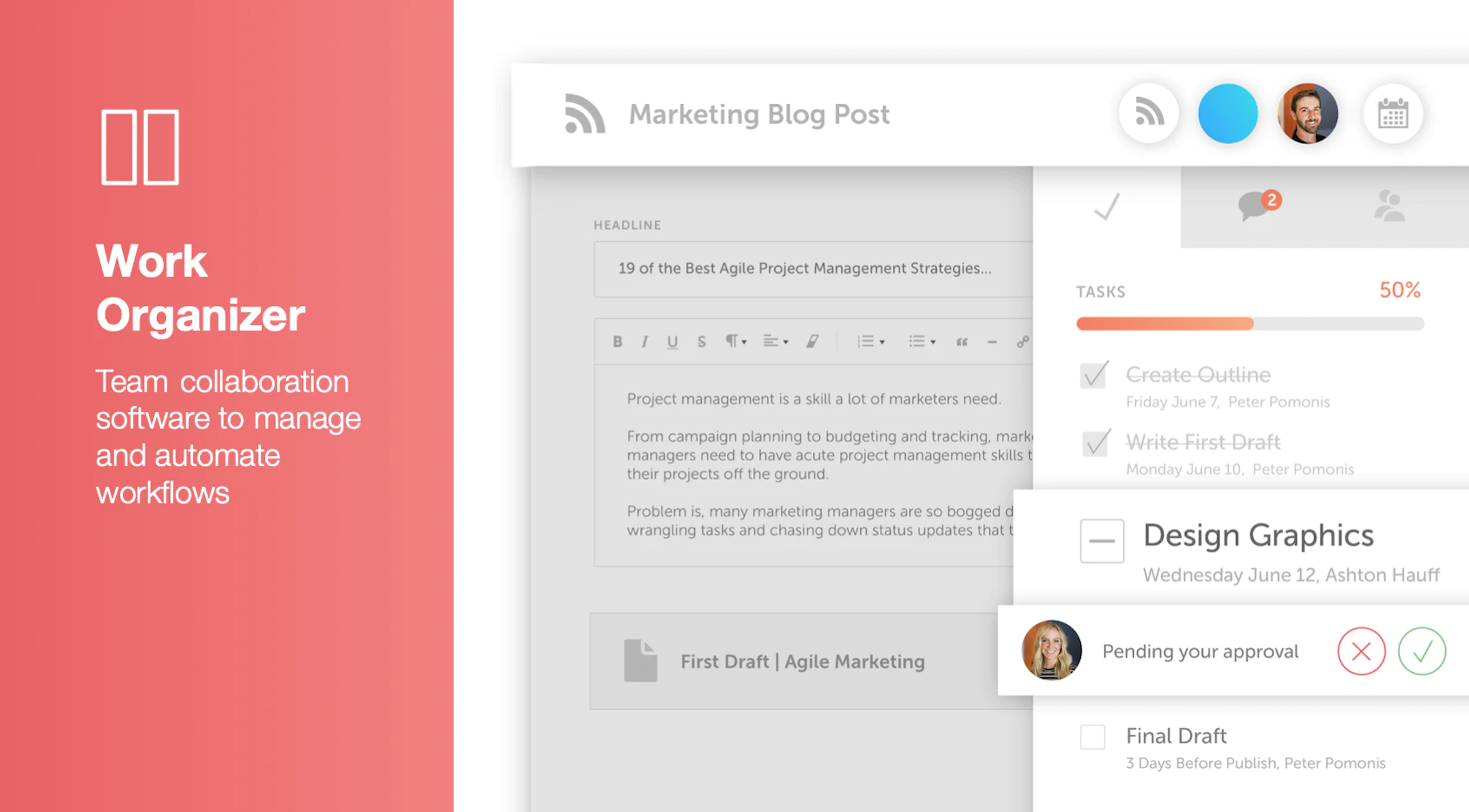
CoSchedule provides a content calendar, content optimization, and contentmarketing products, with users among 50,000 marketers worldwide, helping them organize their work, deliver projects on time, and prove marketing team value.
N/A
Olapic
Score 6.0 out of 10
N/A
Olapic is a content marketing tool specifically focused on visual marketing content. It allows a brand to locate, curate and publish user or fan photos into its own marketing material and website, sourcing many sites (e.g. Instagram, Twitter, Tumblr, Facebook, etc.), and sending select material omni-channel, using it in emails, print, in-store, or elsewhere. Olapic also provides measures for judging how effective your curation and user-generated content were in boosting conversions. Olapic was…
N/A
Pricing
CoSchedule Marketing Suite
Olapic
Editions & Modules
No answers on this topic
No answers on this topic
Offerings
Pricing Offerings
CoSchedule Marketing Suite
Olapic
Free Trial
No
No
Free/Freemium Version
Yes
No
Premium Consulting/Integration Services
No
No
Entry-level Setup Fee
No setup fee
No setup fee
Additional Details
—
—
More Pricing Information
Community Pulse
CoSchedule Marketing Suite
Olapic
Features
CoSchedule Marketing Suite
Olapic
Content Creation
Comparison of Content Creation features of Product A and Product B
CoSchedule Marketing Suite
7.3
1 Ratings
6% below category average
Olapic
6.6
4 Ratings
16% below category average
Ideation
5.01 Ratings
6.33 Ratings
Content collaboration
7.01 Ratings
7.12 Ratings
Content calendar
10.01 Ratings
7.01 Ratings
Approval workflows
00 Ratings
5.44 Ratings
Network for content licensing/production
00 Ratings
7.43 Ratings
Content Publishing
Comparison of Content Publishing features of Product A and Product B
CoSchedule Marketing Suite
10.0
1 Ratings
24% above category average
Olapic
6.7
4 Ratings
16% below category average
Content distribution
10.01 Ratings
7.23 Ratings
Content promotion
10.01 Ratings
7.02 Ratings
Content automation
10.01 Ratings
7.43 Ratings
Content hub
00 Ratings
6.13 Ratings
Forms / Gated content
00 Ratings
6.12 Ratings
Embedded CTAs
00 Ratings
6.73 Ratings
Content Reporting & Analytics
Comparison of Content Reporting & Analytics features of Product A and Product B
CoSchedule is great for businesses or agencies who need an overview of all their marketing efforts, and who want to establish collaboration between multiple departments. The calendar view is one of the best we've worked with and makes it easy to see exactly what's happening. There is some slight clunkiness when it comes to admin-related tasks, and a few things aren't easy to find, but there's great support.
If your brand has a good amount of steady social content, and you like to show it on your site along with shoppable links at the catalog and also at the product level, Olapic is an easy to use utiilty and also allows you to render your Instagram feed shoppable. In our case, we had a very active social presence but did not leverage it directly for the customers to shop from it, so Olapic filled that need.
The platform seems sluggish as of late, likely as a result of the robust amount of data we are entering and the number of filters we're creating.
Social media scheduling exists, but we do run into publishing errors more often then we'd like.
Task templates when updated are not retroactive, so when you create projects for an entire year and then change a template, you need to go back and change them manually.
It's a niche solution. If you're looking for niche, it's great. But if you're looking for an enterprise tool connected to many different systems and data solutions, it might not be for you.
The revenue analytics are not very reliable.
Price. This seems like it would be a great solution for medium size businesses, but the price is not feasible for the product.
The interface is very intuitive, from setting up social profiles, to posting, to tags, to optimizing for best day/time to post. It's super easy to scan the aggregate analytics. The calendar is very easy to grok at a glance, and the more advanced functionality is intuitive to set up.
I didn't have to use their official support, but I can say that they put out a lot of content online to help users. Their YouTube page has quite an array of tutorial videos explaining how things work and how to get the most out of their tools. If you're struggling, before picking up a phone or blasting off an email, try searching for your problem on YouTube or their forums.
CoSchedule provides collaborative planning of projects. The calendar view is very well designed. Meetings and tasks can be scheduled and tracked easily. Whatever is being done, no matter how big the task/project is, it gives a bird-eye view of everything. Additionally, it also integrated very well with WordPress. Their customer service team is also very helpful.
We have not used many competitors, but we stick with Olapic because of the capabilities that it offers. We don't use much of the reporting functionality, but it is a great tool to allow for collaboration between team members. It also allows us options when it comes to sharing content on the website, as it has gallary-style plug ins to display UGC.
It has saved me about 1 hour per day to keep things organized from Asana to WordPress.
By not having a functioning Google Doc import feature, it costs me about 30 minutes for each blog post to copy paste all the content, images, etc.
By bundling too many features into their plans, many of which we don't use (e.g. social media scheduling), we lose a little ROI because we are not using the full feature set. We use and prefer Buffer for social media, so when CoSchedule raised their price $40+ per month on features we would not be using, that hurt.
In general, we are seeing customers react to the content and use the links for shopping on our site. Their analytics is perhaps more optimistic than I believe, but content is king, and customers like to see more images of the product in more sizes and situations
We are starting to make custom brand pages and landing pages for advertising campaigns, and it's always great to add believable UGC to those pages to showcase a brand's style and general feel.
Tracking our social content is a good way to get a more generalized feel of how the brand is tracking, and who is creating content regarding our brand, so that is a beneficial side effect of constantly monitoring our tags.