Dassault Systèmes S.A. is a French company and a world leader in the production of 3D design software, 3D digital mock-up and product lifecycle management (PLM) solutions.
$15
per month
Oracle Fusion Cloud PLM
Score 10.0 out of 10
N/A
Oracle Fusion Cloud PLM is a collaborative platform that helps users bring product ideas to market faster by standardizing and structuring the data and processes that go into innovating, developing, and commercializing products and services. It includes the capabilities of the former Agile Software Corporation, acquired by Oracle in 2007.
N/A
Arena PLM and QMS
Score 8.4 out of 10
N/A
Arena by PTC is a cloud-based PLM and QMS platform. Arena helps product companies that rely on distributed teams and global supply chains to develop products, ensure regulatory compliance, and respond to customer demands.
N/A
Pricing
Enovia
Oracle Fusion Cloud PLM
Arena PLM and QMS
Editions & Modules
Enovia
$15.00
per month
No answers on this topic
Arena PLM Launch
Contact Sales
Arena PLM Enterprise
Contact Sales
Arena QMS
Contact Sales
Arena QMS Enterprise
Contact Sales
Offerings
Pricing Offerings
Enovia
Oracle Fusion Cloud PLM
Arena PLM and QMS
Free Trial
No
No
Yes
Free/Freemium Version
No
No
No
Premium Consulting/Integration Services
No
No
Yes
Entry-level Setup Fee
No setup fee
No setup fee
Required
Additional Details
—
—
Arena's cloud-based PLM and QMS solutions include role-based subscriptions to meet diverse team needs. Their fixed-fee QuickStart™ implementations supports rapid deployment.
More Pricing Information
Community Pulse
Enovia
Oracle Fusion Cloud PLM
Arena PLM and QMS
Considered Multiple Products
Enovia
No answer on this topic
Oracle Fusion Cloud PLM
No answer on this topic
Arena PLM and QMS
Verified User
Engineer
Chose Arena PLM and QMS
nOT WELL. Enovia HAD EXCELLENT INTERCONNECT FEATURES.
Been a long time, and it was called Agile then, and I did not use it a LOT, but my recollection was the interface was FAAARRR better than Arena PLM and QMS. Simple things like 'where uses' was a graphic with lines to all items/places where an items was used, including REF DES, …
I have used Agile PLM with Oracle and had an excellent experience with Agile. Provides good control and configuration control / site management as well.
These two products are extremely similar. Agile has better integration with certain systems, like JDE Enterprise One and is more rigid in terms of entering information.
Arena is only a PLM solution, so if you need PDM + PLM, look elsewhere. Or use a separate PDM to your PLM system. Large companies with complex products may find this an issue, but if you can streamline your PLM use Arena could be a good fit. Once you get past that decision, …
Arena has all the functionality the company needs (all the PLM systems reviewed had the same basic functionality) and was a better price. It also offers great support after implementation at no additional cost. It was also great to work directly with Arena, rather than …
I think Arena is better than Agile because of the useful hints and tips each new page offers. The version of Agile I used did not offer any features like this.
When we all went from using paper files, internal server homegrown storage methods and Excel, we moved to Agile. I used Agile for a few years, however, we had to have on-site servers, backups and the software wasn't very user-friendly. They made improvements over the years …
Very well suited for direct integration with CAD packages (Solidworks/ Auto desk Inventor or AutoCAD) and version control of CAD Model/Assemblies and Drawing files) and creating parts and document objects directly into Enovia and controlling their lifecycle from CAD Interface. Similarly, Enovia's Engineering central is already equipped with Industry standard ECR/ECO process which needs little customization for implementing Engineering Change management process. The hardest part in Enovia is controlling the disposition of released material for the downstream process in other ERP systems. For example, if a released material has gone for production or purchasing in ERP system/MRP system then dispositioning that material with Major revision (which may need manufacturing to stop the production due to faulty design) have no direct control to stop the downstream activities. Most cases its manual process to communicate with ERP team to for taking action. Similarly, revision of Documents (material Spec for example) linked to thousands of parts required special process (some time needs to schedule in the weekend).
We use Oracle Product Hub Cloud to manage our supply chain and increase productivity. This is an awesome tool to manage our customer database and reduce unwanted costs of product management and shipping. The way this tool is designed is really amazing because we can create a product easily and we can streamline ERP and our supply chain.
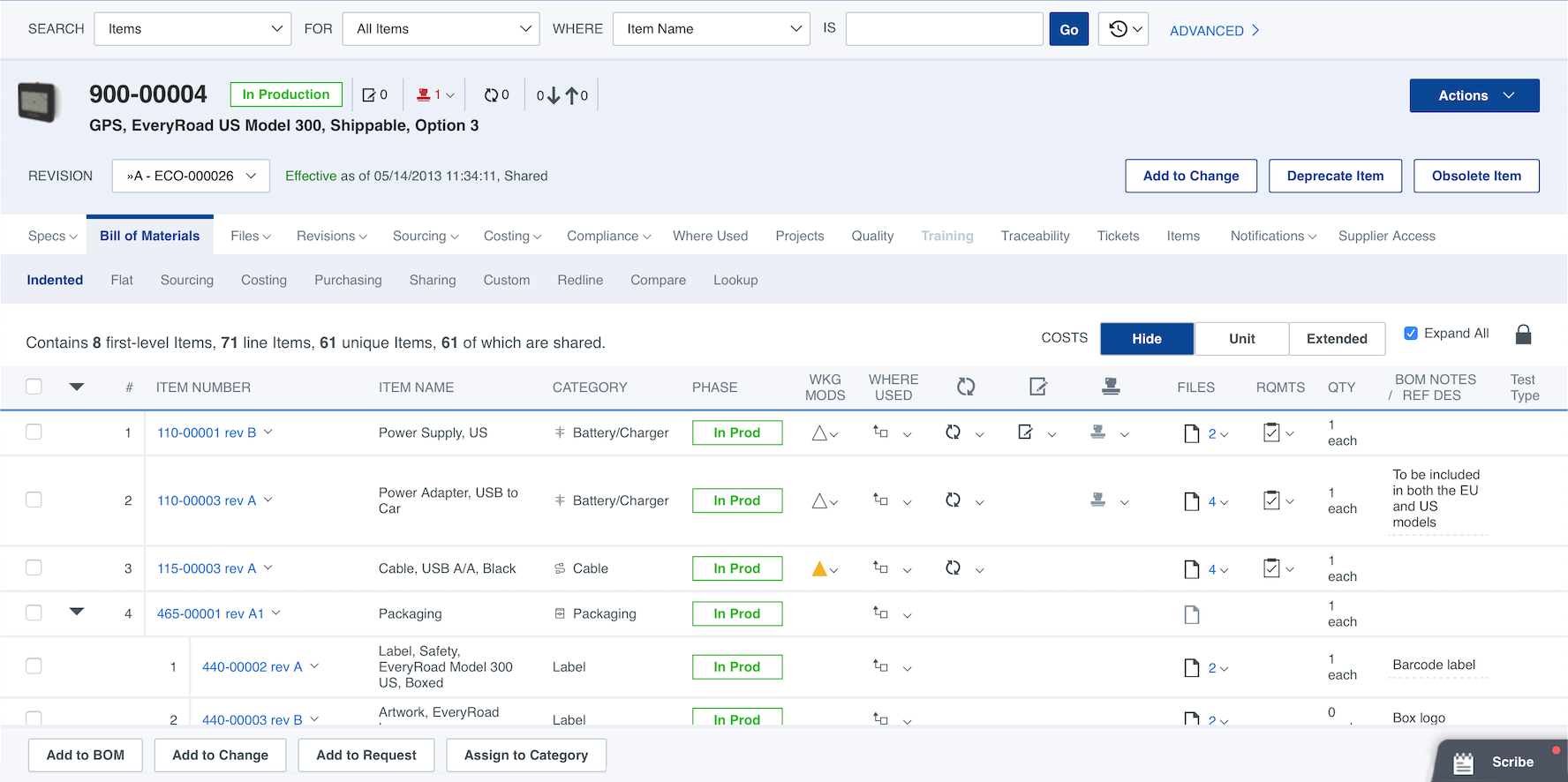
Arena PLM is well suited for part number, BOM and file management. Processing changes (ECNs, ACOs, DCO's, etc.) in Arena is very easy to do and provides great visibility on the status of submitted requests. The ability to communicate with Suppliers and grant them access to files in Arena is extremely helpful. Arena does not appear to be the best suited system for managing software
Products and requirements are growing more complex than ever. Oracle's Agile Product Lifecycle Management helps you innovate profitably, with the broadest and most comprehensive solution to efficiently centralize product data, streamline processes, and launch quality products faster. Agile PLM is a strategic approach to managing the lifestyle of a product throughout its full value chain from initial requirements gathering through to design, prototyping, obtaining certification, product customization, service and retirement. Agile PLM emphasizes process efficiency, cross-functional collaboration in the extended enterprise, rapid innovation, rigorous quality control, risk mitigation, and cost-effectiveness.
The aspects that I like of Oracle Agile Project Management is that it helps foster collaboration between internal team members and vendors. All of our processes are documented on the platform, and the platform helps increase accountability across all internal teams. Collaboration is great in this tool.
Oracle Agile is a good product lifecycle management (PLM) software tool/database. Oracle Agile PLS is overall and for the most part, easy to use and has the ability to be customized and is able to provide visibility into the data that was entered into the database. This tool allows cross-functional teams to work on the same task at the same time, which is great when working remotely and/or working on an all remote team. Overall, this tool helped to accelerate product review, approval, and ultimately launch of new materials, therefore maximizing profitability and enhance product features and design as needed. The database is easy to use and does not require much training for someone who is technically savvy with other similar databases, and/or have used them in the past.
There lots of functionality and features in this product which gives you, as a company, great benefits to be able to manage your products portfolio. Easy to document products and have a way of looking up a product history and quality issues in the past. Better teamwork with pair engineering and co-located teams. Less documentation to restrict creativity, less time spent doing blind research, testing and feedback speeds up learning, and smaller more rapid improvements.
It provides easy, 'login-anywhere' internet cloud-based access to fundamental PLM functions.
It provides secure access control for employees & vendors (but you pay per person for access licenses).
Data is effectively 'always backed up' in the internet-cloud.
There is an option to attach thumbnail graphics representative of each item and create a Bill of Materials view that also displays the graphics to help provide item recognition for BOM readers.
When a part/assembly has been released in Enovia and gone for production or downstream processing, Enovia doesn't have much control, hence, Enovia should come up with an easy controlling mechanism for various disposition of parts and seamless communication with an ERP or downstream process.
If a document is linked to thousands of materials then revising this document takes long time gets floated to the BOMs where the previous document versions are used. So, Enovia should have an efficient way to replace the floating process or another efficient mechanism for document revision processing.
Agile PLM does not let us keep workloads properly balanced if we want to use more than one virtual network (VCN, specifically), forcing us to work with a single network in which we manage the different levels of the work infrastructure. Although this is a drawback, it has helped us to adapt to more centralized methodologies.
In my opinion, the Help Pages clearly do not realize that a picture is worth a 1,000 words; need illustrations and screenshots!
I think the 'Save' button when editing Quality Processes needs to "float" on the active page, not lurking at the bottom.
In my experience, the Arena PLM and QMS Training programs need to be revamped to include "real-world" examples and working through examples, not simply reading through a training manual.
We have so much time and effort invested into Arena. The history of approvals, revisions, etc. are necessary for many of our customers. We also have entire device histories recorded. Having to re-create that on another platform would be a feat requiring years of effort. But mostly, Arena just works. It's transformed our business into a much more streamlined system, resulting in a massive cost and time savings.
Arena has improved their UI over the years that I've used it to make it more user friendly. Additionally, there is a lot of redundancy within Arena (multiple ways to achieve the same end), which makes it easier to learn.
Seems like when I need to access our workspace for an emergency situation, this is when maintenance is scheduled, just the luck of the draw, I guess, and I just wait until the maintenance is complete, and then can proceed
Upon initial observation, Arena Solution appears to possess a rather intricate nature, yet this complexity was effectively navigated during the initial configuration phase with the invaluable assistance of an expert well-versed in Arena, a factor that greatly contributed to our comprehensive mastery and autonomous handling of Arena Solutions thereafter.
The On line training was easy to understand and was very efficient for most of our users. We used the training tools to make sure we use all of the features to their fullest and correctly! After a few weeks mos of our users were very proficient with ARENA PLM and were able to work on their own and use mos of the sections and PLM capablilities.
While considering oracle Product Hub Cloud, the most thing which attracted me toward it is that it provides a single, Best in class data management to deliver master product record that threads business process including cross chain compliance product introductions although it hasn't built a cloud product that the general market is looking for.
Arena is much better than QAD in terms of BOMs and ECOs and Revision Control. We use Arena concurrently with SAP and they integrate very well together, which is nice. The integration team was really helpful in making sure that the SAP to Arena functionality runs smoothly, and when there are any issues, they are very responsive to help make changes to fix the problem that might be there.
Arena is easy to customize and therefore easy to scale. Different user groups with access restrictions can be easily created and new training plans can be created to support different user bases. Suppliers can also easily be added or items can be shared with them
Easy learning curve for the users- Very user-friendly Interface for Engineering central make the users happy and easy to learn the BOM creation and Engineering change management process.
Time-saving - Seamless Creation and revision process of objects saves a huge amount of time compared to other systems.
Easy to copy existing business data and modify them as required.
Decreased the company's time to market for release of its second generation flagship product.
Decreased the turn around on non-conformance reports (NCRs), supplier corrective action reports (SCARs), and corrective and preventative actions (CAPAs).
Better organized the company's process maps, DHF, and other regulatory related information so that major audits are completed faster and with fewer findings.