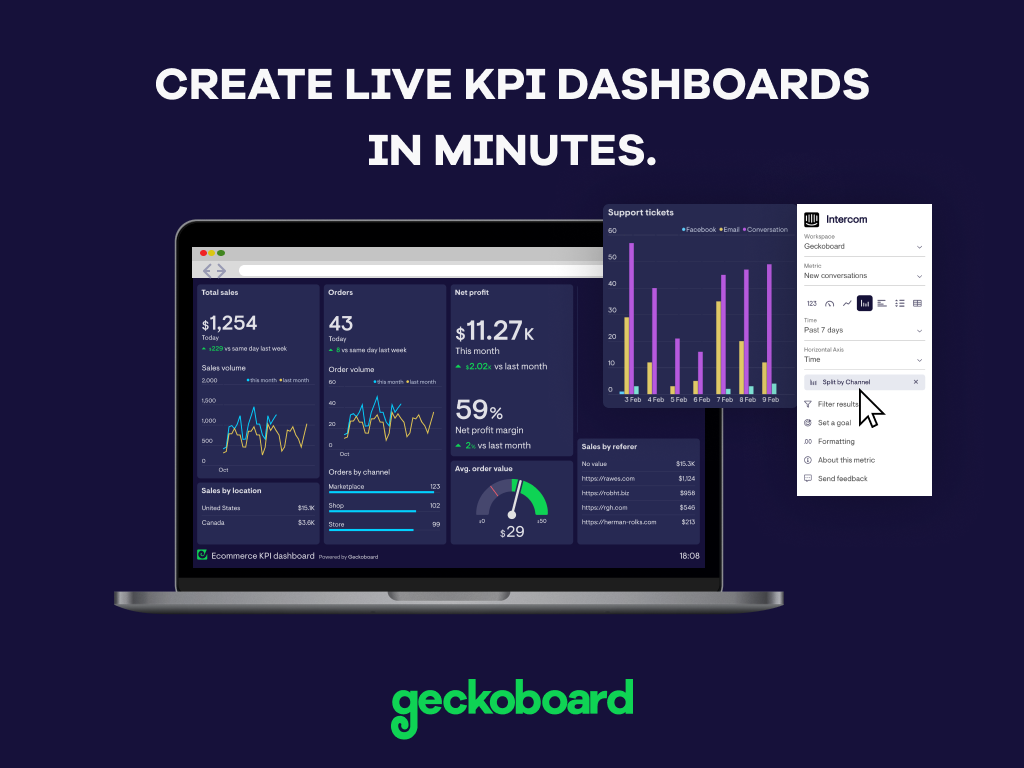
Geckoboard enables users to create real time dashboards using data from over 80 cloud services. It integrates with other products such as: AWeber, Basecamp, Campaign Monitor and HubSpot.
$35
per month
Grafana
Score 8.6 out of 10
N/A
Grafana is a data visualization tool developed by Grafana Labs in New York. It is available open source, managed (Grafana Cloud), or via an enterprise edition with enhanced features. Grafana has pluggable data source model and comes bundled with support for popular time series databases like Graphite. It also has built-in support for cloud monitoring vendors like Amazon Cloudwatch, Microsoft Azure and SQL databases like MySQL. Grafana can combine data from many places into a single dashboard.
$0
Graylog
Score 8.8 out of 10
N/A
Graylog, headquartered in Houston, offers their eponymous platform for centralized log management that helps users find meaning in data faster so as to take action immediately. Graylog is available via Enterprise and Cloud plans, but also has a Small Business Plan, and an Open (free) plan with limited features.
N/A
Pricing
Geckoboard
Grafana
Graylog
Editions & Modules
Starter
$35
per month
Team
$159
per month
Team Plus
$275
per month
Company
$599
per month
Grafana Cloud - Pro
$8
per month up to 1 active user
Grafana Cloud - Free
Free
10k metrics + 50GB logs + 50GB traces up to 3 active users
Graylog has the simplest deployment, and it is ready to work in a few clicks. Although we also use Grafana and Zabbix in our environment, the role of processing log data is better suited to Graylog. In our case, we use Graylog to process and analyze web application logs, such …
Great value for the money. Excellent for smaller agencies with multiple projects and teams in a smaller space. We can quickly roll out mobile displays to help with a particular deployment push or monitoring a clients website engagement. It's also useful for showing live data without requiring analytics to run reports from a CRM, etc.
Just about any organization with more than one server and more than one cluster as it scales very well. Configuration of the application takes time and finesse to fine tune to where the balance of load time and getting data quickly meets. The plugins add load time but fine tuning for the application to meet demand needs nailed down at implementation
For small companies, Graylog is the best solution possible. It's easy to configure and "just works." Above everything else, it's free. The only thing I hold against it is the fact that it's Linux-based. [This] makes sense because Elasticsearch is Linux-based. But Linux adds a layer of complexity that we don't need for something basic as a logging server. I'm pretty sure that we would have had a logging server years earlier if I had to convince quite a few decision-making people to go ahead with it anyway.
Graylog does a great job of its core function: log aggregation, retention, and searching.
Graylog has a very flexible configuration. The backend for storage is Elasticsearch and MongoDB is used to store the configuration. You have to option to make your configuration as simple as possible by storing everything on one box, or you can scale everything out horizontally by using a cluster of Elasticsearch nodes and MongoDB servers with several Graylog servers pointed to all the necessary nodes.
Graylog does a good job of abstracting away a fair portion of Elasticsearch index management (sharding, creation, deletion, rotation, etc).
With a simple interface and available templates, creating basic dashboards is easy. Obviously depending on the data you want to visualize, there may be higher learning curves. That being said, they have a huge amount of integrations and extensible frameworks. If you are using anything made in the past ten years there is an API function or integration that can get it talking to the platform. As such, it's pretty easy to hit the main data points you want and get it on a cheap display in front of your team.
It is infinitely flexible. If you can imagine it, Grafana can almost certainly do it. Usability may be in the eye of the beholder however, as there is time needed to curate the experience and get the dashboards customized to how it makes sense to you. I know one thing they are working on are more templates, based on data sources
Graylog is easy to deploy. The tricky part is to configure all hosts that are going to send their log data to Graylog, considering the retention period of this data, it will need a lot of disk space to store it. Its rotation works fine. It is very simple to navigate and explore the data you send to it, and very easy to filter and export them too.
The support levels vary based on the level of plan that you have but that's to be expected. Virtually everything except the Enterprise plan has basic chat/email support. While they are responsive they are not going to be much assistance in helping you figure out API calls or implementing 3rd party integrations. That is to be expected and the support community can pretty much get you in the right direction if you look.
Community support does not give simple straightforward answers; simply search up Graylog Issues and look at some of the responses on the forums. The documentation is your only hope if you are on the free version, as you can NOT purchase only support. The few times I have worked with Graylog Enterprise support they were great though.
Grafana blows Nagios out of the water when it comes to customization. The ability to feed almost any data source makes it very versatile and the cost is great.
In terms of log aggregation, the free product fully stacks up with the competitors listed. Full control over the data ingests for flexible configuration. Graylog even better on that front than AlienVault USM because you cannot configure the variable mapping. We haven't used the threat exchange stuff or correlation. But with regex searches, we have created function dashboards that show threat theater pictures of our network based on logs from our firewall.
While we originally used this as an internal IS tool, we eventually have expanded it to be used by nearly every department.
Because pricing is monthly, we can grow or decrease our usage based on our current client needs.
Because it is low cost and easy to deploy, we can utilize it in place of considerable resources in analytics and reporting by delivering snapshots of data without pulling reports.