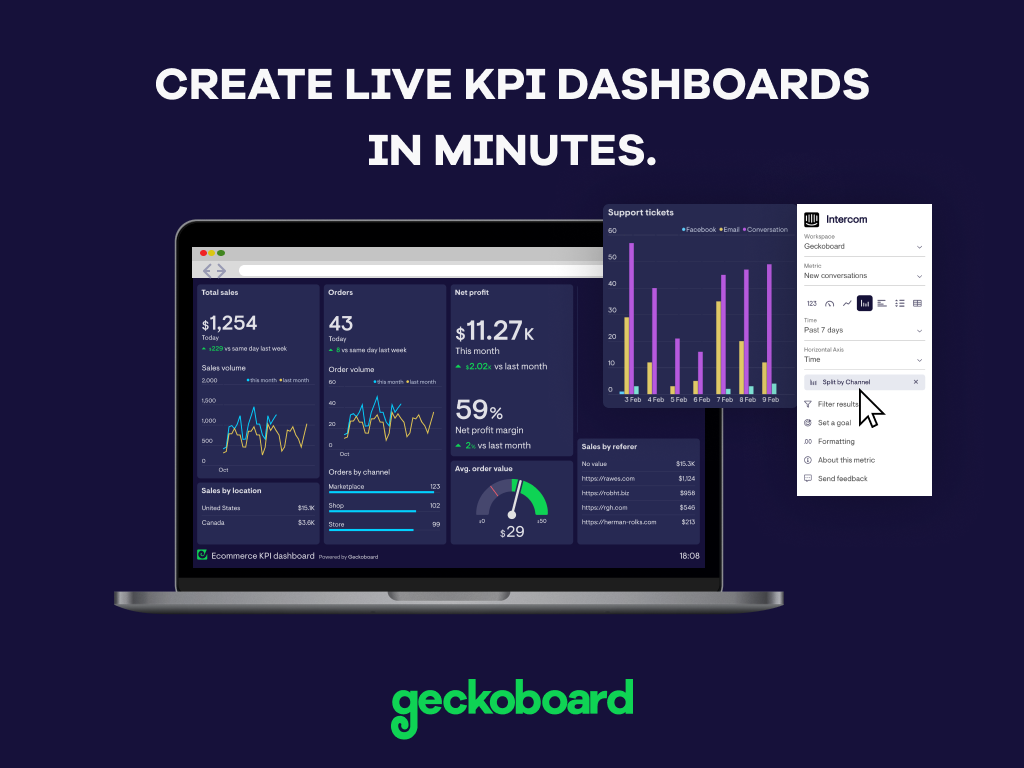
Geckoboard enables users to create real time dashboards using data from over 80 cloud services. It integrates with other products such as: AWeber, Basecamp, Campaign Monitor and HubSpot.
$35
per month
MATLAB
Score 8.8 out of 10
N/A
MatLab is a predictive analytics and computing platform based on a proprietary programming language. MatLab is used across industry and academia.
$49
per student license
Mathematica
Score 7.0 out of 10
N/A
Wolfram's flagship product Mathematica is a modern technical computing application featuring a flexible symbolic coding language and a wide array of graphing and data visualization capabilities.
$1,520
per year
Pricing
Geckoboard
MATLAB
Wolfram Mathematica
Editions & Modules
Starter
$35
per month
Team
$159
per month
Team Plus
$275
per month
Company
$599
per month
Student
$49
per student license
Home
$149
perpetual license
Education
$250
per year
Education
$500
perpetual license
Standard
$860
per year
Standard
2,150
perpetual license
Standard Cloud
$1,520
per year
Standard Desktop
$3,040
one-time fee
Standard Desktop & Cloud
$3,344
one-time fee
Mathematica Enterprise Edition
$8,150.00
one-time fee
Offerings
Pricing Offerings
Geckoboard
MATLAB
Mathematica
Free Trial
Yes
No
No
Free/Freemium Version
Yes
No
No
Premium Consulting/Integration Services
No
No
No
Entry-level Setup Fee
No setup fee
No setup fee
No setup fee
Additional Details
—
—
Discounts available for students and educational institutions. The Network Edition reduce per-user license costs through shared deployment across any number of machines on a local-area network.
More Pricing Information
Community Pulse
Geckoboard
MATLAB
Wolfram Mathematica
Considered Multiple Products
Geckoboard
No answer on this topic
MATLAB
Verified User
Analyst
Chose MATLAB
Mathematica provide more modern user interface, functionality wise, they are similar
Apart from Matlab, I used Matematica for some of my integral evaluations. Mathematica is also a "clean" and easy-to-use software that solves symbolic math problems (even better than Matlab for symbolic math). I also used Anaconda and Spyder for my career so far.
Those are expensive than MATLAB and their GUI is not great along with editor. However, they have more libraries set as compared to Matlab. However, the place where MATLAB adds value is its user community as well as its support and we can find solutions to any problem with …
How MATLAB compares to its competition or similar open access tools like R (programming language) or SciLab is that it's simply more powerful and capable. It embraces a wider spectrum of possibilities for far more fields than any other environment. R, for example, is intended …
We selected Wolfram Mathematica as it offers lot of functionality that other products like MATLAB or sageMath do not have. And it also has advantages on the feature that it does share in common with other tools like sageMath, MATLAB etc. It is more powerful than MATLAB. It …
MATLAB is an excellent tool, but it can't handle analytic manipulations in algebra, calculus and differential equations. MATLAB is superior when it comes to a less steep learning curve. In terms of using only one tool for analytic and numerical calculations, Mathematica wins. …
The ability to manipulate algebraic expressions, nested lists, and data structures in Mathematica was unequalled when I first did the comparison. Since then, I've stuck with Mathematica mostly because it's "the tool I know."
Great value for the money. Excellent for smaller agencies with multiple projects and teams in a smaller space. We can quickly roll out mobile displays to help with a particular deployment push or monitoring a clients website engagement. It's also useful for showing live data without requiring analytics to run reports from a CRM, etc.
MATLAB really does best for solving computational problems in math and engineering. Especially when you have to use a lot of functions in your solving process, or if you have a nonlinear equation that must be iteratively solved. [MATLAB] can also perform things like integration and derivation on your equations that you put into it.
We are the judgement that Wolfram Mathematica is despite many critics based on the paradigms selected a mark in the fields of the markets for computations of all kind. Wolfram Mathematica is even a choice in fields where other bolide systems reign most of the market. Wolfram Mathematica offers rich flexibility and internally standardizes the right methodologies for his user community. Wolfram Mathematica is not cheap and in need of a hard an long learner journey. That makes it weak in comparison with of-the-shelf-solution packages or even other programming languages. But for systematization of methods Wolfram Mathematica is far in front of almost all the other. Scientist and interested people are able to develop themself further and Wolfram Matheamatica users are a human variant for themself. The reach out for modern mathematics based science is deep and a unique unified framework makes the whole field of mathematics accessable comparable to the brain of Albert Einstein. The paradigms incorporated are the most efficients and consist in assembly on the market. The mathematics is covering and fullfills not just education requirements but the demands and needs of experts.
Mathematica is incompatible with other systems for mCAx and therefore the borders between the systems are hard to overcome. Wolfram Mathematica should be consider one of the more open systems because other code can be imported and run but on the export side it is rathe incompatible by design purposes. A better standard for all that might solve the crisis but there is none in sight. Selection of knowledge of what works will be in the future even more focussed and general system might be one the lossy side. Knowledge of esthetics of what will be in the highest demand in necessary and Wolfram is not a leader in this field of science. Mathematics leves from gathering problems from application fields and less from the glory of itself and the formalization of this.
It allows straightforward integration of analytic analysis of algebraic expressions and their numerical implemented.
Supports varying programmatic paradigms, so one can choose what best fits the problem or task: pure functions, procedural programming, list processing, and even (with a bit of setup) object-oriented programming.
The extensive and rich tools for graphical rendering make it very easy to not just get 2D and 3D renderings of final output, but also to do quick-and-dirty 2D and 3D rendering of intermediate results and/or debugging results.
With a simple interface and available templates, creating basic dashboards is easy. Obviously depending on the data you want to visualize, there may be higher learning curves. That being said, they have a huge amount of integrations and extensible frameworks. If you are using anything made in the past ten years there is an API function or integration that can get it talking to the platform. As such, it's pretty easy to hit the main data points you want and get it on a cheap display in front of your team.
MATLAB is pretty easy to use. You can extend its capabilities using the programming interface. Very flexible capabilities when it comes to graphical presentation of your data (so many different kinds of options for your plotting needs). Anytime you are working with large data sets, or with matrices, MATLAB is likely to be very helpful.
The support levels vary based on the level of plan that you have but that's to be expected. Virtually everything except the Enterprise plan has basic chat/email support. While they are responsive they are not going to be much assistance in helping you figure out API calls or implementing 3rd party integrations. That is to be expected and the support community can pretty much get you in the right direction if you look.
The built-in search engine is not as performing as I wish it would be. However, the YouTube channel has a vast library of informative video that can help understanding the software. Also, many other software have a nice bridge into MATLAB, which makes it very versatile. Overall, the support for MATLAB is good.
Wolfram Mathematica is a nice software package. It has very nice features and easy to install and use in your machine. Besides this, there is a nice support from Wolfram. They come to the university frequently to give seminars in Mathematica. I think this is the best thing they are doing. That is very helpful for graduate and undergraduate students who are using Mathematica in their research.
How MATLAB compares to its competition or similar open access tools like R (programming language) or SciLab is that it's simply more powerful and capable. It embraces a wider spectrum of possibilities for far more fields than any other environment. R, for example, is intended primarily for the area of statistical computing. SciLab, on the other hand, is a similar open access tool that falls very short in its computing capabilities. It's much slower when running larger scripts and isn't documented or supported nearly as well as MATLAB.
We have evaluated and are using in some cases the Python language in concert with the Jupyter notebook interface. For UI, we using libraries like React to create visually stunning visualizations of such models. Mathematica compares favorably to this alternative in terms of speed of development. Mathematica compares unfavorably to this alternative in terms of license costs.
While we originally used this as an internal IS tool, we eventually have expanded it to be used by nearly every department.
Because pricing is monthly, we can grow or decrease our usage based on our current client needs.
Because it is low cost and easy to deploy, we can utilize it in place of considerable resources in analytics and reporting by delivering snapshots of data without pulling reports.
MATLAB helps us quickly sort through large sets of data because we keep the same script each time we run an analyzation, making it very efficient to run this whole process.
The software makes it super easy for us to create plots that we can then show to investors or clients to display our data.
We are also looking to create an app for our product, and we will not be able to do that on MATLAB, therefore creating a limiting issue and a new learning curve for a programming language.