Grafana is a data visualization tool developed by Grafana Labs in New York. It is available open source, managed (Grafana Cloud), or via an enterprise edition with enhanced features. Grafana has pluggable data source model and comes bundled with support for popular time series databases like Graphite. It also has built-in support for cloud monitoring vendors like Amazon Cloudwatch, Microsoft Azure and SQL databases like MySQL. Grafana can combine data from many places into a single dashboard.
$0
Looker
Score 8.3 out of 10
N/A
Looker is a BI application with an analytics-oriented application server that sits on top of relational data stores. It includes an end-user interface for exploring data, a reusable development paradigm for data discovery, and an API for supporting data in other systems.
N/A
Splunk AppDynamics
Score 8.4 out of 10
N/A
AppDynamics is an APM and Mobile APM program, with application mapping and predictive capabilities. These capacities enable automated remediation and code-level diagnostics in real time. It can be deployed on-premise or as a SaaS.
N/A
Pricing
Grafana
Looker
Splunk AppDynamics
Editions & Modules
Grafana Cloud - Pro
$8
per month up to 1 active user
Grafana Cloud - Free
Free
10k metrics + 50GB logs + 50GB traces up to 3 active users
Technically, Power BI is much more complete and powerful, but it's like an ocean liner. I didn't need all that equipment. In my case, I needed to move more quickly, like on a speedboat, to build a page with several data sources in a single source of truth that could be easily …
Looker's user-friendly interface and pre-built visualizations resonated with us. While other tools offered similar features, Looker felt smoother and more intuitive, especially for non-technical users. This was crucial for our goal of empowering widespread data exploration …
Those applications are not feature-rich. AppDynamics application is quite good and impressive. It is very helpful to make business decisions. Analytics part is good to make business forecast. UI part is [more] interesting than others. Here I recommend AppDynamics over other[s] …
Just about any organization with more than one server and more than one cluster as it scales very well. Configuration of the application takes time and finesse to fine tune to where the balance of load time and getting data quickly meets. The plugins add load time but fine tuning for the application to meet demand needs nailed down at implementation
When data drives potential for new orders, Looker earns its place in our tech stack. If, on the other hand, we are hoping for pipeline generation, Looker is useful if you are willing to repeatedly go check customer utilizations .... it is not appropriate if you are hoping to automate data analysis for this purpose.
Platforms for software as a service (SaaS) frequently cater to a large number of users with a variety of needs and usage patterns. Because AppDynamics offers multi-tenant monitoring capabilities to track performance across various customer environments, it is a good choice for SaaS platform monitoring. SaaS providers can maximize resource utilization, proactively detect and resolve performance issues, and provide a dependable and consistent user experience for their clients with AppDynamics.
Show visited pages - sessions, pageviews - which programs are viewed the most.
Displays session source/medium views to see where users are coming from.
It shows the video titles, URLs, and event counts so we can monitor the performance of our videos.
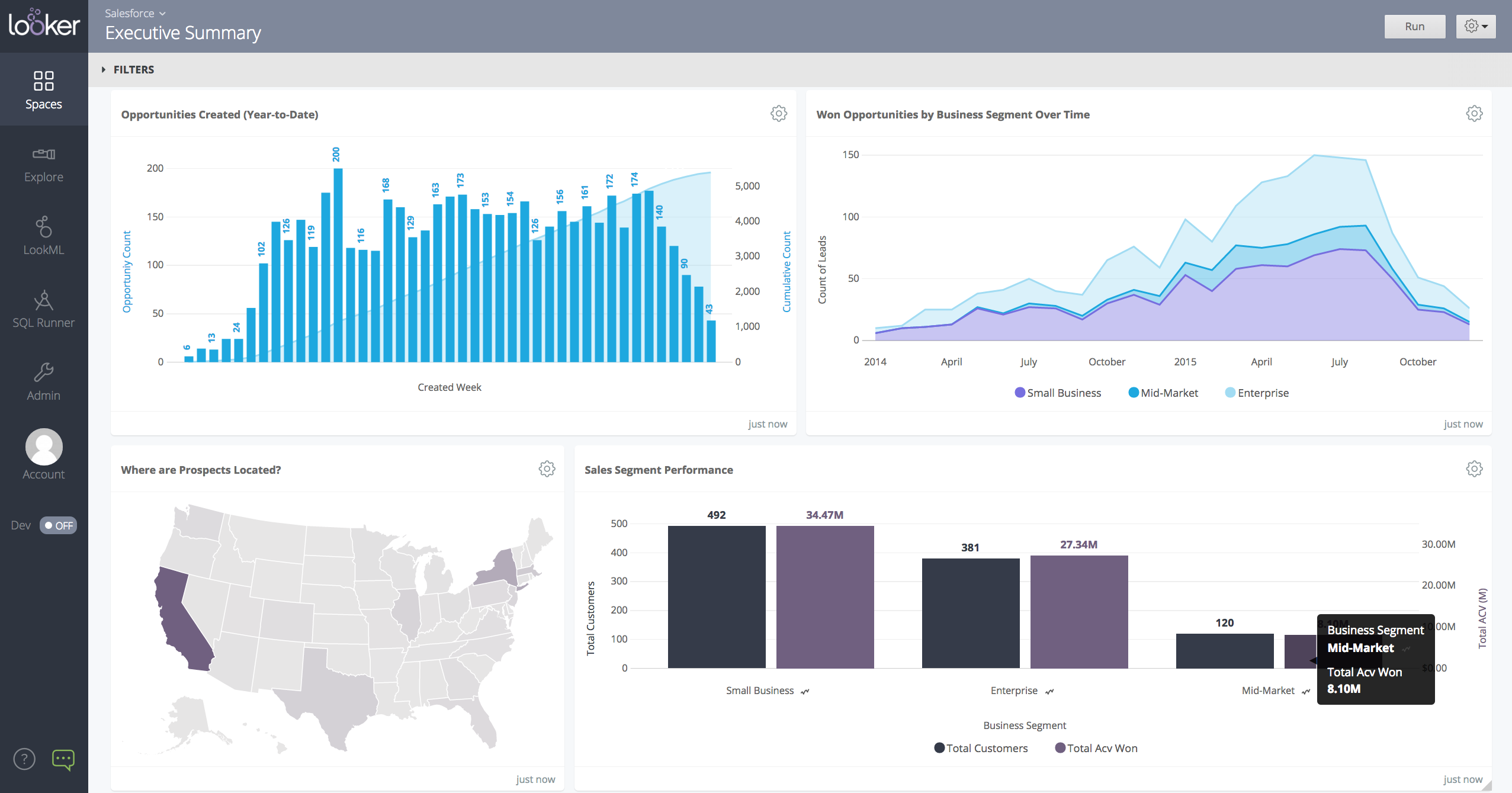
It gives a graphic face to the numbers, such as using bar charts, pie graphs, and other charts to show user trends or which channels are driving engagement.
Our clients like to see the top pages visited for a month.
I like the drop-and-drag approach, and building charts is a little easier than it was before.
Business Transaction Monitoring is one of its signature strengths. This represents a major differentiator from generic infrastructure monitoring tools.
AI‑driven anomaly detection and intelligent alerting provide a significant advantage over traditional monitoring.
When combined with Splunk AppDynamics, full‑stack observability becomes a key part of Cisco/Splunk’s unified observability strategy.
AppDynamics may enhance its capacity to track transactions through complex distributed systems and microservices, offering a more comprehensive understanding of application behavior.
Better search and filtering capabilities would enable engineers to quickly obtain deeper context by drilling down into individual data points.
AppDynamics might be more widely available to engineers and organizations if it offered subscription plans or tiered pricing options.
I give it this rating because it deems as effective, I am able to complete majority of my tasks using this app. It is very helpful when analyzing the data provided and shown in the app and it's just overall a great app for Operational use, despite the small hiccups it has (live data).
cause it achieves all our targets and we are satisfied with using Splunk also stable no technical challenges or problem caused by Splunk a lot for innovative integrations also all layers are using splunk NOC team , DEV team, application support team, managers security team also in forcasting for EA team
It is infinitely flexible. If you can imagine it, Grafana can almost certainly do it. Usability may be in the eye of the beholder however, as there is time needed to curate the experience and get the dashboards customized to how it makes sense to you. I know one thing they are working on are more templates, based on data sources
Looker is relatively easy to use, even as it is set up. The customers for the front-end only have issues with the initial setup for looker ml creations. Other "looks" are relatively easy to set up, depending on the ETL and the data which is coming into Looker on a regular basis.
Splunk AppDynamics is great product that has positively maintained solid application workflows. It has simple and clean UI that displays graphical representation of our database and application behaviour. It gives us an opportunity to customize and set most reliable alerts and data configurations that aligns with our policies. It is easy to monitor operation hypothesis and lower RCA if you identify application coding errors.
On a scale of 1 to 10, I would rate the availability of Splunk AppDynamics as a 9. Overall, the platform has proven to be highly reliable and is available when we need it. It consistently supports our monitoring and performance management needs across critical applications and infrastructure. There have been occasional issues with platform availability, such as intermittent application errors or brief unplanned outages. However, these instances have been infrequent and typically resolved quickly, minimizing any significant impact on operations. The stability and uptime of the platform have met our expectations, and we continue to rely on it as a core component of our APM strategy.
Somehow resources heavy, both on server and client. I recommned at least 50Mbs data rate and high performance desktop comouter to be abke to run comolex tasks and configure larger amount of data. On the other hand, the client does not need to worry when viewing, the performance is usually ok
On a scale of 1 to 10, I would rate the performance of Splunk AppDynamics as a 6. While the platform generally delivers the expected functionality, we’ve experienced periodic slowness—particularly with page loads and report generation. These performance issues can be frustrating, especially when trying to quickly access critical data during incident response or analysis. One contributing factor may be our use of a shared controller environment with other enterprises, which can introduce resource contention and impact overall responsiveness. In some cases, this has led to delays in accessing dashboards or completing complex queries. Despite these challenges, the platform remains a valuable tool, and we’re exploring options to improve performance, including potential changes to our deployment model and support agreements.
Never had to work with support for issues. Any questions we had, they would respond promptly and clearly. The one-time setup was easy, by reading documentation. If the feature is not supported, they will add a feature request. In this case, LDAP support was requested over OKTA. They are looking into it.
AppDynamics has its own community site that includes forums and a knowledge base. On the forums, you can converse with other members of the community and ask technical questions as you have them. Though this forum isn’t filled with people there are active members for you to gain some valuable insights.
On a scale of 1 to 10, I would rate the online training for Splunk AppDynamics as a 7. The training was generally acceptable and covered the core concepts and functionality of the platform. However, there were some challenges with communication during sessions—particularly around clarity and instructor engagement—which occasionally made it difficult to fully grasp certain topics. Additionally, the training could benefit from being more focused and tailored to specific roles or use cases. A more structured approach with clearer learning paths and practical, hands-on examples would enhance the overall effectiveness and help users apply the knowledge more confidently in real-world scenarios.
On a scale of 1 to 10, I would rate our satisfaction with the implementation of Splunk AppDynamics as a 9. The deployment process was smooth and well-coordinated, thanks to the collaborative efforts between Cisco Professional Services, our internal business stakeholders, and agency technical teams. Key Insights from the Implementation: Cross-functional Collaboration Was Critical: Engaging both technical and business teams early in the process ensured that the platform was configured to meet a wide range of operational and strategic needs. Value of Expert Guidance: Cisco’s Professional Services provided invaluable expertise, helping us navigate complex configurations and tailor the solution to our environment. Their involvement accelerated deployment and ensured best practices were followed. Importance of Planning and Communication: A well-defined implementation roadmap and regular communication across teams helped us stay aligned, manage expectations, and address challenges proactively. Scalable Architecture: We designed the implementation with scalability in mind, allowing us to expand usage across agencies and applications without major rework. Overall, the implementation laid a strong foundation for our APM program and positioned us for long-term success.
Grafana blows Nagios out of the water when it comes to customization. The ability to feed almost any data source makes it very versatile and the cost is great.
Looker Studio, you can easily report on data from various sources without programming. Looker Studio is available at no charge for creators and report viewers. Enterprise customers who upgrade to Looker Studio Pro will receive support and expanded administrative features, including team content management. So it's good.
It is distinguished from these programs because the platform provides visualizations of application processes, showing the interplay between various parts and services. Understanding the architecture of complicated apps and finding their weak spots is greatly aided by this.
While the overall value of the Splunk AppDynamics platforms is strong, the pricing structure and contract terms can be complex and difficult to navigate. Unit pricing, licensing tiers, and billing frequency are not always intuitive, which can make it challenging to align purchases with the State’s evolving needs. I rely heavily on our Account Manager to help interpret and tailor the licensing model to our specific requirements. Their support has been invaluable in ensuring we make informed decisions. The most impactful change would be to simplify the licensing and pricing model. Clearer documentation, more transparent pricing tiers, and streamlined purchasing processes would significantly improve the experience and reduce administrative overhead.
On a scale of 1 to 10, I would rate the overall scalability of Splunk AppDynamics as a 7. The platform is designed to support enterprise-wide deployments across multiple departments and sites, and it performs well in large-scale environments. Its architecture allows for horizontal scaling and supports a wide range of application types and infrastructures. However, the agent management and deployment process can be complex and time-consuming, especially when onboarding a large number of applications or systems. Coordinating agent installation, configuration, and updates across diverse environments requires careful planning and often significant manual effort. Streamlining these processes—perhaps through more centralized management tools or automation—would enhance scalability and reduce operational overhead. Despite these challenges, once deployed, AppDynamics scales effectively and provides consistent performance and visibility across the enterprise.
Our experience with the professional services team supporting Splunk AppDynamics has been exceptional. They demonstrated deep technical expertise, strong collaboration skills, and a clear understanding of our business objectives. Their guidance was instrumental in the successful implementation of our APM program and platform integration. The rating of 9 reflects our high level of satisfaction, with a small margin left to acknowledge that continuous improvement is always possible. Overall, their support has been a key factor in the success of our deployment.
Looker has a poignant impact on our business's ROI objectives. As an advertising exchange we have specific goals for daily requests and fill, and having premade Looks to monitor this is an integral piece of our operational capability
To facilitate an efficient monthly billing cycle in our organization, Looker is essential to track estimated revenue and impression delivery by publisher. Without the Looks we have set up, we would spend considerably more time and effort segmenting revenue by vertical.
Looker's unique value proposition is making analytical tools more digestible to people without conventional analytical experience. Other competing tools like Tableau require considerably more training and context to successfully use, and the ability to easily plot different visualizations is one of its greatest selling points.
Through the identification of performance bottlenecks and efficient resource allocation, AppDynamics has contributed to cost savings and resource optimization. This has a direct positive impact on our overall return on investment.
While AppDynamics' numerous capabilities help maximize efficiency, they may place a strain on your system. Organizations with limited infrastructure capacity may have difficulties and therefore give this serious thought before implementing it.