Graylog, headquartered in Houston, offers their eponymous platform for centralized log management that helps users find meaning in data faster so as to take action immediately. Graylog is available via Enterprise and Cloud plans, but also has a Small Business Plan, and an Open (free) plan with limited features.
N/A
Pulseway
Score7 out of 10
Mid-Size Companies (51-1,000 employees)
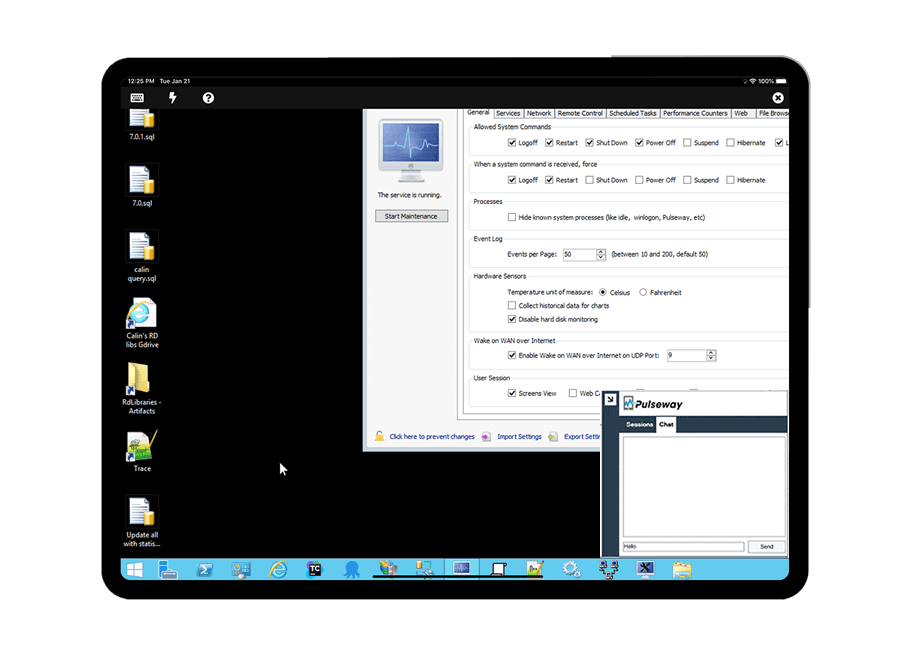
Pulseway is an IT monitoring and management solution that enables users to monitor, manage and control all systems and servers from a smartphone, tablet or browser. For system administrators, Pulseway sends a notification, so they can see an issue and sort it in seconds. Pulseway features: Automation: Auto-remediation workflows, so that IT issues are fixed before users even notice them. Mobile Access: Customers can monitor, manage, connect with…
$0.80
per month per installation
Pricing
Graylog
Pulseway
Editions & Modules
No answers on this topic
Enterprise
$0.80
per month per installation
Offerings
Pricing Offerings
Graylog
Pulseway
Free Trial
No
Yes
Free/Freemium Version
Yes
Yes
Premium Consulting/Integration Services
No
Yes
Entry-level Setup Fee
No setup fee
No setup fee
Additional Details
—
No hidden fees or contracts. Term-based discounts.
For small companies, Graylog is the best solution possible. It's easy to configure and "just works." Above everything else, it's free. The only thing I hold against it is the fact that it's Linux-based. [This] makes sense because Elasticsearch is Linux-based. But Linux adds a layer of complexity that we don't need for something basic as a logging server. I'm pretty sure that we would have had a logging server years earlier if I had to convince quite a few decision-making people to go ahead with it anyway.
A de minimis incentive was given to thank the reviewer for their time. The incentive was not used to bias or drive a particular response, nor was the incentive contingent on a positive endorsement. More Info
If you have to manage a large number of computers, especially spread over multiple clients or a large physical area. This is one of the main products that allows us to act as a Managed Service Provider (MSP) and actually manage our clients devices and not just react to issues as clients call them in. Clients really love the proactive approach it allows us to take. Sadly as we became more familiar with options out there we found this area lacking and what was actually holding us back.
A de minimis incentive was given to thank the reviewer for their time. The incentive was not used to bias or drive a particular response, nor was the incentive contingent on a positive endorsement. More Info
Graylog does a great job of its core function: log aggregation, retention, and searching.
Graylog has a very flexible configuration. The backend for storage is Elasticsearch and MongoDB is used to store the configuration. You have to option to make your configuration as simple as possible by storing everything on one box, or you can scale everything out horizontally by using a cluster of Elasticsearch nodes and MongoDB servers with several Graylog servers pointed to all the necessary nodes.
Graylog does a good job of abstracting away a fair portion of Elasticsearch index management (sharding, creation, deletion, rotation, etc).
A de minimis incentive was given to thank the reviewer for their time. The incentive was not used to bias or drive a particular response, nor was the incentive contingent on a positive endorsement. More Info
It monitors computers and notifies us of any issues with any computer.
It allows remote control of computers, such as requesting a computer to reboot itself.
It is very highly configurable to monitor exactly what we need to monitor. For example, on server, we can have it notify us any time the server is shutdown or rebooted. On the other hand, for a desktop computer, we don't have to be bothered with notifications when a user decides to reboot his computer.
A de minimis incentive was given to thank the reviewer for their time. The incentive was not used to bias or drive a particular response, nor was the incentive contingent on a positive endorsement. More Info
A de minimis incentive was given to thank the reviewer for their time. The incentive was not used to bias or drive a particular response, nor was the incentive contingent on a positive endorsement. More Info
A de minimis incentive was given to thank the reviewer for their time. The incentive was not used to bias or drive a particular response, nor was the incentive contingent on a positive endorsement. More Info
Graylog is easy to deploy. The tricky part is to configure all hosts that are going to send their log data to Graylog, considering the retention period of this data, it will need a lot of disk space to store it. Its rotation works fine. It is very simple to navigate and explore the data you send to it, and very easy to filter and export them too.
A de minimis incentive was given to thank the reviewer for their time. The incentive was not used to bias or drive a particular response, nor was the incentive contingent on a positive endorsement. More Info
The tool is easy to use however it is can be daunting with the amount of features available in it. Last I checked, their knowledge base was not very expansive and they relied a lot on the changelog for how to do some stuff. This can make it hard to learn how to do some more advanced things like the automation.
A de minimis incentive was given to thank the reviewer for their time. The incentive was not used to bias or drive a particular response, nor was the incentive contingent on a positive endorsement. More Info
Community support does not give simple straightforward answers; simply search up Graylog Issues and look at some of the responses on the forums. The documentation is your only hope if you are on the free version, as you can NOT purchase only support. The few times I have worked with Graylog Enterprise support they were great though.
A de minimis incentive was given to thank the reviewer for their time. The incentive was not used to bias or drive a particular response, nor was the incentive contingent on a positive endorsement. More Info
I have never had to use the support for Pulseway. However, when initially starting out, we would receive emails every so often asking how we are doing and if there is any support that they can provide. I would imagine that any request would be supplied with the same great support!
A de minimis incentive was given to thank the reviewer for their time. The incentive was not used to bias or drive a particular response, nor was the incentive contingent on a positive endorsement. More Info
In terms of log aggregation, the free product fully stacks up with the competitors listed. Full control over the data ingests for flexible configuration. Graylog even better on that front than AlienVault USM because you cannot configure the variable mapping. We haven't used the threat exchange stuff or correlation. But with regex searches, we have created function dashboards that show threat theater pictures of our network based on logs from our firewall.
A de minimis incentive was given to thank the reviewer for their time. The incentive was not used to bias or drive a particular response, nor was the incentive contingent on a positive endorsement. More Info
Pulseway has the most features, the best looking app with the best design and better usability than any others we evaluated. We liked the uniformity of the app design across all platforms (Windows, Android, Apple) and the notifications displayed on each platform. The price was a major contributor to our selection of Pulseway compared to the competition.
A de minimis incentive was given to thank the reviewer for their time. The incentive was not used to bias or drive a particular response, nor was the incentive contingent on a positive endorsement. More Info
A de minimis incentive was given to thank the reviewer for their time. The incentive was not used to bias or drive a particular response, nor was the incentive contingent on a positive endorsement. More Info
Problems can be dealt with more rapidly because I have access to systems from anywhere. I don't have to carry a computer with me nor do I have to find a location with potentially non-secure wifi to gain access to my systems.
I can handle 99% of my system admin tasks using Pulseway and never have to touch a system or connect to the console.
Pulseway gives so much control over a system that I don't need to spend extra money on other software to perform management tasks.
A de minimis incentive was given to thank the reviewer for their time. The incentive was not used to bias or drive a particular response, nor was the incentive contingent on a positive endorsement. More Info