HCL Domino (formerly IBM Domino, and before that Lotus Domino) is an enterprise application development platform, boasting mobile-app capabilities to enterprise authentication and a companion low-code app builder called Domino Volt.
N/A
Zimbra
Score 6.6 out of 10
N/A
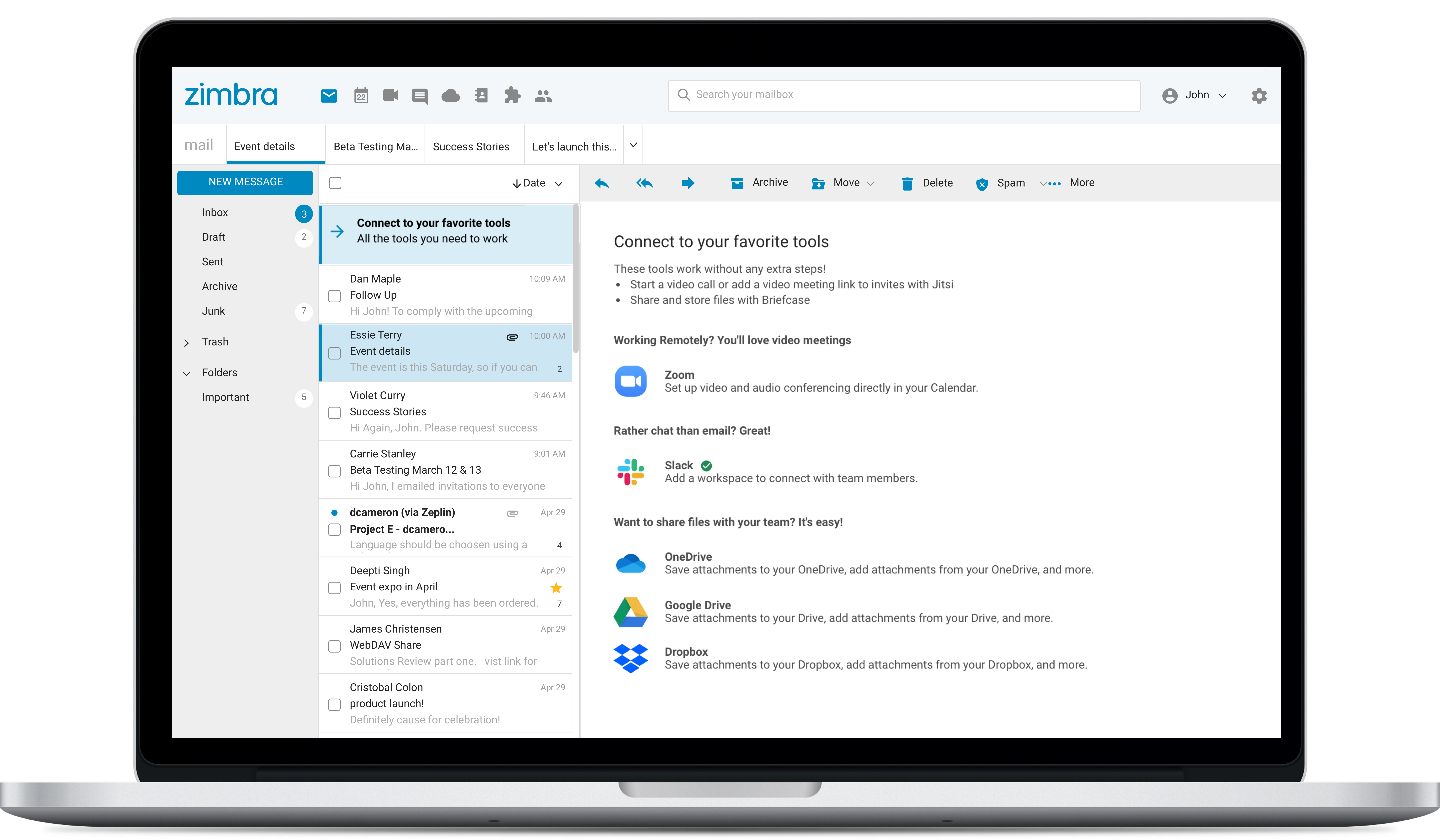
Zimbra is an email and collaboration platform and productivity suite that includes contacts, calendar, tasks, chat and file sharing, plus videoconferencing, document editing, and file storage.
N/A
Pricing
HCL Domino
Zimbra by Synacor
Editions & Modules
No answers on this topic
No answers on this topic
Offerings
Pricing Offerings
HCL Domino
Zimbra
Free Trial
No
Yes
Free/Freemium Version
No
No
Premium Consulting/Integration Services
No
No
Entry-level Setup Fee
No setup fee
No setup fee
Additional Details
—
—
More Pricing Information
Community Pulse
HCL Domino
Zimbra by Synacor
Features
HCL Domino
Zimbra by Synacor
Project Management
Comparison of Project Management features of Product A and Product B
HCL Domino
-
Ratings
Zimbra by Synacor
9.0
6 Ratings
15% above category average
Task Management
00 Ratings
9.86 Ratings
Gantt Charts
00 Ratings
8.13 Ratings
Scheduling
00 Ratings
9.85 Ratings
Workflow Automation
00 Ratings
7.23 Ratings
Mobile Access
00 Ratings
9.76 Ratings
Search
00 Ratings
9.86 Ratings
Visual planning tools
00 Ratings
8.53 Ratings
Communication
Comparison of Communication features of Product A and Product B
HCL Domino
-
Ratings
Zimbra by Synacor
6.6
9 Ratings
19% below category average
Chat
00 Ratings
7.07 Ratings
Notifications
00 Ratings
5.58 Ratings
Discussions
00 Ratings
2.07 Ratings
Surveys
00 Ratings
7.72 Ratings
Internal knowledgebase
00 Ratings
7.73 Ratings
Integrates with GoToMeeting
00 Ratings
7.63 Ratings
Integrates with Gmail and Google Hangouts
00 Ratings
8.04 Ratings
Integrates with Outlook
00 Ratings
7.53 Ratings
File Sharing & Management
Comparison of File Sharing & Management features of Product A and Product B
If you're looking for a high-security environment, then Domino is great. The built-in cybersecurity features are seamless, unlike those in the Microsoft or Google environments. Large databases are easily managed, and Domino enables us to automate many of our business workflows. It's easier to use than Microsoft PowerApps, for example. It doesn't integrate easily with other systems, which can be problematic at times. And because of the long-term lack of support from when IBM owned it, the user community has dwindled somewhat, making it hard to reach out for help.
Zimbra is great for an email system for a medium or large organization with appropriate IT staffing. The system is easy to use for end-users, and has a fantastic web interface. Unfortunately, it is overly complex, when considering staffing requirements and price, when compared with Office 365 or Google Apps for smaller organizations. For other education customers, it is hard to compete with Microsoft and Google providing their services for "Free" now though
I am not a fan of the Domino ID for authentication purposes. Some Admins appreciate this feature, but ID aging, updating and management issues are burdensome.
Integrations with current available software applications as a result of lower Domino adoption rates.
Administration tools are somewhat dated and clunky. Even with updates and patches, the Domino administrator console hasn't changed in years.
Zimbra's mobile application leaves much to be desired; it is its weakest point.
This forces the use of third-party applications on smartphones, which only offer a more or less complete integration with the ActiveSync protocol.
Zimbra allows for an on-premise scenario, which is not for everyone, especially considering that the trend nowadays is to outsource email; in any case, it also offers this alternative.
The cost of Zimbra as a SaaS solution comes too close to that of more widely adopted competing options.
Zimbra lacks a robust integrated chat system, which its competitors offer.
The UI is somewhat dated, and the email experience is not at all like Outlook, but we love the versatility and functionality of Domino. I would absolutely hate to give it up for anything else. We've tried to replicate some of Domino's functionality in SharePoint and found that Domino is considerably better.
The web usability of the solution is adequate, with all functions integrated into a single interface. However, it is important to note that in the desktop environment, it lacks its own application and relies on ActiveSync synchronization with reference solutions like Outlook or Thunderbird. Some features, such as the briefcase, will be excluded. The same happens on smartphones.It is also common for competing solutions to include integrated chat or video call tools, which Zimbra lacks. These shortcomings are among the most frequently requested by users.
Overall, we were satisfied with the implementation. We perhaps should have spent more time consulting with Zimbra or others regarding best practices but as we got to know the system better we were able to make changes relatively easily after the fact.
We use SharePoint, SQL and Teams but only for the things that they excel in. For example, we use teams for small team interactions (including external participants). We use teams for meetings too. We've discovered that Teams collaboration is not as full-functional as Domino and more importantly, that our members (financial services) do not trust the Open Office365 cloud. SharePoint and Team collaborative features are often blocked in our member organizations. Domino is much easier to identify and unblock at the firewall level. It's much easier to restrict collaboration to approved options in Domino.
Zimbra is a significantly cheaper option than one of the Microsoft solutions, such as Exchange. It is able to run in a free environment, as it is in the case of Linux. It offers the advantages of a powerful mail manager, such as indexed searches and the integration of contacts and notes, all in one platform. It is constantly updated and the operation of its connection in mobile equipment is remarkable and very efficient. Additionally, it is able to easily integrate with Outlook solutions with its connector, which brings all the benefits of Zimbra to the user under the interface known as "mail manager." So far, I have been using Zimbra for several years and I have not missed my previous work platforms.
Zimbra is a cheaper email service than other similar platforms and in my point of view offers better features, that's why the company migrated services to this platform several years ago and without a doubt, it has been the best investment.
Zimbra has a more user-friendly interface for employees, this has improved response times to external customers of the company.
The implementation of Zimbra in the company motivated the IT engineering department to make improvements in open source to adapt it to the needs of the company.