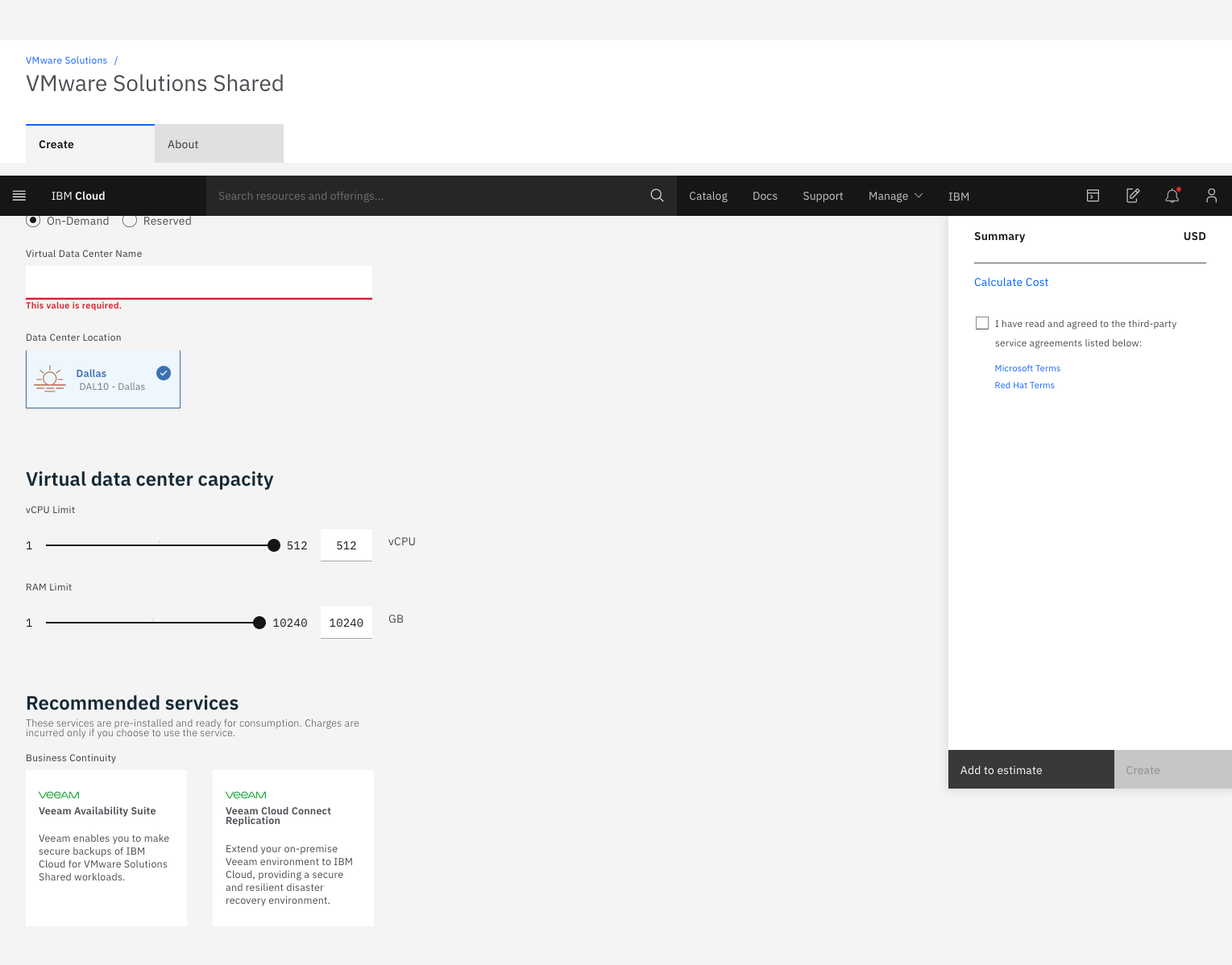
IBM Cloud for VMware
Solutions is designed to make cloud adoption easier, allowing the user to optimize the
value of existing on-premises infrastructure, while leveraging the
same tools, technologies and skills in the cloud. The solution provides rapid scalability,
deployment in 35+ global data centers and access to disaster
recovery, backup, security and compliance solutions from an array of ecosystem
partners. To address varying workload needs, IBM Cloud…
$0
IBM Cloud Object Storage Cross-Regional Smart Tier 1 GB (hourly)
Pricing
Hyper-V
IBM Cloud for VMware Solutions
Editions & Modules
Developer
$24.95
per month
Bronze
$49.00
per month
Silver
$89.00
per month
Gold
$135.00
per month
Platinum
$199.00
per month
Add-on
$0
IBM Cloud Object Storage Cross-Regional Smart Tier 1 GB (hourly)
On-demand
$0
0.25 IOPs 1 GB
Reserved (monthly or 730 hours)
$0
0.25 IOPs 1 GB (Per gigabyte of storage (hourly))
Add-on
$0
IBM Cloud Block Storage 1 GB (hourly)
On-demand
$0.01
Per vCPU (hourly)
On-demand
$0.09
Per gigabyte of network and bandwidth egress (monthly)
Reserved (monthly or 730 hours)
$0.09
Per gigabyte of network and bandwidth egress (monthly)
We went with Hyper-V since it's backed by Microsoft. Most of our businesses use MS, so going with supported products helps when we need to open a case if we run into issues. There are other alternatives, but the ease and support of Hyper-V make it our go-to product for …
Hyper-V makes a lot of sense in scenarios that will support several Windows Server-based OS virtual machines. The only limitation of those licensed VMs is the hardware that hosts the Hyper-V role. If you need to deploy many servers running Windows Server OS, it is worth the price. Hyper-V also does a great job of managing the server host's computational resources, including memory, CPU, network, and storage.
VMware Cloud Foundation for Disaster Recovery environment, when the client needs to deploy a pay-as-you-go service or if they need to migrate SAP workloads, you can use VMware Cloud Foundation for Classic and VPC. We are the unique SAP-Certified VMware cloud service provider.
Easy to use GUI - very easy for someone with sufficient Windows experience - not necessarily a system administrator.
Provisioning VMs with different OSes - we mostly rely on different flavors of Windows Server, but having a few *nix distributions was not that difficult.
Managing virtual networks - we usually have 1 or 2 VLANs for our business purposes, but we are happy with the outcomes.
The presentation is first rate. Our on-prem climate was continually experiencing slack and general languor. With IBM running everything, it's much smoother.
Start another group as little as one ESXi worker or scale a current bunch.
We manage Hyper-V using both System Center Virtual Machine Manager (SCVMM) and the in-build Hyper-V administration tool, the former being the main product we use as the built-in tool is very light on functionality, unlike VMware ESXi.
Management of storage is not great and quite a shift away from how VMware does it with ESXi; there is no separate panel/blade/window for LUNs/data stores, which means there is a lot of back and forth when trying to manage storage.
A dedicated client with all functionality in one place would be awesome.
Having the equivalent of ESXi's virtual console is something which is absolutely needed.
Cheap and easy is the name of the game. It has great support, it doesn't require additional licenses, it works the same if it is a cluster or stand-alone, and all the servers can be centrally managed from a system center virtual machine manager server, even when located at remote sites.
It is quite intuitive. Junior techs are able to provision and administrate Hyper-V virtual server infrastructure with little to no additional training. Documentation from Microsoft is easily avaliable and decently well written. Hyper-V is reliable and does what it is supposed to. Can be admin from an intuitive gui, or aoutmated with extensive powershell.
It is easy to use and setting it up is simple. The only con is that the pricing is a little bit high as well as documentation is a little low; so we had to do some personal learning to be able to fully utilize the product, or hop on the phone with someone.
In the past 2 years our Hyper-V servers have only had a handful of instances where the VM's on them were unreachable and the physical Hyper-V server had to be restarted. One time this was due to a RAM issue with the physical box and was resolved when we stopped using dynamic memory in Hyper-V. The other times were after updates were installed and the physical box was not restarted after the updates were installed.
Hyper-V itself works quickly and rarely gave performance issues but this can be more attributed to the physical server specifications that the actual Hyper-V software in my opinion as Hyper-V technically just utilizes config files such as xml, and a data drive file (VHD, VHDX, etc) to perform its' duties.
I gave it a middle of the road rating - as far as getting direct help from Microsoft this never seems to happen. (Good luck getting ahold of them.) Getting help from online support forums is pretty much where I get all my help from. Hyper-V is used quite widely and anything you could need help with is out there and easily searched for on your favorite search engine.
Overall, just a great experience here. No one in my opinion gets a perfect 10/10 rating (no one is ever perfect), so 9/10 is probably as good as it gets! From initial planning to post implementation support, the IBM Cloud and professional services has been there for my group as much as we have needed them. Great job!
We had in person training from a third party and while it was very in depth it was at a beginner's level and by the time we received the training we had advanced past this level so it was monotonous and redundant at that point. It was good training though and would have provided a solid foundation for learning the rest of Hyper-V had I had it from the beginning.
The training was easy to read and find. There were good examples in the training and it is plentiful if you use third party resources also. It is not perfect as sometimes you may have a specific question and have to spend time learning or in the rare case you get an error you might have to research that error code which could have multiple causes.
initial configuration of hyper-v is intuitive to anyone familiar with windows and roles for basic items like single server deployments, storage and basic networking. the majority of the problems were with implementing advanced features like high availability and more complex networking. There is a lot of documentation on how to do it but it is not seamless, even to experienced virtualization professionals.
IBM professional services helped us plan and implement the project with great success. They guided the project from planning, scoping, pre-implementation, testing, roll-out, then production and post-production support. We were very impressed with their knowledge of VMware and really appreciated their desire to make our project a success. I would highly recommend them!
VMware is the pioneer of virtualization but when you compare it with Hyper-V, VMware lacks the flexibility of hardware customization and configuration options Hyper-V has also GPU virtualization still not adequate for both platforms. VMware has better graphical interface and control options for virtual machines. Another advantage VMware has is it does not need a dedicated os GUI base installation only needs small resources and can easily install on any host.
IBM Cloud for VMware Solutions stacks up against them, we fully agree there are so many features in IBM cloud for VMware Solutions that make it unique and different. The system provides us hypervisor security level and the system even has live backup and storage capacity of data. This system provides us with accuracy that helps us to reduce errors and vulnerability.
Nothing is perfect but Hyper-V does a great job of showing the necessary data to users to ensure that there is enough resources to perform essential functions. You can also select what fields show on the management console which is helpful for a quick glance. There are notifications that can be set up and if things go unnoticed and a Hyper-V server runs out of a resource it will safely and quickly shut down the VM's it needs to in order to ensure no Hardware failure or unnecessary data loss.
Massively positive impact on expenses in my company by reducing our storage needs drastically. We were able to reallocate the budget to upgrading our primary Hyper-V server with pure enterprise SSD's as we reduced the storage needs by over 50% and by this we increased performance by over 400%.
We have deployed more than 8 servers with EXTREMELY minimal cost using Hyper-V and not requiring another hardware server to host it. We have leveraged our hardware resources in our 2 servers so well that we were able to add many new services, not in place prior, as we did not have the servers to host them. Now with Hyper-V, we deployed many more servers in VM's, purchased OS's & CAL's, but did not need any hardware, which is the greatest expense of all.
With Hyper-V, our ROI was reduced from 36-40 months on our primary server, down to only 13 months by reducing costs of storage and adding so many more servers, by calculating the "would-be" cost of those servers that was avoided by creating them in Hyper-V.
It has a positive impact on the cost required to maintain our vSphere environment by allowing us to get rid of our vsphere hardware and not worry about maintenance either.
There have been very few negatives, but one would definitely be the open-ended cost associated with cloud products in general.