Icinga is an open source network monitoring platform. It includes automation, modularized integration packages, and prebuilt alerts and reporting capabilities.
N/A
PingPlotter
Score 8.8 out of 10
N/A
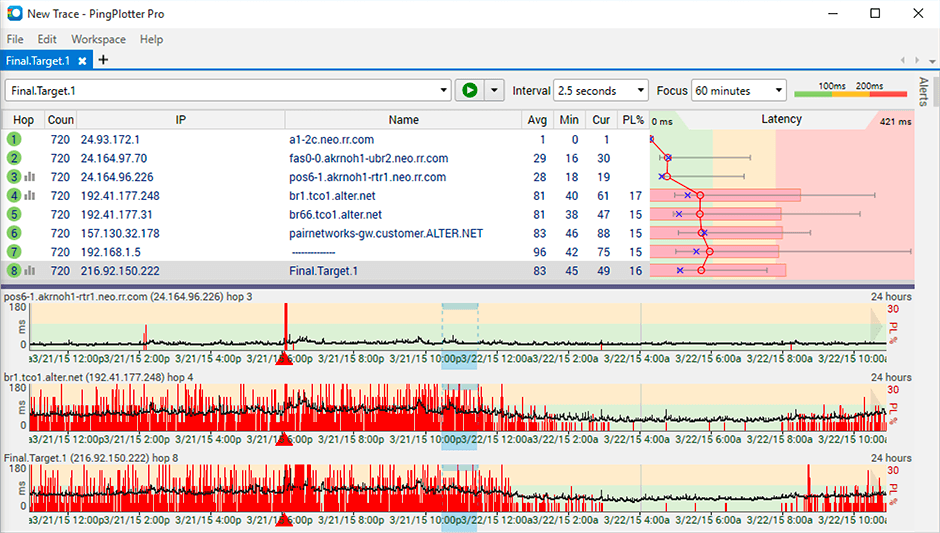
PingPlotter is a graphical traceroute and ping tool that visualizes network performance in a way that makes identifying the source of problems quicker and easier for everyone from online gamers and video streamers to VoIP admins and IT pros. Features for remote deployment, network monitoring, scripting, and a web interface are included along with several additional capabilities.
PRTG was the solution that was implemented before. As Icinga is Open Source we saved the licensing fee, as we ran out of free checks. I also had knowledge in Icinga so we switched over.
Nagios is inferior to Icinga in my opinion, as Icinga has the better Web UI, which I use the …
Icinga was initially a fork of Nagios. Over time, the configuration language was replaced with something more programmatic. This configuration language is one of the big sellers of this product. It allows flexible, quick configuration of large sets of hosts and services with …
While Icinga holds its own against old stalwarts like Nagios and Zabbix, it simply can't compete with the new generation of SaaS service/server monitoring software in terms of ease of use, feature-completeness, integration with things like Cloudwatch, CloudHealth, New Relic, …
There are two main competitors of Icinga in my opinion, Nagios, and NetFlow based monitoring solutions. Both are good, Icinga, is a more refined version of Nagios with a much better API and backwards compatibility to the platform. If you are running Nagios, you can transfer …
Icinga is better than Nagios because of its nicer user interface. New Relic can monitor CPU/memory and disk usage, but it's more of a performance and application troubleshooting tool rather than monitoring.
I used Ping.app and UptimeLog.app on the Mac. These both provided different aspects. These two had a menubar to show me green or red for multiple connections. UptimeLog showed me very clearly when my connectivity was on or off and for exactly how long.
I've tried more products that are not in the list but PingPlotter is the easiest to use and the better one so far because of the interface and function.
PingPlotter has better visualizations and a stronger ability to capture historical data than other tools I've used. This makes it easier to find the root cause by looking back in the log data to find where latency or packet loss occurred.
A balance of a generic tool vs a network equipment product is necessary when investigating network incidents or disruptions. Need to train the engineer to use both tools to perform their analysis and to dive down to the issues as fast as they can. Experience with the tools will …
PingPlotter stacks up very well to Solarwinds NPM and can provide many of the same benchmark tests that Solarwinds can. PingPlotter is most certianly much better at doing Traceroutes than NPM, and you can run a lot of the same reports.
PingPlotter is a basic version of Auvik, although it is easier to setup and there is less intrusion in the customers network. This allows us to use PingPlotter as a prospecting tool and allows to accurately gather network information very quickly. Basic troubleshooting is great …
I have tried a few free products and some paid ones but never really did what I wanted. I just needed a simple, always-on link monitor specifically with a traceroute element and this is what PingPlotter delivers. The others were either overly complex or too expensive, some just …
If you're running bare-metal in a datacenter and your hosts are fairly static, it's probably okay to use something like Icinga to monitor your systems. In general, I would not recommend using any monitoring software based on Nagios (Icinga is a fork of Nagios) due to the outdated concepts inherent in those systems. There are a number of good SaaS monitoring solutions which are superior and several open source projects which implement an automation-centric approach to monitoring
It is well suited for performing monitoring and testing from a single device. It is less appropriate if you have to monitor from multiple different endpoints. That type of deployment would be more of an enterprise application. If you are looking for an end user monitoring solution then PingPlotter is the one for you.
I think Icinga has a great search feature. I can always search for the hosts, host groups, or check names. When using just regular Nagios, I don't recall being able to do this search.
The fact that I can use Active Directory or LDAP for logins is a great feature.
If you are familiar with Nagios, it's very simple to combine the two products to get a polished finished product.
Its a little confusing to see which targets are currently running pings and which ones are displayed in the plots.
Starting and stopping pings requires a right click and that would be better with a play/pause button I think.
Ability to drag and drop the graphs to reorder them.
more columns to show which targets are running and which are displayed. Currently this is done with symbols so you cant sort by just the running targets for example I've found.
Icinga is a solid solution which does everything it promises. It is backwards compatible with most Nagios instances, making the transition very easy. Once you get the hang of installing new plugins and editing configuration files expanding its monitoring capabilities are easy.
I installed it and it just started working. I realized I could then tweak it to show what I needed but didn't have to spend a long time configuring it before use, editing YAML files etc. Maybe that's fine for a network professional, but I only need this software if something goes wrong, and then need it to work quickly out of the box.
I have not had much contact with the PingPlotter support, only one time have I went to them and it was a positive experience. The questions I had were answered quickly and professionally. I have no issue with the experience I had with the Support team. This was from before and after the purchase of the product.
Icinga was initially a fork of Nagios. Over time, the configuration language was replaced with something more programmatic. This configuration language is one of the big sellers of this product. It allows flexible, quick configuration of large sets of hosts and services with minimal input. Comparing it to other products like WhatsUp Gold, Zenoss, Zabbix, etc., it stands out as incredibly flexible. Adding additional features to Icinga can be as simple as searching for them online. And if they don't yet exist, there is a full API available for custom extensions.
I used Ping.app and UptimeLog.app on the Mac. These both provided different aspects. These two had a menubar to show me green or red for multiple connections. UptimeLog showed me very clearly when my connectivity was on or off and for exactly how long