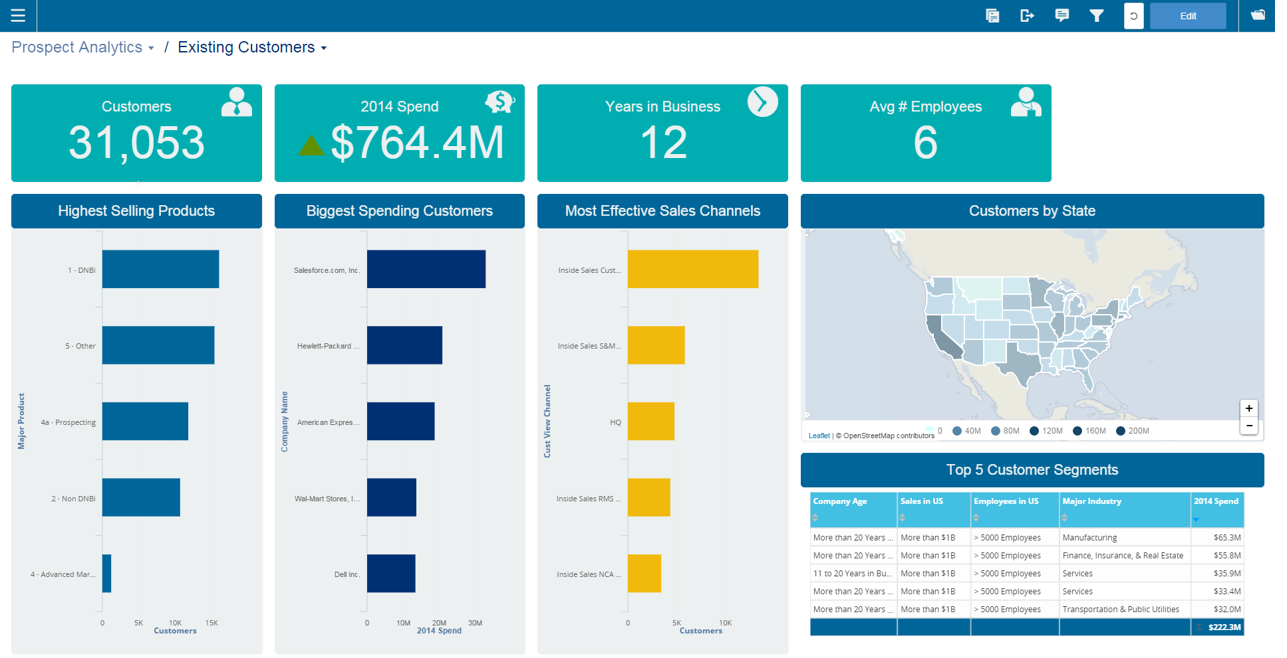
Infor Birst offers multi-tenant cloud BI for deployment in a public or private cloud, or on-premises. It provides an in-memory columnar data store and a BI layer comprising a reporting engine, predictive analytics tools, mobile native apps, dashboards, discovery tools, and an open client interface.
N/A
Pricing
Infor Birst
Editions & Modules
No answers on this topic
Offerings
Pricing Offerings
Infor Birst
Free Trial
No
Free/Freemium Version
No
Premium Consulting/Integration Services
Yes
Entry-level Setup Fee
No setup fee
Additional Details
—
More Pricing Information
Community Pulse
Infor Birst
Considered Both Products
Infor
Verified User
Chose Infor Birst
We were using Birst OEM and now moved to Looker, because it was too old-fashioned and tool capability was limited. It is a different tool - Birst OEM has some more in depth capability and customizations options while Looker is more modern and easy to use, in my opinion.
A de minimis incentive was given to thank the reviewer for their time. The incentive was not used to bias or drive a particular response, nor was the incentive contingent on a positive endorsement. More Info
Human Resources Analyst in Human Resources at Accenture (Human Resources, 10,001+ employees)
Chose Infor Birst
Infor Birst OEM and embedded analytics have low-code no-code features which are easy to deploy and with easy instances creation with a dev-quality-production environment. Good capability on data mapping features from source to intermediate to target with impressive metadata …
A de minimis incentive was given to thank the reviewer for their time. The incentive was not used to bias or drive a particular response, nor was the incentive contingent on a positive endorsement. More Info
A de minimis incentive was given to thank the reviewer for their time. The incentive was not used to bias or drive a particular response, nor was the incentive contingent on a positive endorsement. More Info
Verified User
Chose Infor Birst
Birst is the best all in one tool that we found, especially at a good price point and already using Infor
A de minimis incentive was given to thank the reviewer for their time. The incentive was not used to bias or drive a particular response, nor was the incentive contingent on a positive endorsement. More Info
Verified User
Chose Infor Birst
There are a few items I evaluate when looking at different tools.
A de minimis incentive was given to thank the reviewer for their time. The incentive was not used to bias or drive a particular response, nor was the incentive contingent on a positive endorsement. TR verified that a representative sample of customers was invited. More Info
Verified User
Chose Infor Birst
Ease of use
Ability to easily connect to multiple and varying data sources
A de minimis incentive was given to thank the reviewer for their time. The incentive was not used to bias or drive a particular response, nor was the incentive contingent on a positive endorsement. TR verified that a representative sample of customers was invited. More Info
Business Analyst in Marketing at eCornell (E-Learning, 51-200 employees)
Chose Infor Birst
Birst was better than Domo for our needs because we could get in and tinker with it. Our impression of Domo was that it had a lot of connectors and ready to go reports, but it made too many assumptions about applications we use. We customize too much to use a "ready to go" …
A de minimis incentive was given to thank the reviewer for their time. The incentive was not used to bias or drive a particular response, nor was the incentive contingent on a positive endorsement. TR verified that a representative sample of customers was invited. More Info
Verified User
Chose Infor Birst
During the vetting process, we looked at 14 different products (one of them internal) to see if they would fit our needs and whittled it down to this one over a three month period. We did not contact sales for all of them (sales sites were enough to rule out some), but did have …
A de minimis incentive was given to thank the reviewer for their time. The incentive was not used to bias or drive a particular response, nor was the incentive contingent on a positive endorsement. TR verified that a representative sample of customers was invited. More Info
A de minimis incentive was given to thank the reviewer for their time. The incentive was not used to bias or drive a particular response, nor was the incentive contingent on a positive endorsement. TR verified that a representative sample of customers was invited. More Info
Director Of Operations in Corporate at Harvest Food Solutions (Computer Software, 11-50 employees)
Chose Infor Birst
The primary differentiator with Birst is its scalability. Every other system we have developed or reviewed is either very strong in a single focus or requires a large team to manage to deploy over multiple, diverse customers. We have been able to accomplish more successfully …
A de minimis incentive was given to thank the reviewer for their time. The incentive was not used to bias or drive a particular response, nor was the incentive contingent on a positive endorsement. TR verified that a representative sample of customers was invited. More Info
A de minimis incentive was given to thank the reviewer for their time. The incentive was not used to bias or drive a particular response, nor was the incentive contingent on a positive endorsement. TR verified that a representative sample of customers was invited. More Info
Leader, Business Insight & Analytics in Sales at Dun & Bradstreet (Information Services, 5001-10,000 employees)
Chose Infor Birst
We compared Birst vs Tableau and Lumirra and there's no question that Birst is the best option from a cost perspective. Additionally, the ease of use complemented with our support team has allowed us to innovate on the platform quickly
A de minimis incentive was given to thank the reviewer for their time. The incentive was not used to bias or drive a particular response, nor was the incentive contingent on a positive endorsement. TR verified that a representative sample of customers was invited. More Info
Verified User
Chose Infor Birst
Key evaluation criteria: - Is how quickly the query runs - The code and metadata for the database
A de minimis incentive was given to thank the reviewer for their time. The incentive was not used to bias or drive a particular response, nor was the incentive contingent on a positive endorsement. TR verified that a representative sample of customers was invited. More Info
A de minimis incentive was given to thank the reviewer for their time. The incentive was not used to bias or drive a particular response, nor was the incentive contingent on a positive endorsement. TR verified that a representative sample of customers was invited. More Info
Verified User
Chose Infor Birst
Cognos - this tool is also more difficult to set up, takes more time to develop dashboards, harder for the business user to navigate MicroStrategy - this tool is also more difficult to set up, takes more time to develop dashboards, harder for the business user to navigate MS …
A de minimis incentive was given to thank the reviewer for their time. The incentive was not used to bias or drive a particular response, nor was the incentive contingent on a positive endorsement. TR verified that a representative sample of customers was invited. More Info
Verified User
Chose Infor Birst
Birst was the right size for our company. The other vendors were to large and scope was to much.
A de minimis incentive was given to thank the reviewer for their time. The incentive was not used to bias or drive a particular response, nor was the incentive contingent on a positive endorsement. TR verified that a representative sample of customers was invited. More Info
Verified User
Chose Infor Birst
We evaluated and compared Birst, OBIEE 12c, and Tableau based on several criteria such as "Data Analysis & Discovery", "Data Integration", "Security model", "Data Visualization", "User Experience" or "Infrastructure & Architecture". The only point where Birst was rated higher …
A de minimis incentive was given to thank the reviewer for their time. The incentive was not used to bias or drive a particular response, nor was the incentive contingent on a positive endorsement. TR verified that a representative sample of customers was invited. More Info
Verified User
Chose Infor Birst
The standard in our company is SAP Business objects. For the international part of the company we are using Birst because of its accesibility, ease of maintenance and ease of use. Compared to SAP BO dashboarding and easy to medium complex reports are easier to create and …
A de minimis incentive was given to thank the reviewer for their time. The incentive was not used to bias or drive a particular response, nor was the incentive contingent on a positive endorsement. TR verified that a representative sample of customers was invited. More Info
Verified User
Chose Infor Birst
We originally selected Birst because they are a Partner of our ERP system provider. We re-evaluated and reconfirmed that decision after our new investment through a one week prototyping exercise that proved how quickly something that delivers real content and value can be built …
A de minimis incentive was given to thank the reviewer for their time. The incentive was not used to bias or drive a particular response, nor was the incentive contingent on a positive endorsement. TR verified that a representative sample of customers was invited. More Info
Director in Information Technology at Pulse Analytics (Computer Software, 11-50 employees)
Chose Infor Birst
We selected Birst over all other options due to the one-stop-shop nature of their offering - it allows us to rapidly develop and deploy a complete product quickly within a single tool.
A de minimis incentive was given to thank the reviewer for their time. The incentive was not used to bias or drive a particular response, nor was the incentive contingent on a positive endorsement. TR verified that a representative sample of customers was invited. More Info
Verified User
Chose Infor Birst
So much easier to be able to pull data using a query at times, which should be supported alongside drag and drop options. I can actually left join two tables when needed to provide data frequently requested by customers.
A de minimis incentive was given to thank the reviewer for their time. The incentive was not used to bias or drive a particular response, nor was the incentive contingent on a positive endorsement. TR verified that a representative sample of customers was invited. More Info
Director, Business Intelligence & Analytics in Information Technology at XO Group Inc. (Internet, 501-1000 employees)
Chose Infor Birst
Birst provide a much better web UI and end user experience and distribution mechanism than both Tableau and SSRS. Power BI simply did not have the full complement of features that we needed at the time of our selection to be competitive and Pentaho was too custom and would have …
A de minimis incentive was given to thank the reviewer for their time. The incentive was not used to bias or drive a particular response, nor was the incentive contingent on a positive endorsement. TR verified that a representative sample of customers was invited. More Info
Senior Software Engineer in Engineering at Elekta (Health, Wellness and Fitness, 1001-5000 employees)
Chose Infor Birst
We chose Birst as birst Appliance and cloud versions has same set of features available. Power BI hosted on Azure cloud has competitive pricing, but Power BI report server has very limited features available and is also very expensive. Due to PHI data regulations in different …
A de minimis incentive was given to thank the reviewer for their time. The incentive was not used to bias or drive a particular response, nor was the incentive contingent on a positive endorsement. TR verified that a representative sample of customers was invited. More Info
Senior Software Engineer in Information Technology at eCornell (Education Management, 51-200 employees)
Chose Infor Birst
Birst's ETL is better suited to our purposes than Alooma's stream-based processing. Birst's designer is more mature and meets or needs better than Periscope's reporting functionality, at the time I investigated it.
A de minimis incentive was given to thank the reviewer for their time. The incentive was not used to bias or drive a particular response, nor was the incentive contingent on a positive endorsement. TR verified that a representative sample of customers was invited. More Info
Key User Insights
Would buy again
No answers on this topic
Delivers good value for the price
No answers on this topic
Happy with the feature set
No answers on this topic
Lived up to sales and marketing promises
No answers on this topic
Implementation went as expected
No answers on this topic
Features
Infor Birst
BI Standard Reporting
Comparison of BI Standard Reporting features of Infor Birst
Feature
Infor Birst
7.4
77 Ratings
10% below category average
Pixel Perfect reports
7.068 Ratings
Customizable dashboards
8.077 Ratings
Report Formatting Templates
7.159 Ratings
Ad-hoc Reporting
Comparison of Ad-hoc Reporting features of Infor Birst
Feature
Infor Birst
7.0
78 Ratings
13% below category average
Drill-down analysis
8.078 Ratings
Formatting capabilities
7.077 Ratings
Integration with R or other statistical packages
6.127 Ratings
Report sharing and collaboration
7.068 Ratings
Report Output and Scheduling
Comparison of Report Output and Scheduling features of Infor Birst
Feature
Infor Birst
8.0
75 Ratings
3% below category average
Publish to Web
8.052 Ratings
Publish to PDF
8.067 Ratings
Report Versioning
7.28 Ratings
Report Delivery Scheduling
9.066 Ratings
Data Discovery and Visualization
Comparison of Data Discovery and Visualization features of Infor Birst
Infor Birst OEM and embedded analytics are well suited for advanced analytics and business intelligence. It has flexible deployment features and a lot of configuration ability with low code - no coding ability. Ability to ingest data from multiple live data sources. Source data from multiple sources can be segregated into multiple sections based on business criteria. Easily searchable business terms (metadata) across all enterprise analytic content.
End-to-end solution, from raw source data, ETL, warehousing and reporting, Birst is able to do everything we need in one package instead of needing to develop and maintain multiple technologies
Intuitive report development. The drag and drop creation of reports is simple. More complicated queries are easy to generate.
Very user-friendly and interactive. A lot of nice features are available both for developers and end users to streamline the process of preparing and consuming data
Rich API which allows us to programmatically interact with Birst
A de minimis incentive was given to thank the reviewer for their time. The incentive was not used to bias or drive a particular response, nor was the incentive contingent on a positive endorsement. More Info
A de minimis incentive was given to thank the reviewer for their time. The incentive was not used to bias or drive a particular response, nor was the incentive contingent on a positive endorsement. TR verified that a representative sample of customers was invited. More Info
We have been able to overcome any of the drawbacks we've found with Birst easily and it has fulfilled almost all of our analytic needs to date. Having seen their roadmap it would be highly unlikely we would move away from this platform any time soon. You simply can't beat the functionality that Birst provides for the price and the things I see coming out of the company solidify that our decision to choose Birst was the best possible choice. We have never regretted the decision.
I would like to see additional usability put into the ETL scripting. Recently, Birst added a nice function reference inline to formula creation which has kept me from having to return to documentation so much. The same in ETL would be very beneficial. The interface problems related to the Flex framework are being addressed in a rewrite to HTML 5, but for now they are still a hindrance to a higher usability rating.
We frequently experience -103 errors due to us using the Live Connect functionality, which does not seem to handle even minor interruptions in connectivity, and treats all future connection attempts or data requests as errors, even if the issue does not exist any longer
Everything runs very fast and smoothly. The only process that I wish was faster would be processing the data after uploading new data or making changes to the existing data model. It can take 15-20 minutes (roughly) to upload and process new data once you start getting into 10's of millions of rows. Given my experience with how long it takes me to pull the same data using SQL Server Management Studio, I don't think Birst is unreasonably slow - but for me to give a higher rating, I would want it to be unreasonably fast
A de minimis incentive was given to thank the reviewer for their time. The incentive was not used to bias or drive a particular response, nor was the incentive contingent on a positive endorsement. TR verified that a representative sample of customers was invited. More Info
I have attended two different training sessions. The first one was my initial training on the system. It was well paced, clear and concise. If there were questions that were not able to be answered by the instructor, he took down the question and actually followed up and provided us a response quickly. The second session was specific to the dashboard and report design components. This training was very good though there were some attendants who had little or no experience and their questions slowed the class.
Although I found the online resources helpful, a lack of appropriate examples for certain tasks key to report creation and advanced modeling make the online training/documentation less than perfect. For an inexperienced BI professional, the online training would not enable a streamlined launch of the product.
Have clean data! Birst flexibility allows - Start small, then introduce functionality and complexity along the way. If you try to present all the functionality [bells and whistles] and wow them, but bad data is uncovered, the end user blames the new application and turns away.
Birst was better than Domo for our needs because we could get in and tinker with it. Our impression of Domo was that it had a lot of connectors and ready to go reports, but it made too many assumptions about applications we use. We customize too much to use a "ready to go" solution like that. When we looked at Tableau, we liked its visualization capabilities, but it wasn't going to help us do the extractions, ETL, and warehousing of data. It may have come some distance since then.
A de minimis incentive was given to thank the reviewer for their time. The incentive was not used to bias or drive a particular response, nor was the incentive contingent on a positive endorsement. TR verified that a representative sample of customers was invited. More Info
we can see that loading a lot of data can cause a noticable slow down in performance. Birst support indicated that they don't really consider anything less than 30 seconds to be an issue, but that is not the case for our customers, so we have had to change some of implementation to address this
Being a manufacturing company we tend to lag behind technologically. But having all the data for different ERP systems in one place has been an eye opener for the executives. It has lessened the need to convert some legacy ERP systems.
Having such a simple reporting tool is a great asset to some of our sites that have traditionally had trouble gathering data from AS400 systems.
A de minimis incentive was given to thank the reviewer for their time. The incentive was not used to bias or drive a particular response, nor was the incentive contingent on a positive endorsement. TR verified that a representative sample of customers was invited. More Info