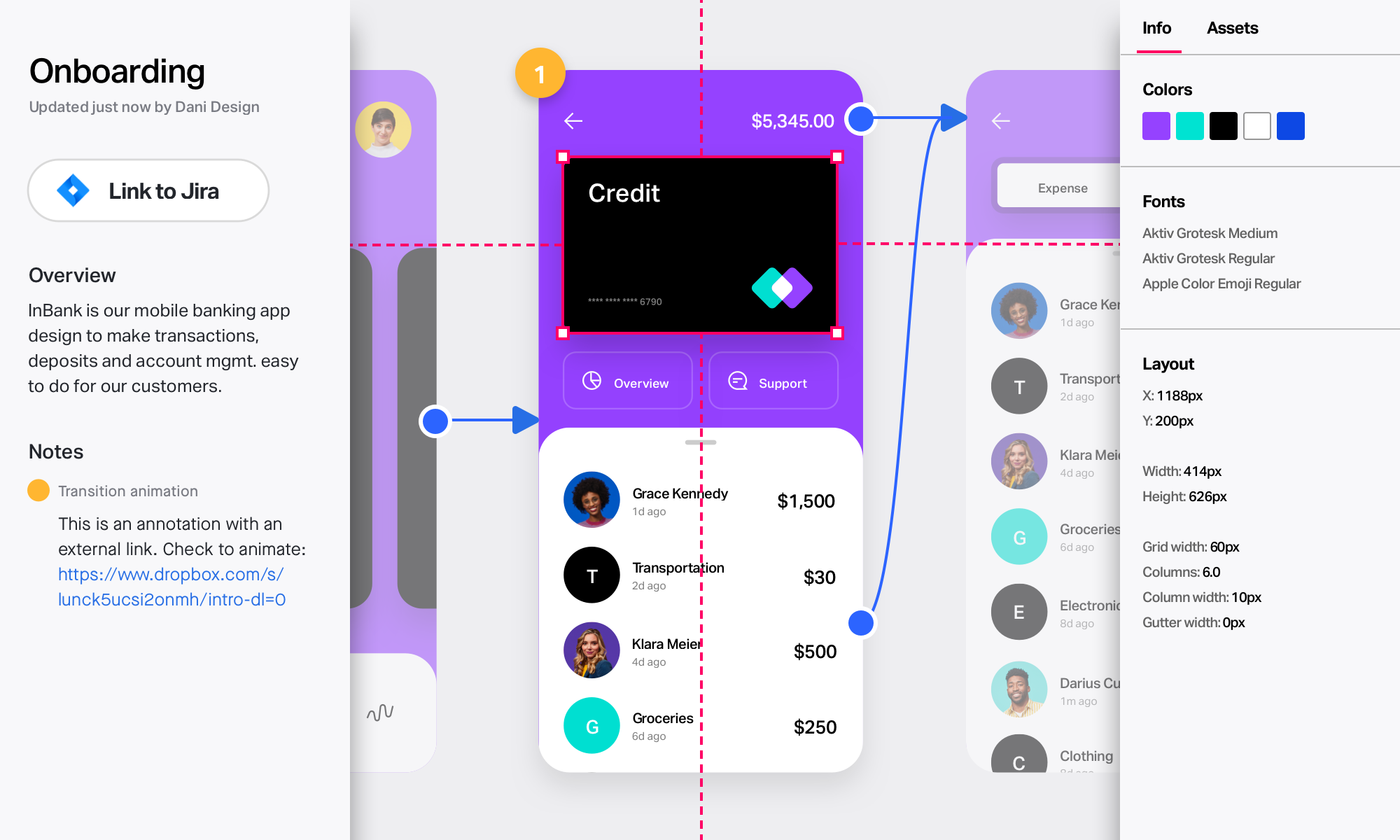
InVision is a collaborative design and prototyping platform with features such as freehand drafting mode and interactive mockups, collaboration, idea management, user testing, and integration with Slack and other collaboration tools. According to the vendor, 1 million designers are using the free version.
$0
Marvel
Score 9.0 out of 10
N/A
Marvel is a prototyping and wireframing app.
N/A
Splunk Enterprise Security
Score 8.3 out of 10
N/A
Splunk Enterprise Security is an analytics-driven SIEM that helps to combat threats with actionable intelligence and advanced analytics at scale.
Compared to other tools, InVision is a very solid tool with a great reputation and prototyping functionalities to back it up. InVision was the first prototyping tool we purchased, and it’s served us really well. However, more and more design tools are now also providing …
I decided to switch to Zeplin and Principle after using InVision. The whole workflow becomes bit faster and simpler. I will upload all design files into Zeplin and share them with our developers. At the same time, I use Principle to create dynamic animation/transition between …
We started using Marvel for rapid prototyping and the two are fairly analogous. In the end team and enterprise functionality drove the switch from one tool to the other. Another tool we had used is Axure, and for truly advanced, data driven prototyping, it's still the tool to …
Axure is expensive, and there's a much bigger then you get with InVision. I also feel like the finished prototype just never looks as nice. I do still use Balsamiq on occasion, that's the best option when you want to create something quickly, to communicate a simple idea. …
Marvel is also a good prototyping tool. I have experimented these two tools for my prototyping work, and both seemed very good to me. Maybe for some people Marvel may have and easy to lean dashboard and features, but I love to use InVision. I don't really find any major …
Marvel has replaces InVision for me in terms of quick prototyping for high-fidelity mockups. There is a greater variety of interactions, especially between screens, and overall it seems to just have a sleeker feels. I still use Principle over Marvel for more detailed …
Marvel creates prototypes much faster than InVision. Both tools use global hotspots---a global hotspot is a linked area which is visible on multiple screens. Marvel has a better UX for setting up new hotspots. Marvel asks only necessary questions, does not interrupt the flow, …
Verified User
Strategist
Chose Marvel
Ultimately, InVision was just a better fit for our company's needs. It's probably faster to create prototypes using Marvel, but InVision's collaboration features (comments, notes, etc.) are much more robust, which was helpful for our large team spread across multiple …
Marvel isn’t the most robust prototyping tool, but its simplicity is what makes the tool rise to the top when it comes to creating quick, simple prototypes to elicit feedback on designs and iterate upon them. While tools like InVision and Axure provide many tools to make more …
In some works, I prefer to use InVision than Marvel for high fidelity prototypes, as there is a wide variety of interactions and micro-interactions available, but still, I use marvel a lot for quick prototyping. It also uses Figma a lot for high-fidelity prototypes. The …
InVision is well suited for design reviews and immersing yourself in the experience of an app-to-be. As a Product Manager, it's difficult to take abstract concepts, user pain points, and business needs, and produce a vision for an app without a visual aid to communicate a vision. InVIsion offers PMs, designers, and developers the opportunity to sketch a vision, communicate about it with inline commenting, and shareable with other stakeholders.
Marvel is a very strong tool in scenarios where designers seek to quickly create simple prototypes on their desktops using a simple, intuitive interface. It offers “just enough” functionality to create somewhat realistic designs to present to stakeholders and other designers. However, there’s a limit to how “realistic” those designs can be, given that Marvel has somewhat limited functionality around animations. Marvel is not a strong option for those who want to create very complex prototypes with many animations, or for those who want to edit prototypes on their tablet or phone. Marvel is a jewel for simplicity but starts to be difficult to use when creating complicated designs. For creating more complicated prototypes, I would recommend a more robust tool, such as Axure.
Based on my experience, Splunk is a strong git for some environments and a poor match for others. The distinction is primarily based on infrastructure complexity and budget. It's perfect for large enterprises with a mix of on-prem/cloud infrastructure. It's not a perfect match for small teams with restricted resources.
Writes Powerful Queries: The queries that can be written using the Splunk Query Language are very powerful and highly customizable to meet every need. Ex: Writing queries to search the intersection of two different sources like Network and Endpoint Logs.
Offers Dashboard Abilities: Helps build complex panels for Dashboards in addition to providing several out-of-the-box panels. Ex: creating panels to calculate the performance of analysts in a given timezone.
Helpful Search Aids: It helps to set up complex custom alerts very easily. The interesting fields section is very helpful while threat hunting. Ex: It shows all the users and the frequency of each in a failed login event. The user list on the interesting fields is useful to look for suspicious logins.
I really miss being able to duplicate, make a copy of the prototype I'm working on. Sometimes, I want to make a comparison with detail changes and without being able to duplicate it is difficult.
Compared to other similar services, I feel the animations could be more fluid and smoother.
It could have more free sophisticated icons and images.
Improved User Interface Customization: While the interface is generally intuitive, providing more options for users to customize their dashboards and views would enhance the overall user experience. Tailoring the interface to specific roles or use cases could be a valuable addition.
Simplified Alert Management: Streamlining the process of managing alerts, such as grouping or categorizing them based on severity or type, would make it easier for security teams to prioritize and respond to incidents effectively.
Expanded Threat Intelligence Feeds: Increasing the variety and sources of threat intelligence feeds available within ES would provide a broader context for identifying and mitigating emerging threats, ensuring a more comprehensive defense against evolving attack vectors.
Easy for prototyping, sharing for comments and review changes with version. lags a bit when the design is heavy and large design models learning curve is shorter so saves time with new stakeholders responsiveness could be better and auto modeling can be introduced Not much advance features that can be used
Maintaining hundreds or even 1000+ SOC use cases is really difficult, considering that the Data sources may not always send the data. A module that detects data freshness issues and detect data format changes would be a great help. the main challenge today using Splunk Enterprise Security is making sure that the detection rules are still working properly given all the changes that occur in data source applications. Also, maintaining the data collects on tens of thousands of servers and more than 100k workstations is a real company IT challenge: the splunkbase forwarder may not support old OS anymore, while these are the most important to monitor. Moving to the Open Telemetry collector has become essential so that only 1 agent is required for both SIEM and application observability.
It takes a long time for items to load if you are just generally searching through logs. It is best to use the data models which load faster but can be strange in terms of what is coming from which logs where. Yes, you can look it up, but this also requires familiarity with where things are and how to look them up.
I didn't need to contact InVision support, as I've never needed it. They have an intuitive UI, and most of the questions are answered in their help portal or in tutorials online. Since many people use it, there a great resources available on for example YouTube. No problems so far with InVision.
It's good when it's responsive, but I've had times where I had to wait quite a while for a response. But these are typically the exceptions rather than the rule. When you do get a response it is always well-informed and appropriate. I would say they've been trending better over time with this.
I experienced only on-line training, but the trainers were very professional and competent. Maybe it could be more useful if they also have an experience in projects because sometimes they didn't have a real project experience to communicate to the students. Anyway, it was very interesting and I learned many thing that's very difficoult (or maybe impossible!) to have by myself, aven if I have more than 10 years of Splunk activity experience.
It was very interesting and I learned many thing that's very difficoult (or maybe impossible!) to have by myself. The only problem was that, when I worked with the Splunk Professional Services, I found some difference between the training contents and the information from PS. In addition is required a long experience on Splunk Enterprise for the data ingestion part, in other words I'm able to work with ES because I'm worling on Splunk since 11 years, otherwise I'd some problem.
We only tested out using Adobe XD for similar uses and found it to be more challenging to fit within our processes. It didn't have as robust a set of capabilities as InVision and wasn't as easy to use enterprise wide. I recall also having issues with working with Sketch.
Ultimately, InVision was just a better fit for our company's needs. It's probably faster to create prototypes using Marvel, but InVision's collaboration features (comments, notes, etc.) are much more robust, which was helpful for our large team spread across multiple continents. InVision also offers more advanced features, and Marvel felt a little too limited for our overall business needs.
Splunk enterprise is the only solution that we’ve been able to identify that provides risk based alerting, which allows our SOC to reduce analyst fatigue which would be a huge problem without it. Before RBA, there were thousands of alerts a day and it was impossible to review all of them
for my exterience, unit pricing and billing frequency are correct. As I already said, I hint to have more discount flexibility, expecially with new customers, because there are competitors less expensive and very aggressive that are dangerous. In addition the possibility to don't pay the license for the development period could be a very interesting feature for the final customers.
- 8 out of 10 and took 2 for the data pipeline and administration part. Even if you'd like to improve yourself or your team, you have to pay a lot of money and it could be more than GIAC education + cert. - Normalization for Data models and CPU-based searches can be a problem sometimes.
I had a fantastic experience with Splunk Professional Services: they worked with us in our last SON project (a SOC migration for a very large customer) and helped to build a multi tenent environment even if ES isn't a multi tenant platform. Th Splunk PS was a very professional and competent people, he is italian and was able to speak with our italian customers.
InVision helps our team better and more professionally portray the value and the work we do as designers, leading to more company buy-in in supporting and funding our work. In the past, we would create PowerPoints with screenshots to portray a user workflow that we would share out to stakeholders. Once we began to use this app, where stakeholders could click through and comment as though they were “real” users, stakeholders began to better understand our work, designs, and workflows. This has led to more productive conversations that, in turn, lead to more effective end products that have more consistently served our business goals in tangible ways.
InVision helps us save production time, effort, and cost, as we are able to solve design issues early in the process by having clickable prototypes to show to internal stakeholders and external users. It’s, understandably, difficult for people to provide effective feedback on screenshots. Using the clickable prototypes we created in InVision, we are able to get more effective feedback to solve user workflow issues before we spend time and money developing problematic designs (and later having to redesign them).
It’s easier to market designs to potential buyers with clickable prototypes than with screenshots. With these prototypes, we’ve been able to sell more digital products before product release dates, which has helped to secure many contracts and new business relationships that continue to this day.
We have a 100% success rate on all our ES implementations due to the amazing documentation and Splunk enablement on the subject.
Our Splunk ES business has grown 100% YoY for the last 3 years.
In terms of long term management and maintenance, ES has been highly stable and predictable, reducing our overhead on costly services team for ad hoc maintenance work.