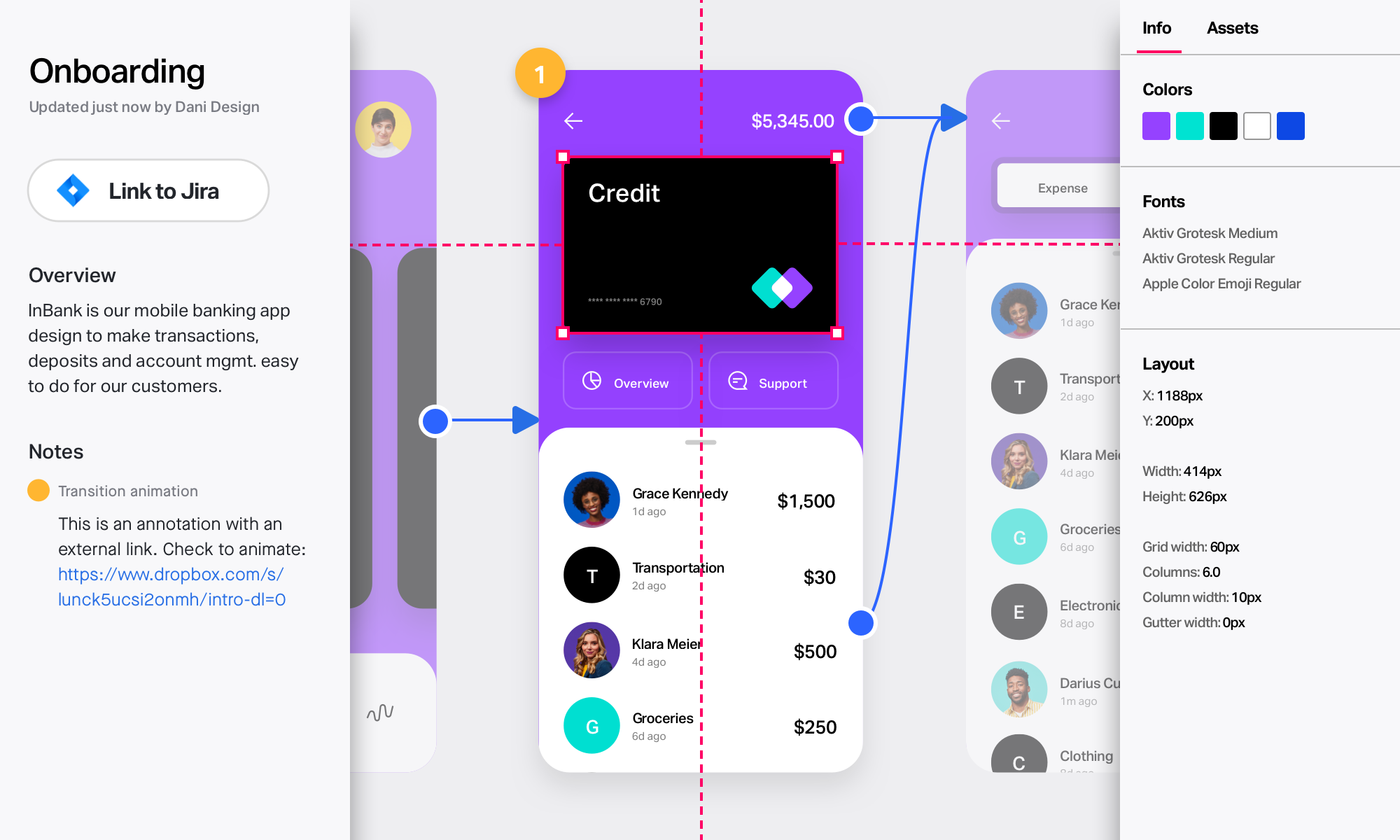
InVision is a collaborative design and prototyping platform with features such as freehand drafting mode and interactive mockups, collaboration, idea management, user testing, and integration with Slack and other collaboration tools. According to the vendor, 1 million designers are using the free version.
Director of Product Experience in Research & Development at WuXi NextCODE (Biotechnology, 201-500 employees)
Chose InVision
We started using Marvel for rapid prototyping and the two are fairly analogous. In the end team and enterprise functionality drove the switch from one tool to the other. Another tool we had used is Axure, and for truly advanced, data driven prototyping, it's still the tool to …
A de minimis incentive was given to thank the reviewer for their time. The incentive was not used to bias or drive a particular response, nor was the incentive contingent on a positive endorsement. More Info
Director of Product Experience in Research & Development at WuXi NextCODE (Biotechnology, 201-500 employees)
Chose OmniGraffle
OmniGraffle is a solid Mac based Visio with much added functionality specific to wireframe designs. The libraries, although somewhat out of date, allow rapid designs with low fidelity, exactly what you want in wire frames. We use Sketch increasingly to handle the layout of the …
A de minimis incentive was given to thank the reviewer for their time. The incentive was not used to bias or drive a particular response, nor was the incentive contingent on a positive endorsement. More Info
Senior Web Designer - User Experience in Marketing at Houston Methodist (Hospital & Health Care, 10,001+ employees)
Chose OmniGraffle
Axure RP is almost unnecessarily complicated in some areas and the UI can be drastically improved. FlairBuilder is great overall but lack of or slow support is what hurts it. OmniGraffle is one of my top 2 choices currently and InvisionApp is the other.
A de minimis incentive was given to thank the reviewer for their time. The incentive was not used to bias or drive a particular response, nor was the incentive contingent on a positive endorsement. More Info
UX Technical Lead / Senior UX Consultant in Information Technology at CGI (Information Technology and Services, 10,001+ employees)
Chose OmniGraffle
Omnigraffle handles flows and diagrams better than other tools I've listed above. However, Axure is far superior for creating wireframes and turning them into interactive prototypes (basically "coding" using if/then logic statements). Sketch is much better for detailed design …
A de minimis incentive was given to thank the reviewer for their time. The incentive was not used to bias or drive a particular response, nor was the incentive contingent on a positive endorsement. More Info
Verified User
Chose OmniGraffle
In comparison to Sketch, OmniGraffle is much better with connectors and placeholders. The placeholders were key for me as I use them often while building wireframes. It's so easy to access and drop in. I'm still trying to figure out how to download and sync stencils for Sketch …
A de minimis incentive was given to thank the reviewer for their time. The incentive was not used to bias or drive a particular response, nor was the incentive contingent on a positive endorsement. More Info
InVision is well suited for design reviews and immersing yourself in the experience of an app-to-be. As a Product Manager, it's difficult to take abstract concepts, user pain points, and business needs, and produce a vision for an app without a visual aid to communicate a vision. InVIsion offers PMs, designers, and developers the opportunity to sketch a vision, communicate about it with inline commenting, and shareable with other stakeholders.
A de minimis incentive was given to thank the reviewer for their time. The incentive was not used to bias or drive a particular response, nor was the incentive contingent on a positive endorsement. More Info
Omnigraffle is great for documentation, mapping, flowcharting, and other technical diagramming scenarios. It's simple enough to bang out a quick illustration and powerful enough to build complex blueprints for complicated technical systems. If you need cross-platform compatibility, though, you're probably better off looking elsewhere. If you want complex integration with data sources (ala Visio's SQL Server integration for shape metadata), OmniGraffle also falls short — but those scenarios are few and far between in my experience.
A de minimis incentive was given to thank the reviewer for their time. The incentive was not used to bias or drive a particular response, nor was the incentive contingent on a positive endorsement. More Info
A de minimis incentive was given to thank the reviewer for their time. The incentive was not used to bias or drive a particular response, nor was the incentive contingent on a positive endorsement. More Info
OmniGraffle is fairly simple to use, but the one thing I think it does best is working with curved lines, particularly if you are using some of the available arc templates. Drop an arc onto your page, then tell it the dimensions it needs to be, and viola! Done. Manipulating the arcs is as simple as clicking and dragging offset points.
OmniGraffle has also done an excellent job in stirring up the creative minds of many people who create templates and tools to work with OmniGraffle (not that Microsoft hasn't done so either), and managed to get the bulk of those into well organized repositories.
What it all boils down to for me is: it just works. One doesn't need to have a computer science degree to work with it either. It is as simple or complex as you want it to be.
A de minimis incentive was given to thank the reviewer for their time. The incentive was not used to bias or drive a particular response, nor was the incentive contingent on a positive endorsement. More Info
A de minimis incentive was given to thank the reviewer for their time. The incentive was not used to bias or drive a particular response, nor was the incentive contingent on a positive endorsement. TR verified that a representative sample of customers was invited. More Info
I'd love to be able to keep more than one of the different tool tabs open at a time.
The stencils are amazing. Would be great if a whole lot more of the free ones came standard as opposed to having to download them from Graffletopia or other sites.
A de minimis incentive was given to thank the reviewer for their time. The incentive was not used to bias or drive a particular response, nor was the incentive contingent on a positive endorsement. More Info
A de minimis incentive was given to thank the reviewer for their time. The incentive was not used to bias or drive a particular response, nor was the incentive contingent on a positive endorsement. More Info
A de minimis incentive was given to thank the reviewer for their time. The incentive was not used to bias or drive a particular response, nor was the incentive contingent on a positive endorsement. More Info
Easy for prototyping, sharing for comments and review changes with version. lags a bit when the design is heavy and large design models learning curve is shorter so saves time with new stakeholders responsiveness could be better and auto modeling can be introduced Not much advance features that can be used
A de minimis incentive was given to thank the reviewer for their time. The incentive was not used to bias or drive a particular response, nor was the incentive contingent on a positive endorsement. More Info
I didn't need to contact InVision support, as I've never needed it. They have an intuitive UI, and most of the questions are answered in their help portal or in tutorials online. Since many people use it, there a great resources available on for example YouTube. No problems so far with InVision.
A de minimis incentive was given to thank the reviewer for their time. The incentive was not used to bias or drive a particular response, nor was the incentive contingent on a positive endorsement. More Info
A de minimis incentive was given to thank the reviewer for their time. The incentive was not used to bias or drive a particular response, nor was the incentive contingent on a positive endorsement. More Info
We only tested out using Adobe XD for similar uses and found it to be more challenging to fit within our processes. It didn't have as robust a set of capabilities as InVision and wasn't as easy to use enterprise wide. I recall also having issues with working with Sketch.
A de minimis incentive was given to thank the reviewer for their time. The incentive was not used to bias or drive a particular response, nor was the incentive contingent on a positive endorsement. More Info
While these other tools are great for what they are, OmniGraffle’s solid focus on and support for diagramming makes it our tool of choice for communicating workflows and concept relationships, creating documentation, and creating other diagrams. Its libraries allow us to create designs quickly, and its ease of use enables us to use the tool widely across the company without much time or effort spent on onboarding.
A de minimis incentive was given to thank the reviewer for their time. The incentive was not used to bias or drive a particular response, nor was the incentive contingent on a positive endorsement. More Info
InVision helps our team better and more professionally portray the value and the work we do as designers, leading to more company buy-in in supporting and funding our work. In the past, we would create PowerPoints with screenshots to portray a user workflow that we would share out to stakeholders. Once we began to use this app, where stakeholders could click through and comment as though they were “real” users, stakeholders began to better understand our work, designs, and workflows. This has led to more productive conversations that, in turn, lead to more effective end products that have more consistently served our business goals in tangible ways.
InVision helps us save production time, effort, and cost, as we are able to solve design issues early in the process by having clickable prototypes to show to internal stakeholders and external users. It’s, understandably, difficult for people to provide effective feedback on screenshots. Using the clickable prototypes we created in InVision, we are able to get more effective feedback to solve user workflow issues before we spend time and money developing problematic designs (and later having to redesign them).
It’s easier to market designs to potential buyers with clickable prototypes than with screenshots. With these prototypes, we’ve been able to sell more digital products before product release dates, which has helped to secure many contracts and new business relationships that continue to this day.
A de minimis incentive was given to thank the reviewer for their time. The incentive was not used to bias or drive a particular response, nor was the incentive contingent on a positive endorsement. More Info
Omnigraffle isn't an expensive software tool, so there isn't really any negative from the perspective of raw cost. Thinking in terms of time spent using it on a project - what you create in omnigraffle will inevitably lead to a dead end. It's useful only as documentation. There are other tools like Sketch that integrate into prototyping software and can create useable visual assets for applications in addition to being able to create wireframes.
A de minimis incentive was given to thank the reviewer for their time. The incentive was not used to bias or drive a particular response, nor was the incentive contingent on a positive endorsement. More Info