The LevelBlue USM Anywhere XDR platform (replacing the former AlienVault USM) delivers threat detection, incident response, and compliance management.
$1,075
per month
Splunk Observability Cloud
Score8.5 out of 10
N/A
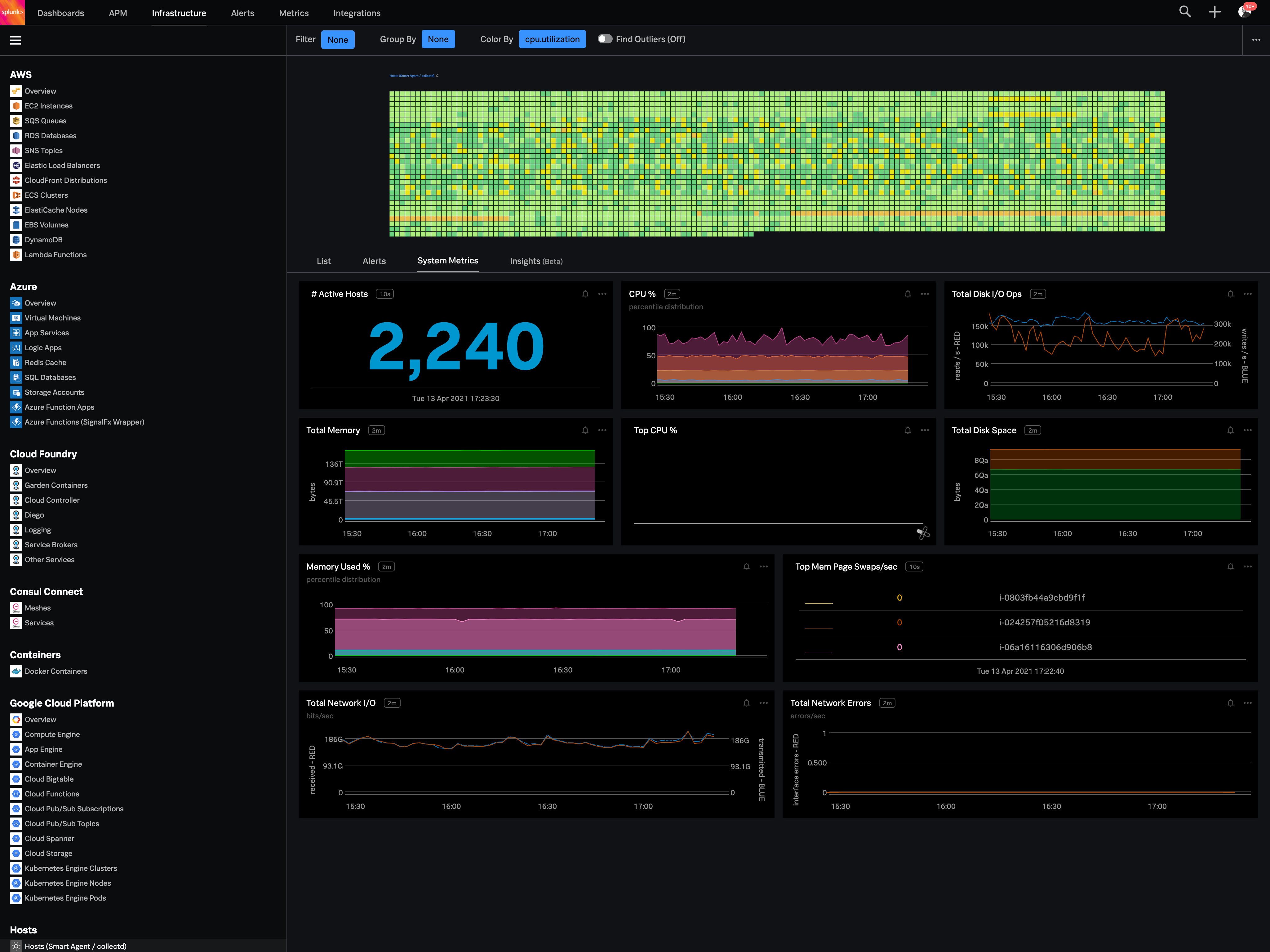
Splunk Observability Cloud aims to enable operational agility and better customer experience through real-time AI-driven streaming analytics allowing accurate alerts in seconds. It is designed to shorten MTTD and MTTR by providing real-time visibility into cloud infrastructure and services.
At this point I'm saying a 4. While the marketing material make it appear to be easy to use and it was relatively easy to set up, as previously mentioned, each event description is based upon the individual asset making it nearly impossible for the administrator to be a SME for each asset. For example, if one of the assets reporting is a router, the administrator monitoring alerts would need to know what the various events are that can be triggered as an event for the particular router; however, if the asset is a workstation, the administrator would need to know the various events that are triggered for workstations.
A de minimis incentive was given to thank the reviewer for their time. The incentive was not used to bias or drive a particular response, nor was the incentive contingent on a positive endorsement. TR verified that a representative sample of customers was invited. More Info
Its great if you need real-time visibility across complex or regulated environments. Also strong for hybrid or multi-cloud setups where uptime, observability and fast IR are required. It’s probably overkill for smaller teams or environments that don’t have constant changes or compliance reporting needs. It's expensive and has a steep learning curve. Also, in my opinion, do not get yourself into a consumption based model. Costs can certainly get out of control quickly.
A de minimis incentive was given to thank the reviewer for their time. The incentive was not used to bias or drive a particular response, nor was the incentive contingent on a positive endorsement. TR verified that a representative sample of customers was invited. More Info
AlienVault USM is simple and easy to deploy. Sensors can be deployed in as little as 15 minutes through the setup wizard.
The USM UI is easy to understand. I've trained multiple analysts who are able to perform their duties on their first day, in part because of USM Anywhere's ease of use.
Top-notch built-in compliance templates and reporting features.
A de minimis incentive was given to thank the reviewer for their time. The incentive was not used to bias or drive a particular response, nor was the incentive contingent on a positive endorsement. More Info
The first one is its Kubernetes container monitoring.
I really like this features because as we know how much K8s is vast and to manually monitor each part of the Kubernetes it takes so much time but Splunk Observability Cloud makes it easier. And even once we integrate K8s with Splunk Observability Cloud it gives us some prebuilt dashboards which gives holistic view of our Cluster and its nodes, pods, etc.
The dashbaord feature of Splunk Observability Cloud, it gives us full flexibility to customize our dashboard with a wide range of predefined chart types.
Now it also supports OTEL, which is a plus point for observability. As now everyone is moving towards Otel and in current market there are only few tools who supports OTEL based integrations, Splunk Observability Cloud is one out of them.
A de minimis incentive was given to thank the reviewer for their time. The incentive was not used to bias or drive a particular response, nor was the incentive contingent on a positive endorsement. TR verified that a representative sample of customers was invited. More Info
Personally, I've wished I could purchase a service that would configure AV for my environment. I get a lot of traffic on a daily basis and I almost need to hire an analyst that just works on AV.
Some of the filters when looking for a specific alert aren't that easy to use.
A de minimis incentive was given to thank the reviewer for their time. The incentive was not used to bias or drive a particular response, nor was the incentive contingent on a positive endorsement. More Info
You can use table-like functionality to generate dashboards, but these queries are heavy on the system.
It could be easier to give insight into what type of line parsing is used for specific documents in a company-managed environment and/or show ways to gain the insights needed.
I would like to see ways to anonymize specific data for shared reports without pre-formatting this in a dashboard on which reports could be based.
A de minimis incentive was given to thank the reviewer for their time. The incentive was not used to bias or drive a particular response, nor was the incentive contingent on a positive endorsement. More Info
The centralized logging and retention for PCI compliance was our main driver, and it is meeting that need. Otherwise there has been enough frustration with the lack of documentation and the need to customize through the CLI that I would be open to alternatives.
A de minimis incentive was given to thank the reviewer for their time. The incentive was not used to bias or drive a particular response, nor was the incentive contingent on a positive endorsement. TR verified that a representative sample of customers was invited. More Info
Good: Stable system with low error rate Easy to use for simple use cases Bad: UI is not very clear for complex usage Mobile view (when logged in from phone) is bad No library for .net
A de minimis incentive was given to thank the reviewer for their time. The incentive was not used to bias or drive a particular response, nor was the incentive contingent on a positive endorsement. More Info
Once you are able to navigate the different panels, finding what you need is quite easily. Before getting used it it can be a bit of challenge . Each panel is quite well laid out and the filtering search capabilities are quite strong.
A de minimis incentive was given to thank the reviewer for their time. The incentive was not used to bias or drive a particular response, nor was the incentive contingent on a positive endorsement. More Info
When there is an issue, it’s a win if one can easily identify the root cause. To do the same, it should allow the user to dig deep with multiple data points and compare the data and identify the anomaly. In this use case, it’s good to drive from Splunk 011y.
A de minimis incentive was given to thank the reviewer for their time. The incentive was not used to bias or drive a particular response, nor was the incentive contingent on a positive endorsement. More Info
We do have issues with maintenance on the AlienVault USM as the disk fills up from time to time with other data sources. Sources for scanning logs and net flow data isn't calculated in regular disk maintenance and can easily fill up our disk if we do not keep an eye on it with some custom Nagios plugins. The system does properly trim logging data from logging sources properly.
A de minimis incentive was given to thank the reviewer for their time. The incentive was not used to bias or drive a particular response, nor was the incentive contingent on a positive endorsement. More Info
With the latest release of AlienVault USM overall performance has not been an issue. We have noticed single source events per second does not scale well with the overall system. 2,000eps on a vmware system with a single source produces delays of up to an hour for us. Pages, reporting and even raw log searches are rather quick though.
A de minimis incentive was given to thank the reviewer for their time. The incentive was not used to bias or drive a particular response, nor was the incentive contingent on a positive endorsement. More Info
The support we received from alienvault was excellent. They went above and beyond in making sure everything was working as it needed to be. They REALLY want their product implementation to be a success and our security goals be achieved. They are like a member of our security team.
A de minimis incentive was given to thank the reviewer for their time. The incentive was not used to bias or drive a particular response, nor was the incentive contingent on a positive endorsement. More Info
A de minimis incentive was given to thank the reviewer for their time. The incentive was not used to bias or drive a particular response, nor was the incentive contingent on a positive endorsement. More Info
I did not have any experience with "in person" training directly. The free online classes offered for a half a day are based on the actual training offered. These little teasers are very good and well worth your time to learn a few quick and dirty ways of getting more information from your SIEM
A de minimis incentive was given to thank the reviewer for their time. The incentive was not used to bias or drive a particular response, nor was the incentive contingent on a positive endorsement. More Info
It was very well organized and helpful in using the product to the fullest extent. The instructor allowed time for folks who were involved with managed services to receive tuning tips in order to better support their customers. In addition, the course materials were automatically updated when the new version came out.
A de minimis incentive was given to thank the reviewer for their time. The incentive was not used to bias or drive a particular response, nor was the incentive contingent on a positive endorsement. More Info
AlienVault USM was a very simple to implement and get up and running. We started with a trial version and had that up and going within an hour of receiving email instructions from the sales engineer. We never had to contact support to get the system up and going. It was extremely easy to convert over to a full license once we started with a paid version.
A de minimis incentive was given to thank the reviewer for their time. The incentive was not used to bias or drive a particular response, nor was the incentive contingent on a positive endorsement. More Info
A de minimis incentive was given to thank the reviewer for their time. The incentive was not used to bias or drive a particular response, nor was the incentive contingent on a positive endorsement. More Info
Splunk's ES is a paid add-on on top of an already pricey product. Finding a MSSP that supports Splunk and isn't a 6 figure annual commitment seems unlikely. LogRhythm did not have a cloud-based solution when we were considering SIEMs. Fantastic product though and have a good MSSP base. Devo did not have a MSSP partner base when we looked. Their product is fantastic too. AlienVault USM has good partners to choose from as well as an affordable cloud model, that's why we chose it.
A de minimis incentive was given to thank the reviewer for their time. The incentive was not used to bias or drive a particular response, nor was the incentive contingent on a positive endorsement. More Info
Splunk Infrastructure Monitoring provides far superior options for anybody using a complex hybrid multi-cloud environment and allows both your SOC and NOC to work together on the same data while driving their own insights. We found other products are still in the old world view of servers and agents residing together within a single data centre, but modern apps are no longer like this.
A de minimis incentive was given to thank the reviewer for their time. The incentive was not used to bias or drive a particular response, nor was the incentive contingent on a positive endorsement. More Info
The AlienVault USM is not very scalable. Some scalability can be achieved by installing additional sensors, but this only offers 500eps per sensor and is still overall limited by the installation type of VM or physical. We have also noticed the EPS (events per second) is rated overall and not towards a single source. A single source on a very healthy VMware partition tops out at 2,000eps for us, no matter how we configure it. Maybe this is a problem of the 5.2 release?
A de minimis incentive was given to thank the reviewer for their time. The incentive was not used to bias or drive a particular response, nor was the incentive contingent on a positive endorsement. More Info
Once you hit the 150 asset mark, you have to jump to their unlimited license. There is no middle ground. We were only 10 or so assets above the 150 so we had to chose to either not monitor those assets or pay the price of the upgrade.
AlienVault brings all the information to one place which makes it much quicker to track down problems.
A de minimis incentive was given to thank the reviewer for their time. The incentive was not used to bias or drive a particular response, nor was the incentive contingent on a positive endorsement. More Info
A de minimis incentive was given to thank the reviewer for their time. The incentive was not used to bias or drive a particular response, nor was the incentive contingent on a positive endorsement. More Info