Microsoft Dynamics SL is one of the ERP products in the Dynamics family.
This product was acquired from Solomon 2000.
The product is typically used by SMBs, particularly in project-based businesses (e.g. construction). It has strong accounting and project management capabilities.
N/A
Sage 100cloud
Score7.2 out of 10
Small Businesses (1-50 employees)
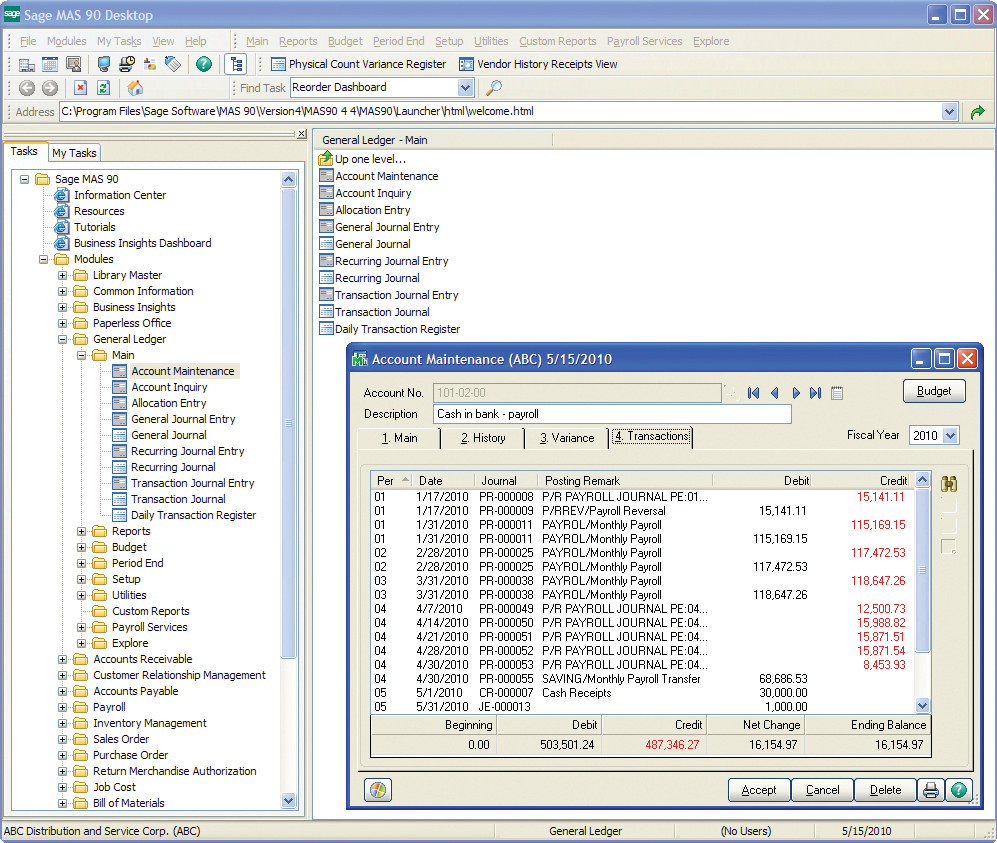
Sage 100 (or Sage 100cloud is a business management software offering a broad range of modules designed to meet the many needs of virtually any business. It encompasses financial operations and accounting, payroll, business intelligence, CRM, eBusiness, manufacturing and distribution.
President in Corporate at SSI Consulting (Computer Software, 11-50 employees)
Chose Microsoft Dynamics SL
We used Connectwise, which did a good job costing function, but had to be periodically integrated and lacked some reporting capability. We looked at GP but it does not have good project accounting, so it was not a good fit for our company. We looked at NAV but there was too much …
A de minimis incentive was given to thank the reviewer for their time. The incentive was not used to bias or drive a particular response, nor was the incentive contingent on a positive endorsement. More Info
For a small to mid-size business, MS Dynamics SL is effective. We are capable of managing our finances with a very low risk of error. We have worked with MS Dynamics for almost 15 years and have more than doubled the size of our business in that time with very few issues from the program. We have exponentially increased our revenue and reporting demands and have found SL to be very dependable and stable. The program does have the occasional glitch and those are sometimes outside of the realm of expertise of our IT department. SL support is excellent, but their timeliness is not as urgent as ours.
A de minimis incentive was given to thank the reviewer for their time. The incentive was not used to bias or drive a particular response, nor was the incentive contingent on a positive endorsement. More Info
Sage 100 has been well suited for running the monthly accounts receivable and accounts payable aging reports. This helps us track our accounts that need to be collected and payments that need to be made. Our field operations team has been slow and unwanting to adopt the Sage Field Ops just because they're resistant to change and technology. It's less appropriate for really detailed accounting reports spanning for long periods of time with all accounts because it takes a very long time to run and process.
A de minimis incentive was given to thank the reviewer for their time. The incentive was not used to bias or drive a particular response, nor was the incentive contingent on a positive endorsement. More Info
Provides flexibility for complex project based cost accounting
Strong and flexible allocation processer for cost allocations, markups, and pricing
A "Flexible Billing" module under the project controller series that allows for multiple billing formats ranging from fixed price schedule of values, T&M or Cost Plus, and scheduled billing.
Flexible reporting with options using Crystal Reports, SSRS, a Quick Query tool, and ability to tie into MS Office tools such as MS Access and MS Excel
Tight integration with Financials, but also the ability to integrate with modules such as Sales Order, Inventory, and Field Service
Customization abilities ranging from a VBA (visual basic for application) foundation to allow customizing existing forms to the ability to use the SDK (Software Development Kit) to build more complex customizations that integrate with Dynamics SL.
A de minimis incentive was given to thank the reviewer for their time. The incentive was not used to bias or drive a particular response, nor was the incentive contingent on a positive endorsement. More Info
A de minimis incentive was given to thank the reviewer for their time. The incentive was not used to bias or drive a particular response, nor was the incentive contingent on a positive endorsement. More Info
Reporting in the Project module is lacking functionality. I understand that most companies have specific needs when it comes to tracking project information but the standard reports are not good.
I would recommend a product like Management Reporter that is for Projects only. Project Reporter should allow users to pull in all Project related data into reports.
Fixing suspended batches. Obviously all of us users have experienced this mess. SL knows what needs to be corrected and there could be some step by step fixes in a separate repair module to do the steps we do in Query Analyzer.
A de minimis incentive was given to thank the reviewer for their time. The incentive was not used to bias or drive a particular response, nor was the incentive contingent on a positive endorsement. More Info
Sage 100 at times will simply not connect to our server, we get remote support & all is well but, that issue tends to happen 2-3X a year.
Other than the above, I really can't complain. Coming from a more custom U.V. type database that used a whole bunch of codes to navigate, I think Sage 100 is 10x easier to use.
A de minimis incentive was given to thank the reviewer for their time. The incentive was not used to bias or drive a particular response, nor was the incentive contingent on a positive endorsement. More Info
Unfortunately, Dynamics' lack of ability to smoothly integrate with our CRM system is causing us to look at other solutions. The efficiencies that we gain by using Dynamics for our day to day accounting are lost in the constant headaches of getting sales quotes to import properly into the system for invoicing. Another major issue for us has been budgeting and reporting. We currently do all of our budgeting and board reporting in Excel, which is too time consuming and inefficient, especially when a system as robust as Dynamics should easily be able to handle this relatively simple task.
A de minimis incentive was given to thank the reviewer for their time. The incentive was not used to bias or drive a particular response, nor was the incentive contingent on a positive endorsement. More Info
I would put this out to bid, if I were at the same organization. There have been a lot of improvements and changes in enterprise software and my preference would be to find a good web-based or cloud-based tool. Lower overall cost of ownership and improved efficiency would be my target criteria for a rebid of this.
A de minimis incentive was given to thank the reviewer for their time. The incentive was not used to bias or drive a particular response, nor was the incentive contingent on a positive endorsement. More Info
I rate it a 10 because we have removed the fields we don't need so users can really crank the data into the system. The software was designed for the professional services firm in mind but does a tremendous job for construction firms and "blended" companies that are both distribution firms but project centric as well. Perhaps they drop ship inventory to a project where their employees or subs need to work on a project for example.
A de minimis incentive was given to thank the reviewer for their time. The incentive was not used to bias or drive a particular response, nor was the incentive contingent on a positive endorsement. More Info
Overall Sage 100 has been pretty user friendly. If we have a question on anything, we are able to contact our implementation rep who helps us right away. Some of the Sage Field Operations may not be as intuitive for our field personnel to use. I wish the reports ran faster so that we could run and put together many reports quickly at once.
A de minimis incentive was given to thank the reviewer for their time. The incentive was not used to bias or drive a particular response, nor was the incentive contingent on a positive endorsement. More Info
We have had only one unplanned outage for 2 hours in the last 30 months. We shut down for 30 min to 1 hour once a month, but that is for Microsoft OS updates to the servers. Being a 24/7 world wide operation, the reliability is really important. We do get an 8 hour window on the weekend that we can be down for a short period to install Microsoft Dynamics SL updates, but we do not have many of those. On our last version upgrade, we shut the users out at 9:30 am and were fully operational in less than 6 hours. The upgrade was New SQL server, New SL server and 2 new Citrix servers.
A de minimis incentive was given to thank the reviewer for their time. The incentive was not used to bias or drive a particular response, nor was the incentive contingent on a positive endorsement. More Info
Support is only used when needed, so unfortunately ,they get all the odd issues. It's a difficult business, but Microsoft and our firm do a great job of meeting customer needs. We get routine feedback that our support services are very good.
A de minimis incentive was given to thank the reviewer for their time. The incentive was not used to bias or drive a particular response, nor was the incentive contingent on a positive endorsement. More Info
A de minimis incentive was given to thank the reviewer for their time. The incentive was not used to bias or drive a particular response, nor was the incentive contingent on a positive endorsement. More Info
Just to let it take its course. The implementation for me once I became a part of my former organization was pretty seamless. Just get to know the basics and call the support team to ask questions if you need help on an issue, should they arise. They are ready, willing, and able to help!
A de minimis incentive was given to thank the reviewer for their time. The incentive was not used to bias or drive a particular response, nor was the incentive contingent on a positive endorsement. More Info
We had an advantage in implementing the tool in that our director of Ops had been part of the team implementing the ERP for other users so we knew what to expect and were able to avoid a lot of the challenges people sometimes face with implementations. However, the process still took far longer than desired.
A de minimis incentive was given to thank the reviewer for their time. The incentive was not used to bias or drive a particular response, nor was the incentive contingent on a positive endorsement. More Info
Of the comparable mid-range ERP systems, Dynamics SL competes at the lower end based on price, but also above the high-end based on flexibility, data, and reporting. Being able to stay with the same core accounting from a $100 million dollar company to a $3 billion dollar company shows the range of capabilities.
A de minimis incentive was given to thank the reviewer for their time. The incentive was not used to bias or drive a particular response, nor was the incentive contingent on a positive endorsement. More Info
I didn't choose Sage 100 ERP -- it was already in use when I started at the organization over five years ago. It has the same types of pros and cons as other big hulking software suites meant to power the infrastructure of corporations. It's slow, tough to customize, and doesn't connect well with other software. It does bring all the information into one place, which is great
A de minimis incentive was given to thank the reviewer for their time. The incentive was not used to bias or drive a particular response, nor was the incentive contingent on a positive endorsement. More Info
A de minimis incentive was given to thank the reviewer for their time. The incentive was not used to bias or drive a particular response, nor was the incentive contingent on a positive endorsement. More Info
A de minimis incentive was given to thank the reviewer for their time. The incentive was not used to bias or drive a particular response, nor was the incentive contingent on a positive endorsement. More Info
Sage 100 overall had a very positive overall ROI for the business. All users were making decisions based on the same information and valuable time was no longer spent trying to analyze data from a number of sources.
Moving the warehouses to using Sage 100 reduced the operating expense of the distribution side of the business by 5% on an annual basis (~$100K).
A de minimis incentive was given to thank the reviewer for their time. The incentive was not used to bias or drive a particular response, nor was the incentive contingent on a positive endorsement. More Info