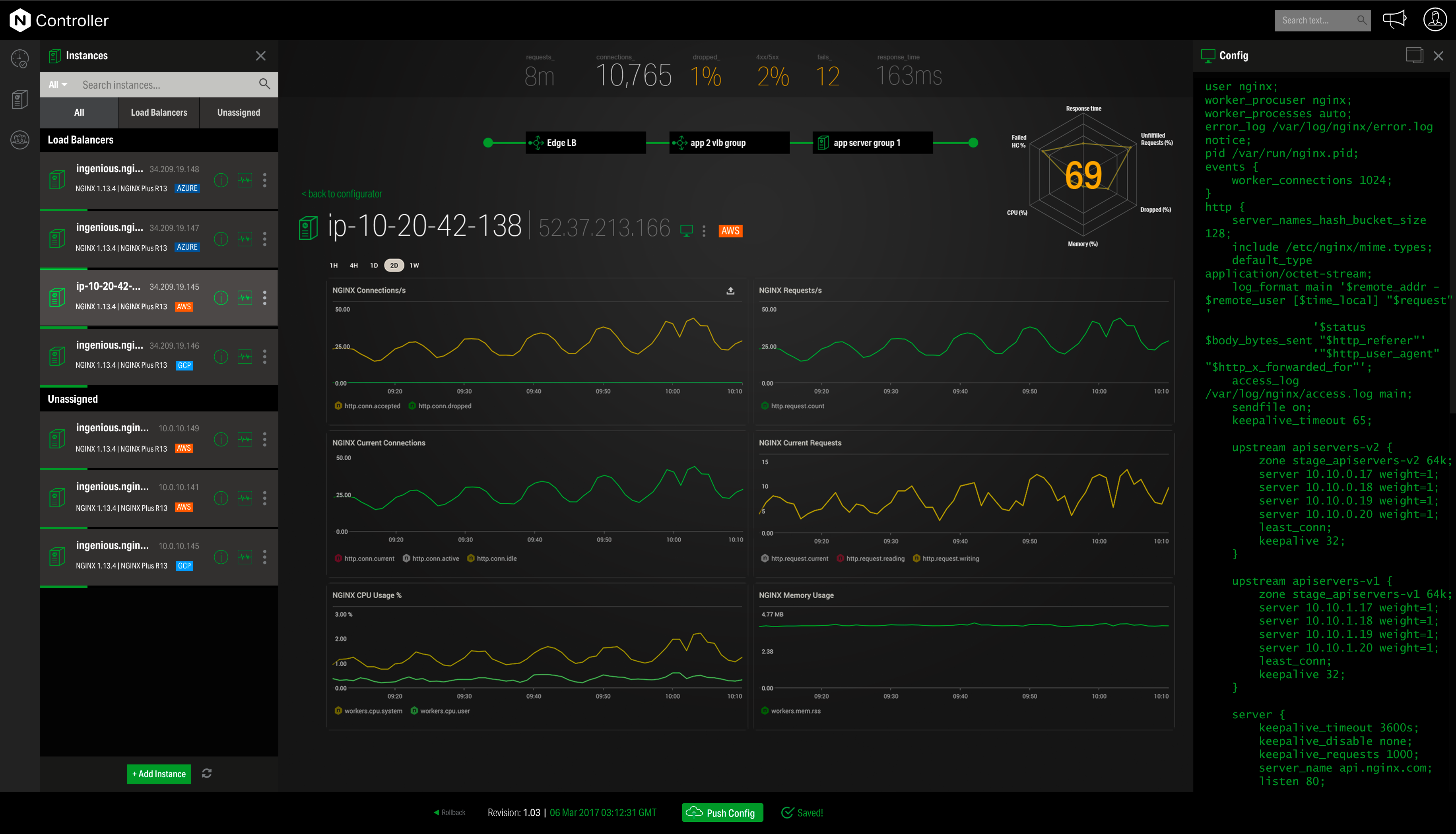
NGINX, a business unit of F5 Networks, powers over 65% of the world's busiest websites and web applications. NGINX started out as an open source web server and reverse proxy, built to be faster and more efficient than Apache. Over the years, NGINX has built a suite of infrastructure software products o tackle some of the biggest challenges in managing high-transaction applications. NGINX offers a suite of products to form the core of what organizations need to create…
N/A
Oracle Dyn Managed DNS
Score8.8 out of 10
Mid-Size Companies (51-1,000 employees)
Oracle Dyn DNS (domain name system) is an infrastructure-as-a-service that is touted by Oracle Dyne as one of the highest performance global networks existent. It is available as a managed DNS with secondary DNS available for more reliable business continuity on higher service tiers.
SRE in Engineering at Crest Data Systems (Information Technology and Services, 201-500 employees)
Chose Oracle Dyn Managed DNS
As our organization had an ample amount of DNS to manage, it was quite inconvenient when it comes to Amazon Route 53 or any other alternatives as the change propagation time was pretty much high as compared to Oracle Dyn Managed DNS. And when it comes to the huge customer base …
A de minimis incentive was given to thank the reviewer for their time. The incentive was not used to bias or drive a particular response, nor was the incentive contingent on a positive endorsement. TR verified that a representative sample of customers was invited. More Info
Nginx is well-suited for any web server scenarios, such as web applications, backend or reverse proxy for both application and HTTP requests, and distribution. It is less appropriate for Windows-based applications that run directly on a Windows Server host. In any case, it is very easy to manage, through separate conf files for each application or site you want to host with it.
A de minimis incentive was given to thank the reviewer for their time. The incentive was not used to bias or drive a particular response, nor was the incentive contingent on a positive endorsement. TR verified that a representative sample of customers was invited. More Info
Oracle managed DNS becomes very heavy when there is an ample amount of DNS being managed. However, the DNS creation and updating takes very less time to propagate and is very easy to use. So, for an organization, where there is a modest amount of DNS to manage, it works very well and gives a splendid experience. So, considering the complexity of managing the DNS for an IT company Oracle Dyn managed DNS is the best option to opt.
A de minimis incentive was given to thank the reviewer for their time. The incentive was not used to bias or drive a particular response, nor was the incentive contingent on a positive endorsement. TR verified that a representative sample of customers was invited. More Info
A de minimis incentive was given to thank the reviewer for their time. The incentive was not used to bias or drive a particular response, nor was the incentive contingent on a positive endorsement. More Info
A de minimis incentive was given to thank the reviewer for their time. The incentive was not used to bias or drive a particular response, nor was the incentive contingent on a positive endorsement. TR verified that a representative sample of customers was invited. More Info
Customer support can be strangely condescending, perhaps it's a language issue?
I find it a little weird how the release versions used for Nginx+ aren't the same as for open source version. It can be very confusing to determine the cross-compatibility of modules, etc., because of this.
It seems like some (most?) modules on their own site are ancient and no longer supported, so their documentation in this area needs work.
It's difficult to navigate between nginx.com commercial site and customer support. They need to be integrated together.
I'd love to see more work done on nginx+ monitoring without requiring logging every request. I understand that many statistics can only be derived from logs, but plenty should work without that. Logging is not an option in many environments.
More responsive sales team to provide relevant QBRs to ensure proper and best practice use of the product/platform
Integration of the Dyn ECT Managed DNS with Dyn Domain Registration would be a nice feature as currently I have to manage two consoles and billing accounts.
A de minimis incentive was given to thank the reviewer for their time. The incentive was not used to bias or drive a particular response, nor was the incentive contingent on a positive endorsement. TR verified that a representative sample of customers was invited. More Info
A de minimis incentive was given to thank the reviewer for their time. The incentive was not used to bias or drive a particular response, nor was the incentive contingent on a positive endorsement. More Info
A de minimis incentive was given to thank the reviewer for their time. The incentive was not used to bias or drive a particular response, nor was the incentive contingent on a positive endorsement. TR verified that a representative sample of customers was invited. More Info
This tool is really easy to use and configure. Consumes very less system resources. It is highly modular and configurable. You can easily use it with other tools like certbot for SSLs. You can configure basic security with configuration and headers
A de minimis incentive was given to thank the reviewer for their time. The incentive was not used to bias or drive a particular response, nor was the incentive contingent on a positive endorsement. TR verified that a representative sample of customers was invited. More Info
This is the only real gripe we have with Dyn; their web-UI can be remarkably painful to use. In the "simple" editor, DNS records are arranged in a kind of "node" view, where each record is a node and any records of the same name or longer (i.e. all records called "record.example.com" or "other.record.example.com") fall under it. This creates an odd sort of hierarchical view that's not really representative of the zone file. The "expert" editor doesn't have an actual delete button, just a checkbox. If you want to update conflicting record types (for example, replacing an A record with a CNAME) you have to check the box for the record being deleted, save changes, create the new record, save changes, and finally publish changes. Dyn uses a publish model for changes, where all changes you make are staged and can be reverted or published all at once. This is fine, except that the publish/revert dialog is in a different page. This is nice when you have many changes, but very annoying when you're changing just one or two records across multiple zones. These are relatively minor issues in an otherwise good platform; annoyances more than deal breakers.
A de minimis incentive was given to thank the reviewer for their time. The incentive was not used to bias or drive a particular response, nor was the incentive contingent on a positive endorsement. TR verified that a representative sample of customers was invited. More Info
Community support is great, and they've also had a presence at conferences. Overall, there is no shortage of documentation and community support. We're currently using it to serve up some WordPress sites, and configuring NGINX for this purpose is well documented.
A de minimis incentive was given to thank the reviewer for their time. The incentive was not used to bias or drive a particular response, nor was the incentive contingent on a positive endorsement. More Info
The support team at Dyn has always been very helpful and have tried to answer our questions to the best of their knowledge. We have never had any issues from support tickets and they are often resolved in a few hours
A de minimis incentive was given to thank the reviewer for their time. The incentive was not used to bias or drive a particular response, nor was the incentive contingent on a positive endorsement. TR verified that a representative sample of customers was invited. More Info
I have found that [NGINX] seems to perform better throughout the years with less issues although I've used Apache more. I would definitely recommend [NGINX] for any high volume site and I've seen this to usually be the case from most provided web hosts who will pick [NGINX] over alternatives
A de minimis incentive was given to thank the reviewer for their time. The incentive was not used to bias or drive a particular response, nor was the incentive contingent on a positive endorsement. More Info
We use both Oracle Dyn Managed DNS and Amazon Route 53. We like having our main DNS provider outside our cloud provider in case there's an issue with Amazon and we need to point things somewhere else temporarily. But for all the smaller stuff and internal stuff, we use Route 53 successfully.
A de minimis incentive was given to thank the reviewer for their time. The incentive was not used to bias or drive a particular response, nor was the incentive contingent on a positive endorsement. TR verified that a representative sample of customers was invited. More Info
By using Nginx, we can host multiple web services on a single server, keeping our infrastructure costs lower.
Nginx maintains our HTTPS connections, allowing us to keep our promise to our customers that their data is safe in transit.
Due to Nginx's extremely low failure rate, our web addresses always return something meaningful, even when individual services go down. In sense, this means we are "always online" and allows us to maintain brand and support our customers even in the face of catastrophe.
A de minimis incentive was given to thank the reviewer for their time. The incentive was not used to bias or drive a particular response, nor was the incentive contingent on a positive endorsement. More Info
For the law firm its being used for, it keeps their remote users working. For law firms, time is money, usually every 15 minutes lost can be a big deal to them.
Sometimes it has switched when its not supposed to, and causes downtime. No real way to inform users when the switch is happening, it would be great to have an email alert we can not only send to ourselves but a notification to primary and technical partners in the firm so they don't have to yell at us like something is broken, instead they are aware it had to change.
A de minimis incentive was given to thank the reviewer for their time. The incentive was not used to bias or drive a particular response, nor was the incentive contingent on a positive endorsement. More Info