OmniFocus is a project management platform for iOS: Mac, iPad, and iPhone. It has features such as task management, Siri capture, and workflow automation.
$4.99
per month
Stackby
Score 8.8 out of 10
N/A
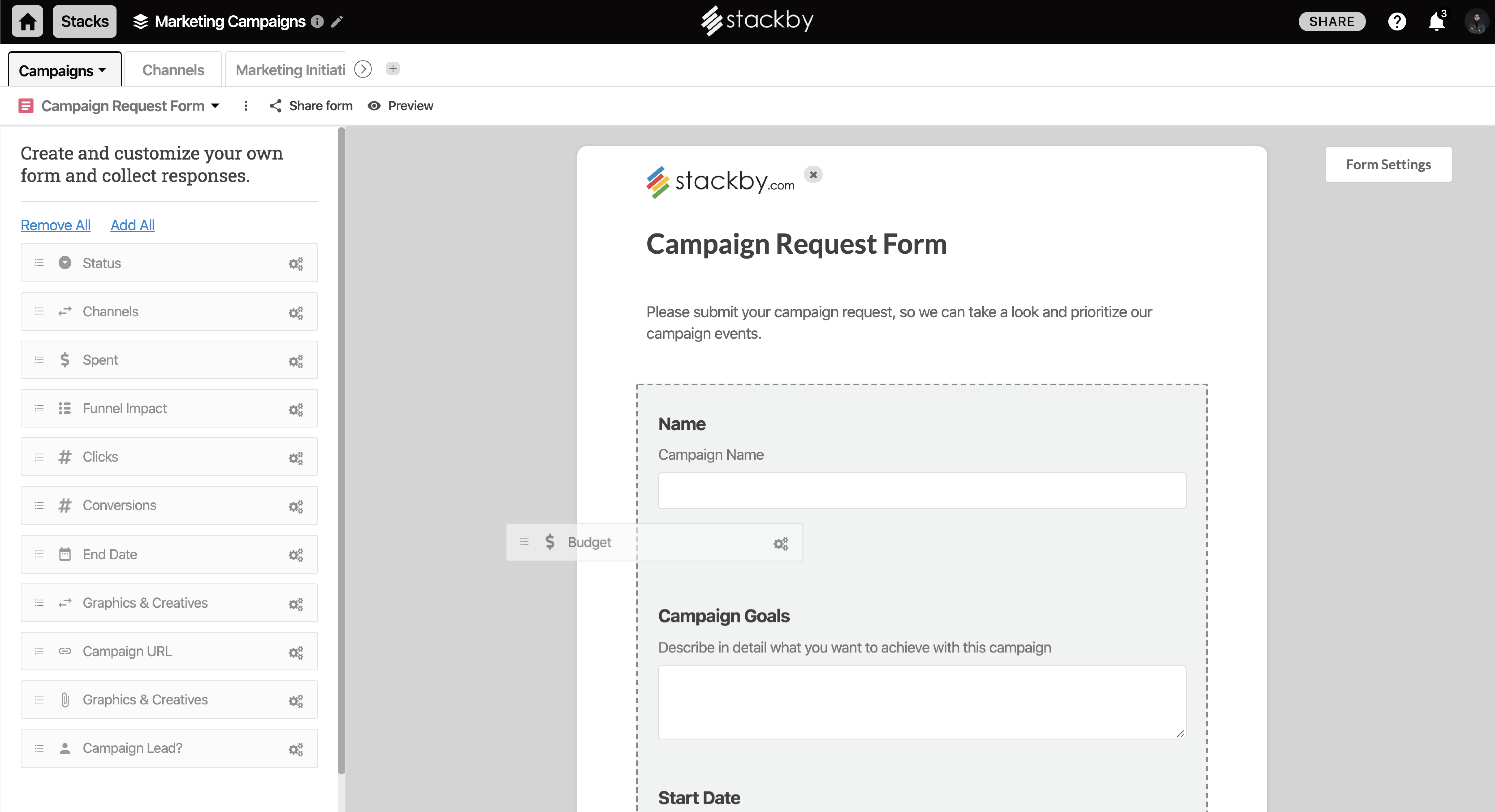
Stackby is designed to bring together the simplicity of spreadsheets, the functionality of databases and integrations with best business APIs to let anyone build their own tools, the way they want. No coding needed. Users can build a database from scratch, import data from pre-existing sources like spreadsheets or Google Sheets, or choose from over 100 pre-built templates across multiple categories. Stackby offers over 25 unique column types like text,…
$5
per month per user
Pricing
OmniFocus
Stackby
Editions & Modules
Web Add-On Subscription
$4.99
per month
Cross-Platform Subscription
$9.99
per month
OmniFocus 3 Standalone (Mac only)
$49.99
per month
OmniFocus 3 Standalone (iPhone only)
$49.99
per month
Personal
$6
per month per user
Economy
$10
per month per user
Business
$20
per month per user
Business Plus
$35
per month per user
Enterprise
Custom
Offerings
Pricing Offerings
OmniFocus
Stackby
Free Trial
No
Yes
Free/Freemium Version
No
Yes
Premium Consulting/Integration Services
No
No
Entry-level Setup Fee
No setup fee
No setup fee
Additional Details
—
20% discount for annual pricing.
More Pricing Information
Community Pulse
OmniFocus
Stackby
Features
OmniFocus
Stackby
Project Management
Comparison of Project Management features of Product A and Product B
OmniFocus
6.6
13 Ratings
15% below category average
Stackby
-
Ratings
Task Management
8.013 Ratings
00 Ratings
Resource Management
7.07 Ratings
00 Ratings
Gantt Charts
6.03 Ratings
00 Ratings
Scheduling
7.011 Ratings
00 Ratings
Workflow Automation
7.06 Ratings
00 Ratings
Team Collaboration
5.04 Ratings
00 Ratings
Support for Agile Methodology
4.04 Ratings
00 Ratings
Support for Waterfall Methodology
8.03 Ratings
00 Ratings
Document Management
6.06 Ratings
00 Ratings
Email integration
7.08 Ratings
00 Ratings
Mobile Access
9.013 Ratings
00 Ratings
Timesheet Tracking
7.03 Ratings
00 Ratings
Change request and Case Management
6.03 Ratings
00 Ratings
Budget and Expense Management
5.02 Ratings
00 Ratings
Professional Services Automation
Comparison of Professional Services Automation features of Product A and Product B
1) Great for managing your work and personal activities. 2) One of the best implementations of the Getting Things Done method. 3) Not really suited for collaborative work management; OmniFocus is managed on a per-user basis so you can't share/assign tasks.
Based on my experience, I can provide specific scenarios where Stackby is well suited and others where it may be less appropriate: Project Management: Stackby is an excellent choice for project management scenarios. Its ability to create custom databases, track tasks, assign responsibilities, and collaborate in real-time makes it highly effective for managing and monitoring project progress. CRM and Sales: Stackby is well suited for managing customer relationships and sales processes. Its customizable database structure allows for organizing customer information, tracking leads, managing deals, and generating reports. The ability to integrate with other tools further enhances its usefulness in CRM and sales workflows. Content Planning: Stackby is a great fit for content planning scenarios. Users can create databases to manage editorial calendars, track content ideas, assign tasks to team members, and monitor content performance. Collaboration features facilitate seamless content collaboration and ensure timely publishing.
Ease of viewing what tasks need to be done at the present moment and the sorting of those tasks by availability, due date, start date, needed resources, and project.
The visual interface is really nice to work with, the UX/UI is intelligent and intuitive.
It's the most extensible software I've used. There is a community of people that publish compatible scripts for Omnifocus at no charge.
The code is robust and I've almost never had a bug or a glitch that resulted in issues.
The software syncs in the cloud between MacOS and iOS seamlessly and faster than other To-Do software. The sync aspect is available free of charge.
The development team at Omnifocus is on top of bugs and they have been adding releases regularly to increase functionality and performance.
While OmniFocus adheres to the GTD (Getting things done) principles, it can be used in almost any manner and you aren't stuck with just that methodology.
I would really like to see graphic presentations of how I allocate my time, what categories of tasks don't get accomplished, etc.
I would like to see OmniFocus include Gantt chart functionality, such as allowing me to see how long it took me to accomplish a task from start to finish. Allowing me to actually input time spent, and seeing it on a Gantt chart, would be icing on the cake.
Implement the same views available on desktop into the mobile app
Internal automations (like Airtable)
Ability to implement and display info as a dashboard (like Airtable)
Polish up the formatting of formulas, inputting them causes user frustration due to the formula input cursor jumping around
Better intelligence and ease of inputting data in bulk i.e have the fields automatically identify what data is being input and format appropriately (like Airtable does)
Stackby is overall pretty easy to use, especially if you're used to something like Airtable or SmartSuite. Some of the pages seem like near exact clones (though they put their own creative spin on things). I'd prefer a slighty fresher interface (like SmartSuite), but I'm willing to sacrifice that for the better price and great customer service.
OmniFocus has excellent user forums. They're active as well as mature, since the product has been around for years. I've never needed to actually contact customer support because OmniFocus is popular enough that I've always been able to find an answer in the forums, or in an article, or in a YouTube video.
OmniFocus is built for the user with a lot going on - consequently, it does a great job at organizing lots of things in a manageable workload. It's perfect for taking a project and breaking it down into small tasks for yourself or teams. Once you get past the learning curve, it's quick at adding new tasks. Overall, it's an excellent product.
I have also tried Ora.Pm. Infinity has better graphical interface, but nowhere near as many features and the UI isn't as effective (i.e, moving around with keys). Grist has a much more technical interface and it comes from being more of a database/interactive spreadsheet vs Stackby. Grist has much more functionality in terms of formulas, but is much harder to learn to use and less other functionalities. Ora.PM is more of a test at a task management app, and doesn't compare - Stackby is much better.
OmniFocus keeps our tasks moving forward. Using a free script you can search all your current projects for projects that have no next step assigned to it to ensure nothing falls through the cracks.
When we serve our clients, the attention to detail we are able to give them comes from accurate tracking of what we need to deliver.
We complete projects 25% faster than before and we can see where the bottlenecks are immediate. We have also been forced to document tasks in a more concrete manner which allows for better execution.