OpenX is an ad serving platform. It is sold option as a hosted solution for can be purchased as an installed application. It allows for easy inventory management , geo-targeting of ads by country, and provides statistics for each ad placement.
N/A
TimeCamp
Score7.3 out of 10
Small Businesses (1-50 employees)
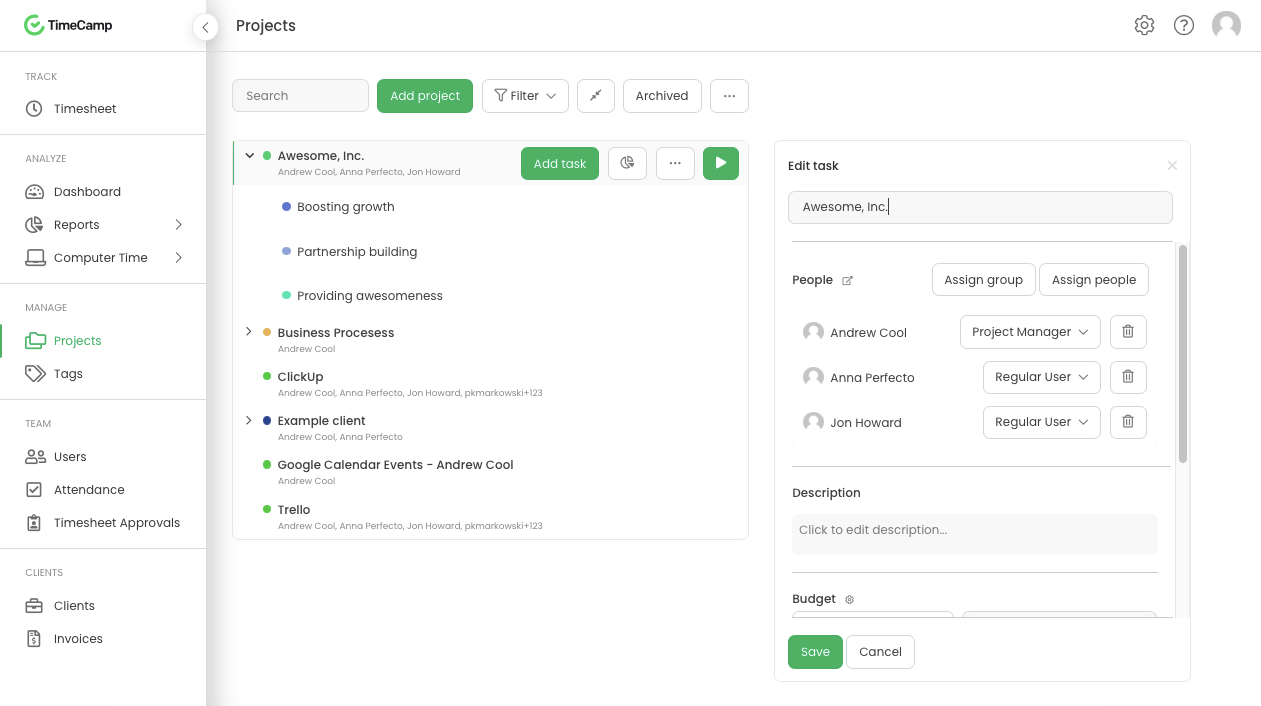
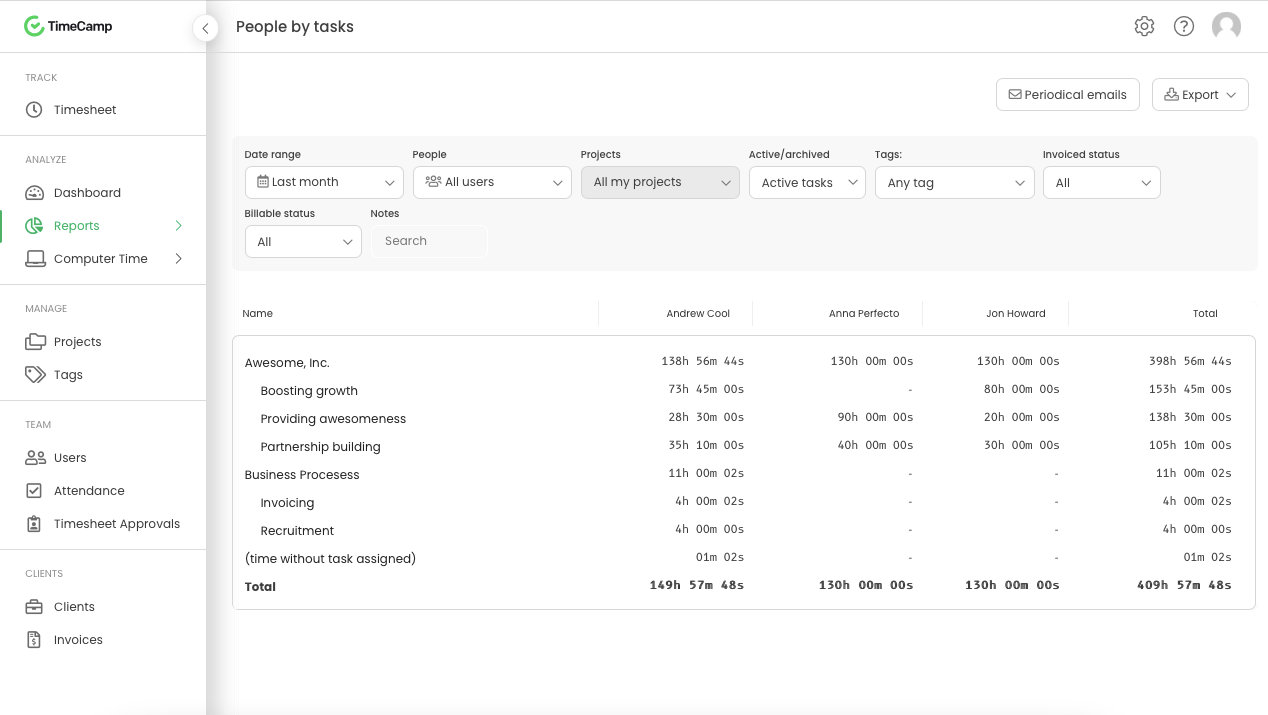
TimeCamp is cloud based, multi-platform (Windows, Mac, Linux, iOS, Android) time tracking and invoicing software.
$5.49
per month per user
Pricing
OpenX
TimeCamp
Editions & Modules
No answers on this topic
Free
$0
free with limited features.
Starter
$5.49
per month per user
Premium
$9.99
per month per user
Ultimate
$13.99
per month per user
Enterprise
Custom
Offerings
Pricing Offerings
OpenX
TimeCamp
Free Trial
No
Yes
Free/Freemium Version
No
Yes
Premium Consulting/Integration Services
No
Yes
Entry-level Setup Fee
No setup fee
No setup fee
Additional Details
—
Discount available for annual billing. The free plan encompass all basic time tracking features for unlimited users.
What are the best ways to integrate it with salesforce.com? What are the best ways to target our users with this tool? To segment the users? How can I integrate my ads with your adexchange-what sizes are you looking for in terms of banners, skyscrapers and so on. In this way I can plan my in house ad and those for the exchange to be the same size, to avoid duplication of work.
It is well suited for a company like ours, where we have different clients and can track hours per client/project. We charge hourly as well, so this is very important I wouldn't recommend it if you don't need to really track time of each task and that you are allowed to take your time with your daily tasks.
A de minimis incentive was given to thank the reviewer for their time. The incentive was not used to bias or drive a particular response, nor was the incentive contingent on a positive endorsement. More Info
OpenX is a system that was designed to scale as is evident in some key design decisions found throughout the platform. The multi-server setup that was chosen at Mail.com allowed for a distributed server architecture which separated the front end web delivery nodes from the backend MySQL Database master which replicated data back to each front end delivery node mysql slave. This eased the ability to horizontally scale as needed due to the ingenious separation of the ad impressions data tables on the delivery nodes which were being collected locally on each ad impression and then processed periodically back to to the master database which replicated the aggregated statistics back to the delivery nodes. The ability to load balance across the front end web delivery nodes, add caching at many different layers, utilize a CDN for the static ad images, implement PHP accelerators, and hit memcached instead of the MySQL master made the OpenX platform a service that was very resilient to failures.
The ability to optimize the platform is also something that OpenX does very well. This is evident in many of the config key parameters available. In addition to OpenX specific tunable's, optimizations can be made at many different levels in which the system sits. These include hardware and operating system level optimizations, tcp and networking stack optimizations, web server/php-cgi configurations, and database (MySQL InnoDB) tunable's. There are many different optimization knobs that can be tuned to help scale the application for the best performance possible
The documentation was simple, to the point, and well written which led to an easy initial implementation and roll out of a multi-server setup. The installation and upgrade procedures were straight forward even for the complexities of the multi-server setup. I also found the OpenX team to be accessible and even got a chance to meet some of the team at their Up Close and Personal events at Cal Tech in Pasadena. Core developers were on hand to answer technical questions and also made themselves available to us via email and irq channels.
The open nature of the OpenX platform allows for flexibility in the choice of web serving platform to use (Apache, nginx, Lighttpd) and also the database management systems (MySQL, PostGreSQL)
A de minimis incentive was given to thank the reviewer for their time. The incentive was not used to bias or drive a particular response, nor was the incentive contingent on a positive endorsement. More Info
The interface is pretty good, but it could be better with some slight restructuring.
One thing that can be a bit annoying is the "Task" bar that displays on the screen showing the task and time. It is there to help you to remember to stop time when you end a task. It is needed but it would be nice if there were some design aspects to it so it could be made smaller.
A de minimis incentive was given to thank the reviewer for their time. The incentive was not used to bias or drive a particular response, nor was the incentive contingent on a positive endorsement. More Info
I no longer work at the company where I was using OpenX, but if I were then I'd certainly stay aboard. Frankly, there are a lot of sunk costs involved with building all of the infrastructure we had put in place, the system was working very well even if reporting was a hassle, and our team was trained on it. Also, I'm not aware of another product that does everything else we'd need it to.
I was given the system to use as part of setting up a whole new site from scratch in less than 2 months, with a large number of specialty hub pages to run ads on and lots of content I needed to run disease specific ads on. The system was easy for me to learn on the fly in a very compressed time frame. I would have loved more chance to really dig in under the hood to see all that it could do, but given how fast I had to work, I got everything up and running and looking great. And I did it ahead of my launch deadline too. My only reservation might be for people who are not as patient as I am in picking things up, or as hands on. Customer service was great if I needed them, and a quick start guide with the essentials would be ideal for those people.
Generally pretty easy to use and doesnt take too much training to get people started. Most of the main features are quite straightforward although some of the reporting and set up options can take a bit of time to figure out properly. The interface is a little cluttered in the browser but overall I think it is a pretty great tool
A de minimis incentive was given to thank the reviewer for their time. The incentive was not used to bias or drive a particular response, nor was the incentive contingent on a positive endorsement. More Info
They went above and beyond without ever asking for additional money and we met our launch date and immediately started to meet and even surpass our business goals. Nothing was too much trouble, which really stood out compared to other companies I had and was at that time also working with. Customer service can really make or break any business; if i expect my staff to give good customer service, I expect to get it too, and Open X gave it.
I am giving support a rating of 8 but that is quite arbitrary. Honestly, we have never had the need to contact support for any reason. There has not been a situation where we became stuck and could not figure out how to work through it. Sign up was easy and billing is like clockwork so there has been no need to contact billing support. I think this is a testament to the ease of use of TimeCamp.
A de minimis incentive was given to thank the reviewer for their time. The incentive was not used to bias or drive a particular response, nor was the incentive contingent on a positive endorsement. More Info
OpenX is less focused than MoPub and it has a bigger reach as it is not limited to the mobile app. Unlike MoPub that focuses on performance, OpenX comes from the branding world and is pushing into CTV and other areas of the industry more catered to traditional media agencies and not pure ad tech players.
A de minimis incentive was given to thank the reviewer for their time. The incentive was not used to bias or drive a particular response, nor was the incentive contingent on a positive endorsement. More Info
Ultimately I selected Clockify instead of TimeCamp. As previously mentioned, I believe that TimeCamp wasn't that intuitive, and too many things were behind pay walls. Clockify offered the same features mostly for free. Although TimeCamps UX was sleeker than Clockify's I found that Clockify was a better fit for me.
A de minimis incentive was given to thank the reviewer for their time. The incentive was not used to bias or drive a particular response, nor was the incentive contingent on a positive endorsement. More Info
OpenX made it easy to manage online advertising. At the time I used the product I was the lead developer in charge of implementing the solution but quickly was put into the role of managing the traffic and training other users. It was really easy for a technical user to become a traffic manager. Getting other users trained and up to speed was very efficient.
A de minimis incentive was given to thank the reviewer for their time. The incentive was not used to bias or drive a particular response, nor was the incentive contingent on a positive endorsement. More Info