Oracle Coherence is database management and development software.
N/A
Splunk Observability Cloud
Score 8.4 out of 10
N/A
Splunk Observability Cloud aims to enable operational agility and better customer experience through real-time AI-driven streaming analytics allowing accurate alerts in seconds. It is designed to shorten MTTD and MTTR by providing real-time visibility into cloud infrastructure and services.
$180
per year per host
Talend Data Fabric
Score 10.0 out of 10
N/A
The Talend Data Fabric helps organizations to achieve and maintain complete, trustworthy, and uncompromised data, so that they can stay in control, mitigate risk, and drive value.
Oracle Coherence can be used to solve latency problems by caching data near the application tier. In-memory performance helps to reduce data contention, thus improving application response time. Oracle Coherence does a great job at scaling linearly and can do so dynamically. Oracle Coherence can replicate data so it can be part of a disaster recovery solution. One thing that is often overlooked with elastic caches is their ability to analyze data in memory, leveraging the processing power of the data grid. This is something Oracle Coherence does exceptionally well. Oracle Coherence also provided event handling capabilities to allow applications to respond to events triggered by transactions.
Its great if you need real-time visibility across complex or regulated environments. Also strong for hybrid or multi-cloud setups where uptime, observability and fast IR are required. It’s probably overkill for smaller teams or environments that don’t have constant changes or compliance reporting needs. It's expensive and has a steep learning curve. Also, in my opinion, do not get yourself into a consumption based model. Costs can certainly get out of control quickly.
Truly trusted contact center where the effective solution is always guaranteed. It is not a one-off fix to a specific data integration or management problem. It is a permanent and scalable solution to manage all of your data under a unified environment. Easy to use, great performance, used it for our internal data warehouse. Easy to build and connect to our data sources such as Salesforce, Netsuite, and Marketo.
The first one is its Kubernetes container monitoring.
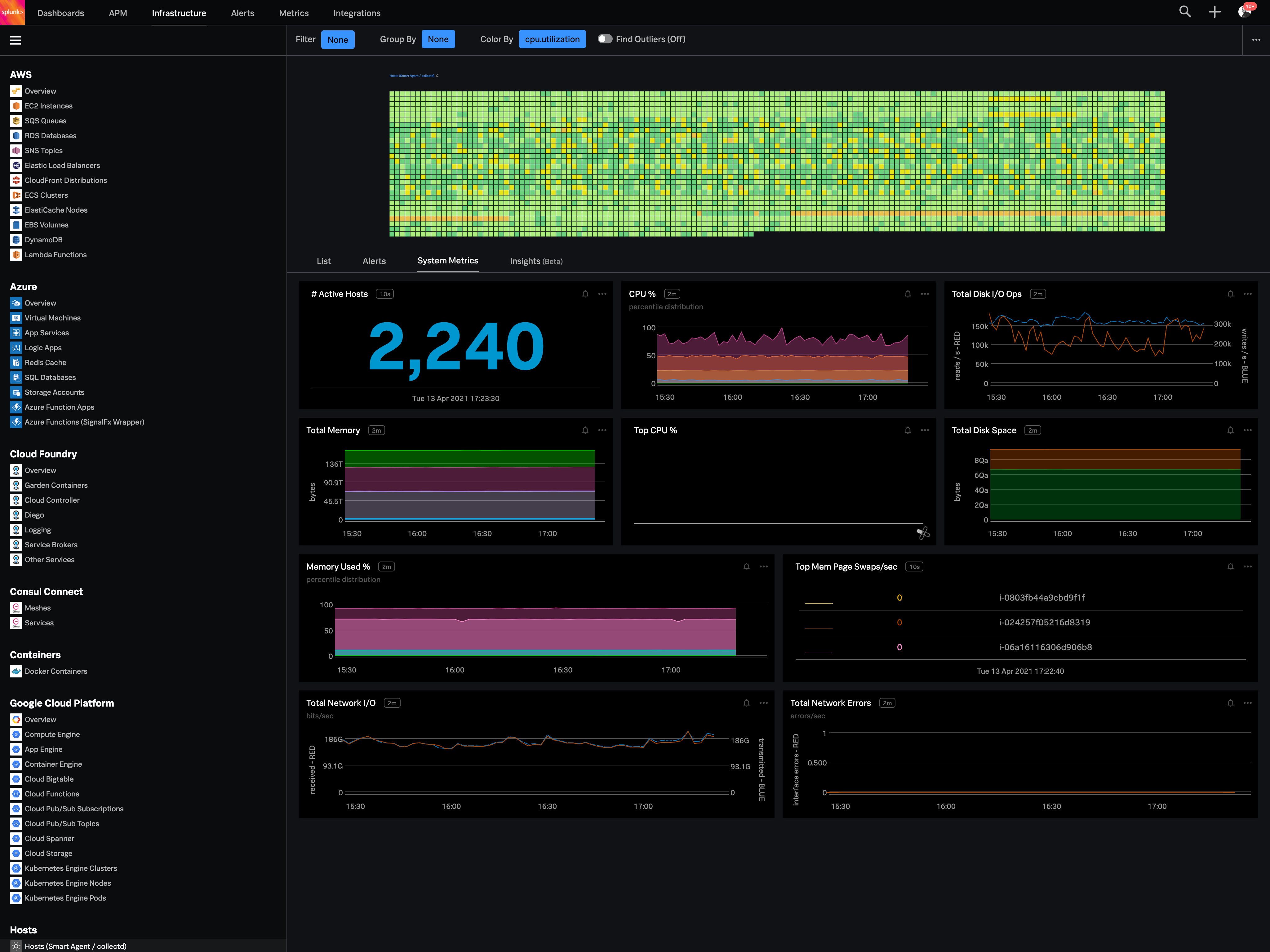
I really like this features because as we know how much K8s is vast and to manually monitor each part of the Kubernetes it takes so much time but Splunk Observability Cloud makes it easier. And even once we integrate K8s with Splunk Observability Cloud it gives us some prebuilt dashboards which gives holistic view of our Cluster and its nodes, pods, etc.
The dashbaord feature of Splunk Observability Cloud, it gives us full flexibility to customize our dashboard with a wide range of predefined chart types.
Now it also supports OTEL, which is a plus point for observability. As now everyone is moving towards Otel and in current market there are only few tools who supports OTEL based integrations, Splunk Observability Cloud is one out of them.
It supports a wide variety of connectors (Systems/endpoints)
It provides great flexibility for developers as it not only has a lot of predefined ready to use the function but also provides the ability to use complex java code within the platform. Great tool if you have good developers available.
You can use table-like functionality to generate dashboards, but these queries are heavy on the system.
It could be easier to give insight into what type of line parsing is used for specific documents in a company-managed environment and/or show ways to gain the insights needed.
I would like to see ways to anonymize specific data for shared reports without pre-formatting this in a dashboard on which reports could be based.
Good: Stable system with low error rate Easy to use for simple use cases Bad: UI is not very clear for complex usage Mobile view (when logged in from phone) is bad No library for .net
When there is an issue, it’s a win if one can easily identify the root cause. To do the same, it should allow the user to dig deep with multiple data points and compare the data and identify the anomaly. In this use case, it’s good to drive from Splunk 011y.
At this moment the usability of Talend Data Quality is optimal, too bad I cannot say the same in the first three months, it was always a problem due to its steep learning curve, but what matters is being able to use it effectively at this precise moment.
Oracle Coherence support team is responsive and knowledgeable. We contacted them to ask a couple of design questions about how we were setting up Oracle Coherence based on how we used IBM's Datapower Extreme Scale. They were able to guide us so that we got the design correct the first time and didn't have to go back and re-architect our design later.
Talend Data Quality gave us direct help in the learning process and prevented us from taking many more months to adapt and I appreciate this from the heart, I think that thanks to the support we can have very detailed reports that help increase the use of Talend Data Quality in the company.
DataSynapse GridServer has the same cache functionality connected with a grid distributed application deployment platform. It provides all the necessary tools to configure and manage these applications. On the otherhand Oracle Coherence has more a flexible configuration and better performance. Also the Oracle configuration and monitoring tools are more convenient and informative than the DataSynapse ones.
Splunk Infrastructure Monitoring provides far superior options for anybody using a complex hybrid multi-cloud environment and allows both your SOC and NOC to work together on the same data while driving their own insights. We found other products are still in the old world view of servers and agents residing together within a single data centre, but modern apps are no longer like this.
The engine with which it works to process a lot of information is striking, the comparison also being the connectors it has for different RDBMS, which other tools do not count as they are GNU licenses or community editions. The friendly and intuitive environment is what catches the eye. that's why I choose Talend over any other tool
In my current project, it is yet to be decided as we are on the way to make it live for users. But I am sure it will be an added value to obtain timely calculations.