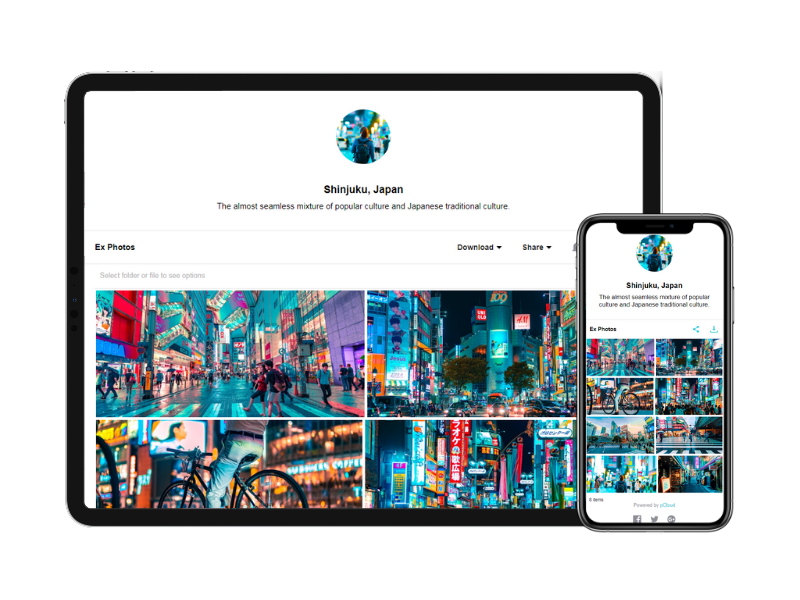
pCloud is a cloud- based digital asset management platform that provides access to all digital content including images,video, audio, documents, and more, anytime, anywhere, on any device. Users can keep important files safe and centralized in one place, and share with team members, clients, etc. across the globe with controlled access and permissions to the digital library. The vendor says that the product has a user-friendly interface that clearly shows where everything is located and…
$29.97
per month 3 users
DiskStation
Score8.8 out of 10
N/A
DiskStation is a line of network-attached storage (NAS) solutions from Synology headquartered in Taiwan.
N/A
Pricing
pCloud
DiskStation
Editions & Modules
pCloud Business
$9.99
per month per user (1 TB storage per user, 3+ users)
Business Pro
$19.98
per month per user (2 TB storage per user, 3+ users)
I need to store and share a lot of files. These include videos and other documents. Before using pCloud, I constantly had to clean up and delete files from my hard drive to free up space for new files. Sharing files and also using files on my website is now easier with pCloud's public folder.
A de minimis incentive was given to thank the reviewer for their time. The incentive was not used to bias or drive a particular response, nor was the incentive contingent on a positive endorsement. More Info
The Synology DiskStation is well suited as a NAS solution, easy enough to mirror a Windows file server shares setup. Access to the Hyperbackup utility eliminates the need to purchase a tape backup solution. A portable USB drive can be used as the initial backup target. For air gap purposes can connect Hyperbackup to the various cloud providers such as AWS, Azure, GCP to copy backup data there. Utilizing it as a backup solution has also been great, instead of purchasing a tape solution, tapes and an offsite tape repository. Active Backup for Business is another excellent backup utility for physical servers, VMWare virtual machines, etc. Restoring files is fairly intuitive. Until Synology introduced the dual controller setup, using it as a SAN was less appropriate as there was occasional downtime when the controller had an issue but this was less important for the scenarios we were using it for. It would be more of a concern if we had used it for things that require more robust uptime requirements. Overall we are happy with the features of the Synology DiskStation.
A de minimis incentive was given to thank the reviewer for their time. The incentive was not used to bias or drive a particular response, nor was the incentive contingent on a positive endorsement. More Info
pCloud helps us to store data very well and it is accessible from anywhere. It makes it easy for anyone to use it and secure the data. It is easy to upload data and access it while having a meeting with our client.
pCloud easily stores files from another platform as well like Google Drive or Dropbox. It easily exchanges information like images, videos, and documents. This feature is amazing as it gives access to files from other storage.
It had one feature known as pCloud Crypto which gives high-end security to the data when stored. It is highly secure and encrypted. It uses blockchain technology which requires a key to use called Crypto Pass to unlock your data. Really like it.
A de minimis incentive was given to thank the reviewer for their time. The incentive was not used to bias or drive a particular response, nor was the incentive contingent on a positive endorsement. More Info
Synology DiskStation offers lots of options for creating links to share files or request that some uploads files. It makes it really easy to just share a link that can have an expiration or a set number of times it is accessed.
We always had enough storage on our Synology DiskStation, we never had to worry about something being too big to upload or share.
Love how you can create folders that are shared and also have some that are private. This makes it so easy to have shared collaborations with coworkers or clients, but also allows you to have a private place to save things that only you need.
A de minimis incentive was given to thank the reviewer for their time. The incentive was not used to bias or drive a particular response, nor was the incentive contingent on a positive endorsement. More Info
A de minimis incentive was given to thank the reviewer for their time. The incentive was not used to bias or drive a particular response, nor was the incentive contingent on a positive endorsement. More Info
While BTRFS is a more advanced file system than ext4, it also is in a perpetual state of development, with many features not fully functional and a plethora of bugs. Synology has managed to overcome many of these limitations by placing BTRFS on top of a LVM, but there are much better file systems that Synology could have used, such as OpenZFS.
DSM's built-in backup software, HyperBackup, while robust, oftentimes runs into issues. Specifically, backups can be working fine for months or years, and then suddenly the backups will fail. Sometimes these failures can be resolved, but oftentimes the backups need to be completely restarted. Fortunately, even when the backup fails, the existing backups are still accessible, it is just that new backups can not be performed.
The underlying Linux OS provides significant benefits, but also adds a fair amount of complexity. Most of that complexity is wonderfully hidden by the DSM interface, but when certain problems arise, delving into the Linux command line is not out of the question.
Perhaps the biggest issue with Synology DiskStation is Synology's support. The issue isn't that the support is bad, but it can be frustratingly slow when dealing with a major issue. Synology does have a very active community that is always willing to help, but nothing beats first-party support.
A de minimis incentive was given to thank the reviewer for their time. The incentive was not used to bias or drive a particular response, nor was the incentive contingent on a positive endorsement. More Info
As long as Synology give us support for our hard drivers we will not change. I know Synology has now forced their hands to buy their own hard drivers and their new line of products. But if we still have support for old hard drivers from other manufacturers then we will still use Synology Nas. Otherwise we change manufacturers
It is very easy to use, fast loading and the product team keeps adding updates. Like now I can listen to all my audiobooks from a playlist in pCloud. I am ask for files or send files easier than ever before. I also have access to all my files whereever I am.
A de minimis incentive was given to thank the reviewer for their time. The incentive was not used to bias or drive a particular response, nor was the incentive contingent on a positive endorsement. More Info
The Synology DiskStation is easy to set up and manage. The interface is clean and features are well documented. These units are reliable and can be set up to do scheduled integrity checks so failures can be mitigated before they halt business operations. The available packages for expanded roles makes these devices versatile.
A de minimis incentive was given to thank the reviewer for their time. The incentive was not used to bias or drive a particular response, nor was the incentive contingent on a positive endorsement. More Info
Unfortunately, the one time I've had to reach out to DiskStation support, it did not go well. My NAS appliance wasn't appearing on the network, and no matter what the support team tried, they could not get it back online. Instead of offering to send me a new unit, they told me to go buy a new one - obviously, this was a disappointing response and not very eco-friendly either! Fortunately, through some internet research of my own, and some ingenuity, I figured out I could restore my NAS to factory settings by removing all the drives and resetting. Only then did I realize I had a bad disk. I had to experiment for a while to figure out which one it was. Once I had done that, though, I was able to get the latest DiskStation loaded back on, no thanks to the DiskStation support crew. If notifications were rock solid, I suspect I would have caught the bad disk before it because an OS problem, but I never received a bad-disk notification.
A de minimis incentive was given to thank the reviewer for their time. The incentive was not used to bias or drive a particular response, nor was the incentive contingent on a positive endorsement. More Info
The reason why we love pCloud over similar tools is because of its neat and clean interface. We also love options for file encryption through pCloud Crypto, which is unavailable on Google Drive, Dropbox, or OneDrive. Also, the upload speed on pCloud is fantastic and it is a lot better than Dropbox or Google Drive
Synology DiskStation packs a punch with the latest and greatest feature set which goes above and beyond many other vendors. It allows for a turn-key solution to cover almost every use case in the SMB market leaving other vendors behind.
A de minimis incentive was given to thank the reviewer for their time. The incentive was not used to bias or drive a particular response, nor was the incentive contingent on a positive endorsement. More Info
pCloud had worked very well for us. It had given the best service and features to us whenever we needed our data. It was there safe and secure.
The Synchronization issue is there with pCloud Data Storage. It needs to be updated by the developers if possible.
pCloud has helped us with the improvement of our business requirements, as it makes our work easier and fast enough to deliver the project details on time to clients.
A de minimis incentive was given to thank the reviewer for their time. The incentive was not used to bias or drive a particular response, nor was the incentive contingent on a positive endorsement. More Info
A de minimis incentive was given to thank the reviewer for their time. The incentive was not used to bias or drive a particular response, nor was the incentive contingent on a positive endorsement. More Info