Perforce P4 (formerly Helix Core) is the company's version control and peer code review solution. Perforce offers add-on products for code review for free, and Git support products.
N/A
Ansible
Score 9.1 out of 10
N/A
The Red Hat Ansible Automation Platform (acquired by Red Hat in 2015) is a foundation for building and operating automation across an organization. The platform includes tools needed to implement enterprise-wide automation, and can automate resource provisioning, and IT environments and configuration of systems and devices. It can be used in a CI/CD process to provision the target environment and to then deploy the application on it.
$5,000
per year
Splunk Observability Cloud
Score 8.4 out of 10
N/A
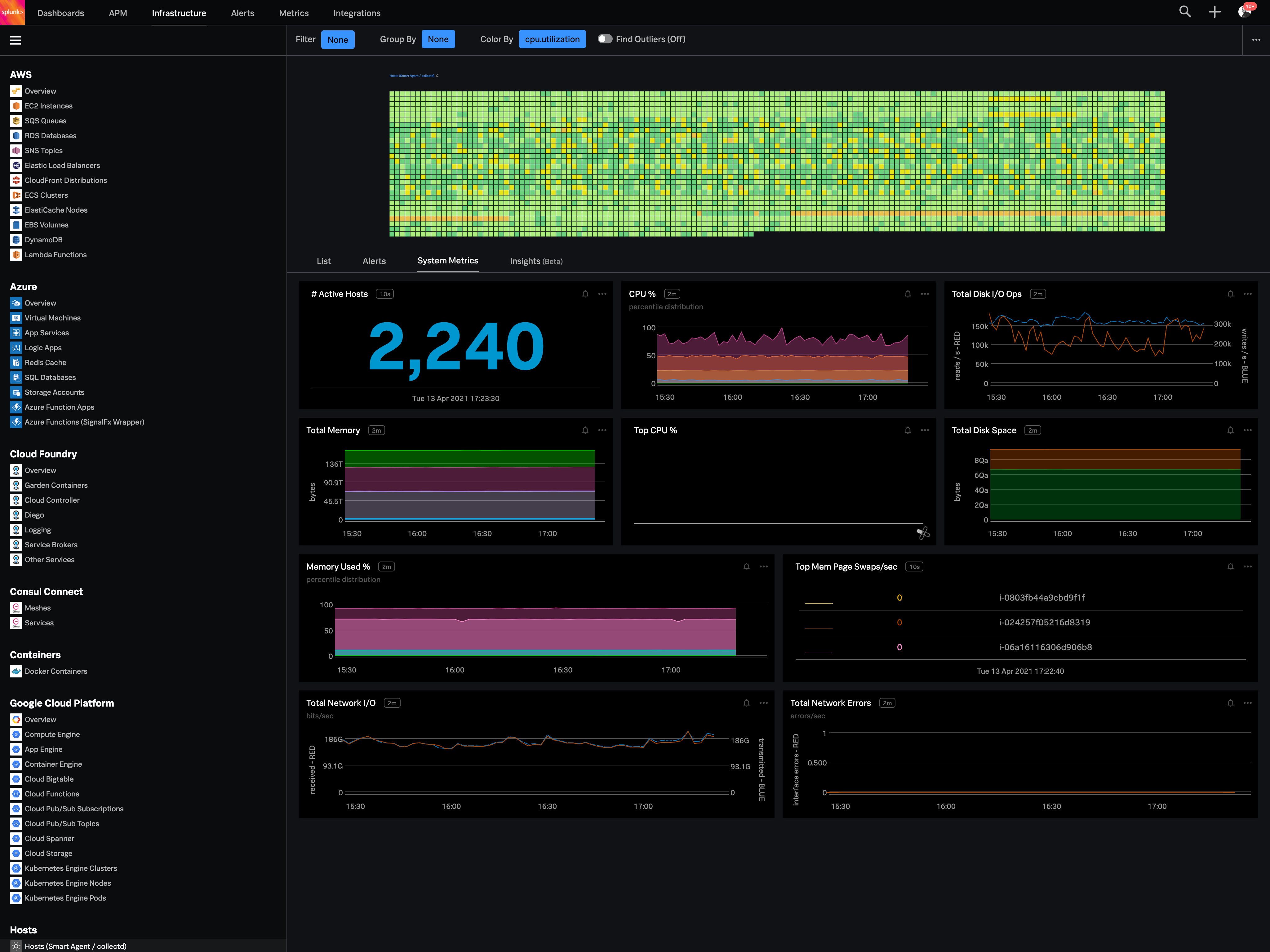
Splunk Observability Cloud aims to enable operational agility and better customer experience through real-time AI-driven streaming analytics allowing accurate alerts in seconds. It is designed to shorten MTTD and MTTR by providing real-time visibility into cloud infrastructure and services.
While Perforce Helix is the best version control software out there, it can also be used to track your documentation, training videos and materials, and requirements. If you have strict compliance requirements, it can be used to ensure that those requirements are satisfied. Perforce Helix is incredibly flexible and can meet the needs of individual users as well as companies with thousands of users.
Anything Infrastructure is the best case scenario for Ansible use cases. The agentless feature of Ansible is one of its best selling points as it allows core Ansible to be supported on nearly any platform via any interface. AAP is a great solution for company's doing adhoc automation. It essentially brings the wild-west into the modern age by providing enterprise-grade capabilities such as API, scheduling, secure vault, centralized logging, RBAC, inventories, and more!
Its great if you need real-time visibility across complex or regulated environments. Also strong for hybrid or multi-cloud setups where uptime, observability and fast IR are required. It’s probably overkill for smaller teams or environments that don’t have constant changes or compliance reporting needs. It's expensive and has a steep learning curve. Also, in my opinion, do not get yourself into a consumption based model. Costs can certainly get out of control quickly.
The branching mechanisms in Perforce allow for an enormous codebase to be duplicated into release versions weekly with little impact upon things such as the speed of queries against the version control.
Action triggers permit such things as automated builds of software versions, dynamic messaging when issues are identified either within or prior to a build process, and much more.
Locking provides the ability to prevent modifications of stable, tested versions in order to ensure validity when they are released.
Easy to read sets of instructions to do various things in and out of a pipeline.
Templating
Cloud and on prem provisioning.
Scalability and reusability.
We use it for everything from provisioning hardware for deploying software to it to running pipelines and building containers, etc. It's readable, easy to scale, and great for creating re-usable templates, scripts, or instructions.
The first one is its Kubernetes container monitoring.
I really like this features because as we know how much K8s is vast and to manually monitor each part of the Kubernetes it takes so much time but Splunk Observability Cloud makes it easier. And even once we integrate K8s with Splunk Observability Cloud it gives us some prebuilt dashboards which gives holistic view of our Cluster and its nodes, pods, etc.
The dashbaord feature of Splunk Observability Cloud, it gives us full flexibility to customize our dashboard with a wide range of predefined chart types.
Now it also supports OTEL, which is a plus point for observability. As now everyone is moving towards Otel and in current market there are only few tools who supports OTEL based integrations, Splunk Observability Cloud is one out of them.
Perforce tends to feel backwards in how it approaches certain tasks, like branching and integrating - even once you figure out how it wants you to perform these tasks, you will likely forget when it comes around to the next time you need to do them again.
Perforce has a higher price tag, comparatively.
Perforce make some tasks very easy, and yet other tasks very difficult - it doesn't always seem to have found its target user's proficiency.
You can use table-like functionality to generate dashboards, but these queries are heavy on the system.
It could be easier to give insight into what type of line parsing is used for specific documents in a company-managed environment and/or show ways to gain the insights needed.
I would like to see ways to anonymize specific data for shared reports without pre-formatting this in a dashboard on which reports could be based.
We are fully committed to our use of Perforce. It works well within our organization and our desire to share our code base with our customers. Their support staff are responsive, inquisitive, and eager to improve their software. I feel like we have a direct line to their design/feature team as they often solicit our feedback.
We are extremely happy with the use of AAP. It's better than expected, There is almost no limit when thinking of automation. The only problem is that the day to day is consuming a big part of our time. Patching and checking vulnerabilities are virtually killing us. But we can only improve with AAP.
Good: Stable system with low error rate Easy to use for simple use cases Bad: UI is not very clear for complex usage Mobile view (when logged in from phone) is bad No library for .net
With Perforce Helix, you can use it via the command line, via P4V, or any of the other APIs included with the product. It is extremely easy for new users to get up and running. Users of Perforce Helix only have to pull in the files of interest to them. Also, Perforce is very easy to script and integrate into your CI/CD pipeline. Streams allows you to have pinpoint control of your workflow, and P4Search is the absolute best--I wish Perforce (the company) would talk more about this. It is absolutely fabulous!
Overall, the product is excellent, with daily-use features for both large and small infrastructure. Ansible does its job quickly and ensures compliance, keeping the environment up to date and safe from open vulnerabilities. Large-scale inventory management and license management. Industry standard followed by best practices to maintain continuity. Budget-friendly compared to other products.
When there is an issue, it’s a win if one can easily identify the root cause. To do the same, it should allow the user to dig deep with multiple data points and compare the data and identify the anomaly. In this use case, it’s good to drive from Splunk 011y.
In our large environment, Perforce is rarely "down". We have regular maintenance windows and from time to time Perforce can feel a little slow, but its always available. Tech support has always worked with our engineers and IT department to make sure that any real performance or stability issues are addressed quickly.
Great in almost every way compared to any other configuration management software. The only thing I wish for is python3 support. Other than that, YAML is much improved compared to the Ruby of Chef. The agentless nature is incredibly convenient for managing systems quickly, and if a member of your term has no terminal experience whatsoever they can still use the UI.
I had two representatives from Perforce contact me after downloading it but never responded when I had questions. I also had a difficult time finding good training material for getting started. There is a lot of available support material when running into issues, though, because of how many large companies use it.
There is a lot of good documentation that Ansible and Red Hat provide which should help get someone started with making Ansible useful. But once you get to more complicated scenarios, you will benefit from learning from others. I have not used Red Hat support for work with Ansible, but many of the online resources are helpful.
This rating is related to setting up an environment from an existing Perforce repository. Initial setup of Perforce as the repository for the company was done by a separate team long prior to my inception.
Git is great, I love Git. But it's not great for dealing with binary assets, even when using Git LFS. Locking is not as simple as on perforce. Git presents some problems on using for non-tech people it can get overwhelming and tech people have to come by and help.
AAP compares favorably with Terraform and Power Automate. I don't have much experience with Terraform, but I find AAP and Ansible easier to use as well as having more capabilities. Power Platform is also an excellent automation tool that is user friendly but I feel that Ansible has more compatibility with a variety of technologies.
Splunk Infrastructure Monitoring provides far superior options for anybody using a complex hybrid multi-cloud environment and allows both your SOC and NOC to work together on the same data while driving their own insights. We found other products are still in the old world view of servers and agents residing together within a single data centre, but modern apps are no longer like this.
First, it keeps our entire server infrastructure aligned with our standards and reduces the time and effort needed to maintain our systems.
Automate routine IT tasks to save time, reduce errors, and ensure every server is configured and updated consistently.
Tasks that used to take our teams weeks to complete manually now run automatically and reliably, with full visibility, making our infrastructure management more effective and our compliance tracking much easier.