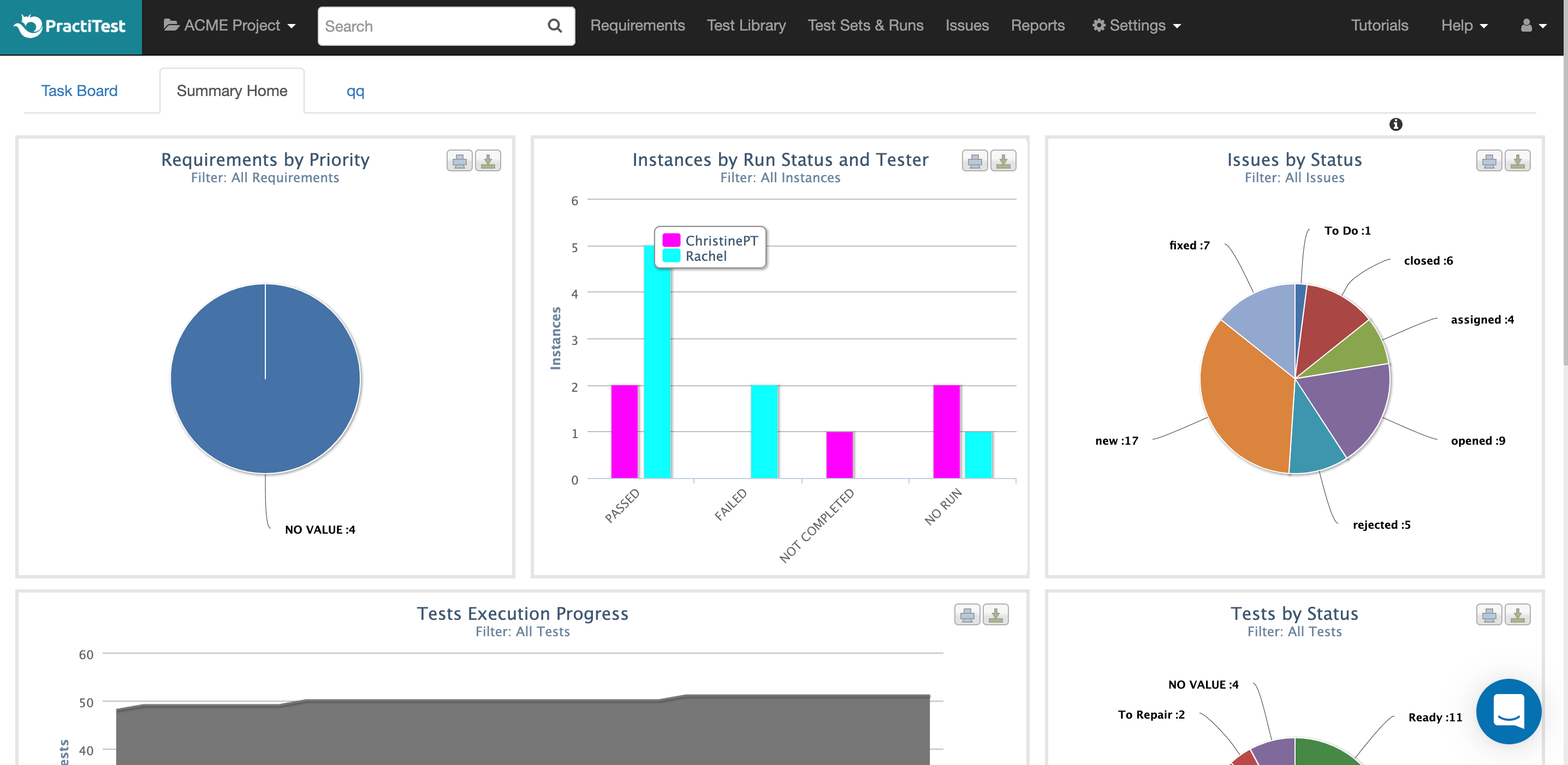
PractiTest is presented as a cloud-based test management tool that provides its customers with an end-to-end system to meet testing and QA needs. It is described by the vendor as flexible but methodological, enabling organizations to ensure visibility and communication at all levels. The solution aims to help users and project development teams streamline and manage their testing processes, while providing management with a clear and simple view of their project status at all times.
$39
user
SpiraTest
Score 8.0 out of 10
Mid-Size Companies (51-1,000 employees)
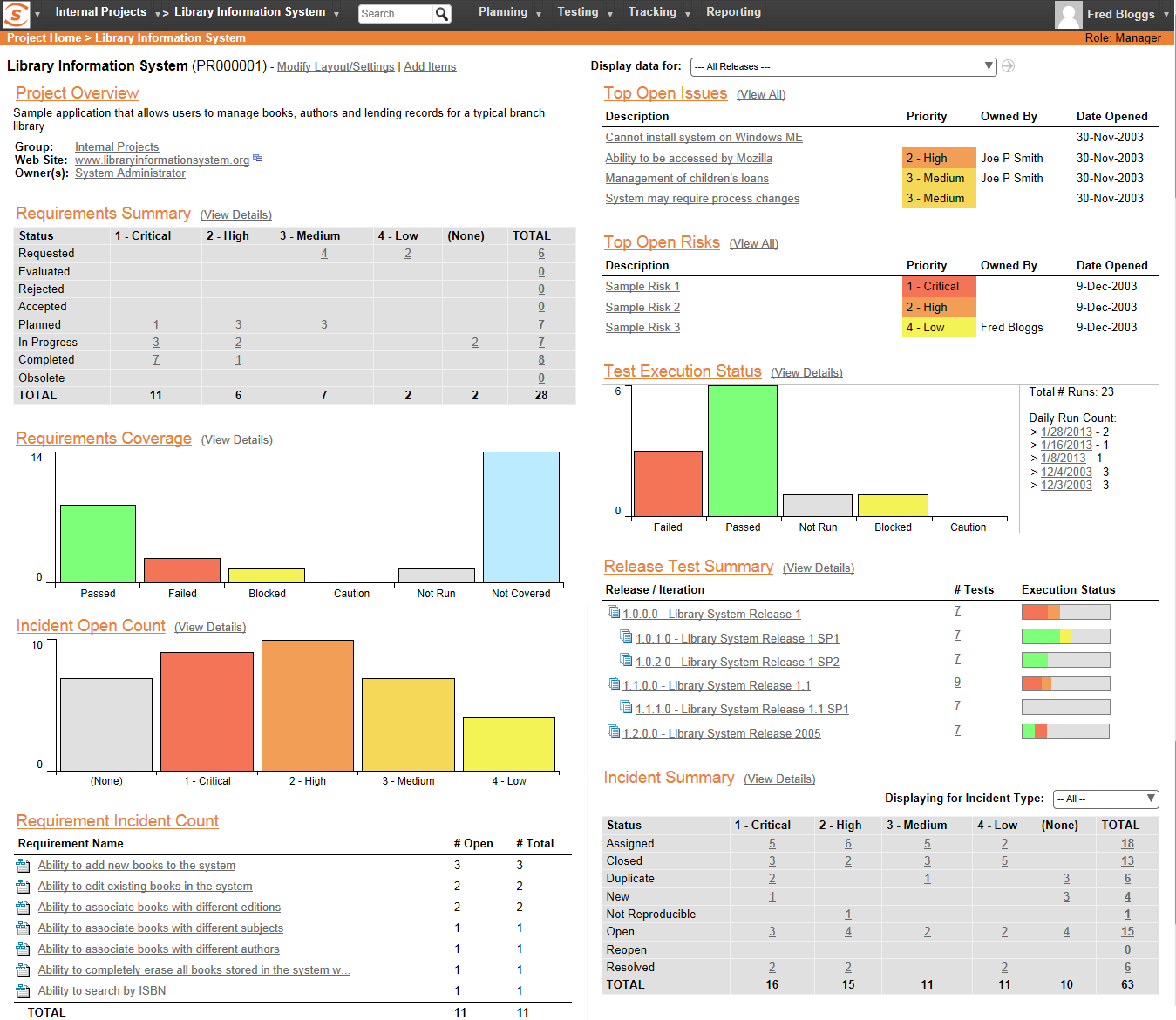
SpiraTest allows customers to manage their software testing and quality assurance activities. It provides requirements management, test management and bug-tracking functionality with integrated reporting.
$130.99
per month 3 concurrent users (minimum)
TestRail
Score 8.5 out of 10
N/A
TestRail by Gurock, an IDERA company, is presented as a complete web-based test case management solution to manage, track, and organize your software testing efforts.
$35
per month billed annually
Pricing
PractiTest
SpiraTest
TestRail
Editions & Modules
Professional
$39.00
user
Enterprise
$49.00
user
Cloud
$43.66
per month per concurrent user
Download
$423.66
per year per concurrent user
Professional Cloud
$35
per month billed annually per user
Professional Cloud
$38
per month per user
Enterprise Cloud
$71
per month billed annually per user
Offerings
Pricing Offerings
PractiTest
SpiraTest
TestRail
Free Trial
Yes
Yes
Yes
Free/Freemium Version
No
No
No
Premium Consulting/Integration Services
No
No
No
Entry-level Setup Fee
Optional
No setup fee
No setup fee
Additional Details
—
Discount available for annual billing on Cloud solution. 3 concurrent user minimum. Volume concurrent user discount available.
TestRail definitely saves times. I work in a company that consists of several development teams, all of which have different processes. Some of the teams leverage test cases, some do not. I've noticed that the turn around time it takes for me to pick up a ticket, QA it, and …
PractiTest works GREAT as a test case repository. It is very easy to gather metrics, filter, and sort based on custom fields. We were able to work with the API to pull our automation results in as well. The support team is always very quick with their responses and monitors the "in-app chat." They are very open to answering questions, providing best practice materials, and looking for additional feedback. If you already have a central location for all of your test cases and testing needs, then I guess you probably wouldn't need to add another. However, PractiTest has high capability and potential, so if it's set up properly you can easily save time managing your tests.
I think SpiraTest is well suited as a test suite, but in situations where the team is already using multiple products from one particular provider, it may be better to go with that provider's test solution. This is because integrations are very important nowadays, and should be considered when picking your project management software. It should be noted that management selected SpiraTest primarily due to the low cost of the test software. I'm less familiar with other test software in the field, but if cost is an issue, you should take a look at SpiraTest.
The integration with other tools, and their user friendly layout and design. It's very comfortable to use and is way better than other tools with the Automation Testing tools, thanks to the great API that is included. Sometimes the integration with Jira is a little faulty, but the links to that tool usually work well. It could be cool if it had a better following for the bug items that were registered on other tools.
A clean view of test case steps, expected results and the ability to record a result for each step quickly on one page per test set. This really helps testers work through executing manual test cases.
Hierarchical structure of releases and builds, requirements, and test cases.
Can quickly build test sets and/or test runs per build/release.
Simple identification of each test case, requirement, test run, build, release, etc.
Basic reporting can become very verbose unless you set lots of filters and parameters.
The ability to customize some of the verbiage in the application would help bridge the gap between translating what SpiraTest's testing terminology is and the company culture uses for testing terminology.
As I am a tester, for me I found this tool to be new in terms of everything like the management of tests, plans, releases, reporting,etc. It is overall a good tool for test reporting and can be used for reference in the future. I liked several features of on the go placement of screenshots. Also I feel like the UI , the font, the color combination can be improved
The chat button is available to anyone who logs into PractiTest. In my experience, the support has always been very quick, very friendly, and very thorough. They make sure that your question is answered in a way that you understand it. They also provide documentation of best practices so you are never left hanging on what to do next.
As promised during product selection, SpiraPlan support has always been quick and helpful. Replies almost always come back in hours (and often in an hour or two). And SpiraPlan's online tech support maintains all support conversations online so no need to look through emails to try to recall repllies.
I've used many different Test Case Repository tools, and while each of them has its perks, I like the capabilities of PractiTest best. When creating a test in qTest for example, you can only input information into the fields provided, and you have everything set up in a folder tree structure. With PractiTest, we are able to create custom fields and filter our tests based on those fields to provide more accurate information in a readily available format while quickly searching for the filter instead of through a folder tree. TestRail did not appear to meet our needs as a company. It just didn't have the potential that we found with PractiTest. Zephyr for example worked seamlessly with Jira, which is really nice since that is what we use for the most part. However since we cater to many different clients, we needed an external Test Case repository so we could use something that wasn't tied to 1 Jira instance.
TestRail definitely saves times. I work in a company that consists of several development teams, all of which have different processes. Some of the teams leverage test cases, some do not. I've noticed that the turn around time it takes for me to pick up a ticket, QA it, and then pass/fail/send feedback is much faster when there is a test case created as I'm not reading through ticket description/comments to figure out what needs to be QA'd.